






BRINGING HISTORY ALIVE:Ken burns offers ‘intimate’ portrait of THE ROOSEVELTS
Like history or not, documentary filmmaker Ken Burns has a way of hooking you. Call it a gotcha moment; that second when big-picture names and dates become personal and universal, flesh and blood. In his new seven-part series “The Roosevelts: An Intimate History,” it comes early in Episode 1.
At 23, Theodore Roosevelt has already elbowed his way into the ranks of New York City politics as a Manhattan assemblyman. Though he was a sickly child thought not to live long, little now seemed to stand in this dynamo’s way.
On Feb. 13, 1884, a telegram reveals that his beloved wife, Alice, had given birth the day before. The celebration, though, is short-lived: A second telegram sends him on an excruciating five-hour journey home.
It’s midnight when brother Elliott meets him at the door. “Mother is dying and Alice is dying, too,” he says.
Roosevelt’s mother, who was caring for Alice, has been stricken with typhoid fever and dies at 3 a.m. Alice, weakened by childbirth and kidney failure, follows her hours later.
The bedrock of his world has crumbled beneath him.
“The light has gone out of my life,” T.R. wrote in his diary. And he never spoke of it again, not even to daughter Alice, who, as a newborn, was left to be raised by T.R.’s sister, Bamie.
“It was as though his wife had never existed,” says biographer H.W. Brands in “The Roosevelts.”
Classic Ken Burns.
Click here for the episode guide for the series
“The service we did in the film is to remind us that they were people, that they weren’t just bold-faced names,” says Burns, the award-winning maker of “The Civil War,” “Baseball” and 23 other documentaries. “They had betrayals and deceptions, difficulties, estrangements and death and illness and competition. Just like the rest of us.”
The 14-hour series, which airs Sunday through Saturday on Rocky Mountain PBS, explores the lives of Teddy, Franklin and Eleanor – from T.R.’s birth in 1858 to Eleanor’s death in 1962. It’s a first, Burns says, for a series to intertwine all three Roosevelts, a family one old New Yorker said was the “closest thing to nobility that we have.”
Fans will recognize Burns’ usual mechanisms here: the voice of a soulful narrator, A-list actors (including Meryl Streep, Paul Giamatti and Ed Harris), and punctuating observations from noted historians, including presidential expert Doris Kearns Goodwin.
And, of course, his trademark way of zooming and panning still photos – combining them with sound effects and/or monologue – to suggest live action. The technique, in fact, is now called the Ken Burns Effect and you can download it for home use (apple.com/mac/imovie).
Ultimately, though, all the talent and glitz and sleight of hand is in service of storytelling, Burns says.
“That’s the thing,” he says. “That’s all there is.”
Getting to know them
If there was a maxim for “The Roosevelts,” it has to be this. “Heroism isn’t the great perfectionism that we think of today,” Burns says. “Sometimes it’s the war between their strengths and their weaknesses.”
This is the way Burns talks. Part Boy Scout, part Ph.D. candidate, all conviction and empathy. Noble, forceful. Like a lone trumpet playing taps at twilight.
Not surprisingly, he’s wicked smart, plucking names and dates from the air like an easy fly ball. And he is unflaggingly gracious when you … well, get him.
“I’m so happy you said ‘storytelling,'” he says after being asked about the challenges in this miniseries.
He seems to be certain – pleasantly – about everything.
On casting: “I’m not interested in celebrity. I’m interested in people who are really, really, really good, who have a voice. You may recognize the voice, but you forget that instantaneously.”
Case in point: Meryl Streep, who voices Eleanor Roosevelt.
“You should have seen our historians in the booth,” Burns says, laughing. “They said, ‘it’s amazing how much (audio) you found of Eleanor.’ They thought it was Eleanor even though they knew it wasn’t. What she brought to it, they said it could have been Eleanor.”
On Teddy’s lack of cache in the 21st century: “Anyone who thinks war is a good thing and pushes his sons to join the war, who emerged from the Spanish American War disappointed that he didn’t have a disfiguring wound? There’s something there.”
T.R. had to outrun his demons, Burns says. “That makes Franklin even more remarkable because he can’t outrun his demons. He can’t walk. He can’t even run. He’s got to deal with them.”
On Franklin hiding his nature of his last illness from Eleanor: “Eleanor, like Teddy, couldn’t deal with it. A lot of what she said she didn’t know, she didn’t want to know.”
On Eleanor: “She was a person with no parental model. She adored her father all her life and, of course, he was insane and an alcoholic and he has an insane fit and just keels over and dies. Her mother died early as well. So she has no model. Franklin is the most important person in the world, leader of the free world, literally. It was a difficult combination: a husband that disappointed you, a father to your children and a father figure.”
He laughs. “I do not know a couple that doesn’t have issues. Saying a marriage is complicated is redundant.”
“Emotional archaeology”
In the year between the completion of the series and Sunday’s airing, Burns has spoken often about the project and shown it many times.
At one screening, a psychologist friend told him that it was the first time she’d seen a film in which historical events seemed to being happening in real time.
For Burns, the experience was even more personal. “I felt like I got to know these people.”
“At screenings, as a filmmaker, I cried at the end. I didn’t want them to leave. Not because they were perfect but because they are complicated and familiar to me. I feel like I know who Lincoln is. I feel like I know who Jackie Robinson is. I feel like I know who these three fascinating individuals are.”
He stops, seemingly changing the course of the story.
“I was in a meeting in 1977 – when I looked about 12 years old – trying to raise money for my first film on public television, ‘The Brooklyn Bridge.’ Someone was pushing back about history and how boring it was. I said, ‘You’re right. If you excavate the dry dates and events of the past, you will come up with homework, with castor oil. Something that’s good for you, but tastes bad.’ I said, ‘I’m interested in emotional archaeology.’ I coined it in that moment and I still feel that way.”
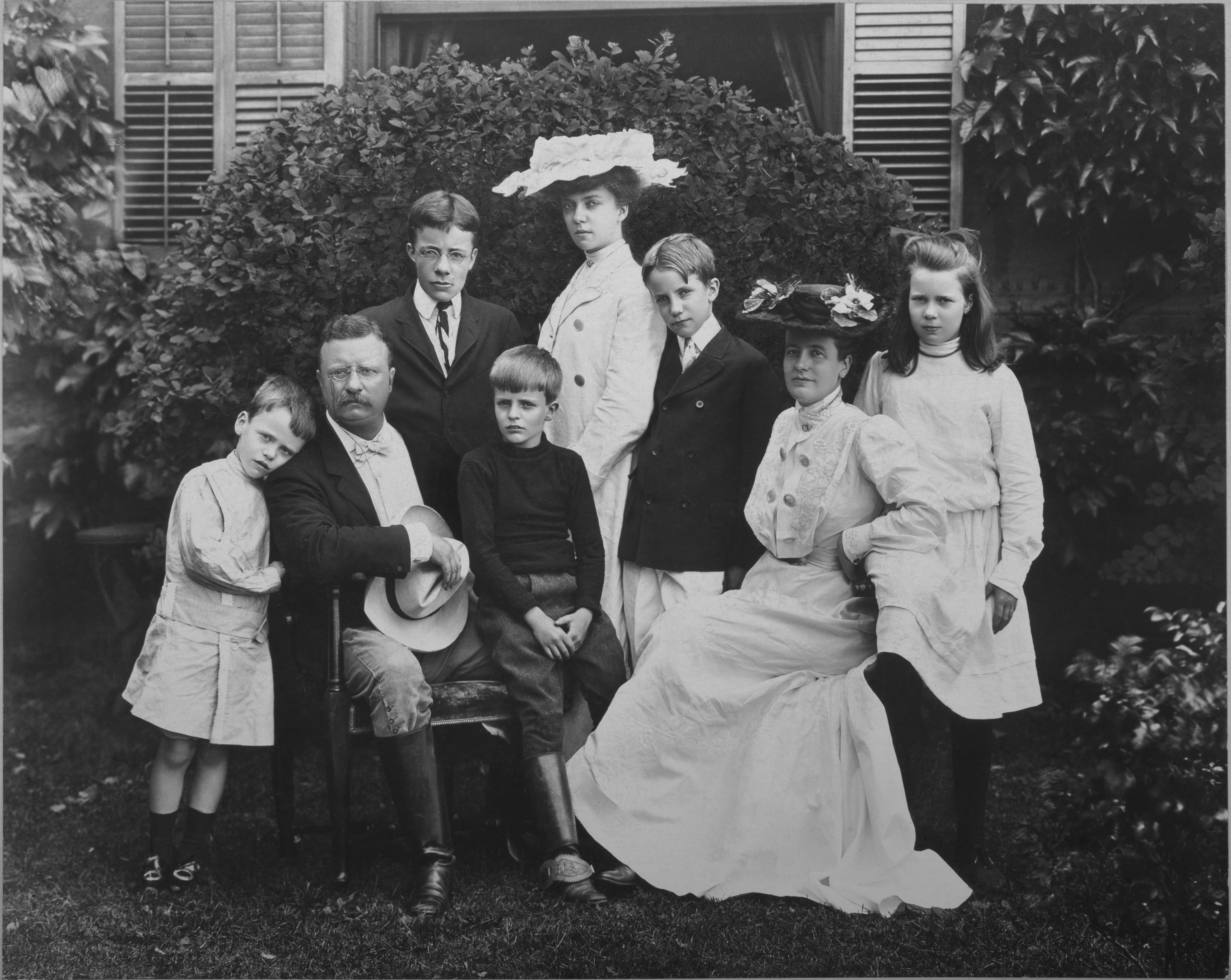
President Theodore Roosevelt with his family, 1903 Photo credit: Theodore Roosevelt Birthplace NHS
Eleanor Roosevelt, Hyde Park, NY, August 1920 Photo credit: Roosevelt-Vanderbilt National Historic Site
First Lady Eleanor Roosevelt with Mary Bethune and Aubrey Willliams at the Naitonal Conference on the Problems of the Negro and Negro Youth. January, 1937 Photo credit: Corbis
Franklin Delano Roosevelt courts Eleanor Roosevelt on Campobello Island. 1904 Photo credit: Franklin D. Roosevelt Presidential Library
Theodore Roosevelt waves to the crowd. Photo credit: Library of Congress
Theodore Roosevelt at the Cheyenne Frontier Days rodeo. Photo credit: Theodore Roosevelt Collection, Houghton Library, Harvard University
Theodore Roosevelt, 1875 Photo credit: Theodore Roosevelt Collection, Houghton Library, Harvard University
Congressmen welcome back President Roosevelt after a fishing trip, 1934 Photo credit: Franklin D. Roosevelt Presidential Library