






Fatal attraction killer moves to halfway house
Jennifer Reali, one of the most notorious killers in El Paso County, was transferred to a Lakewood halfway house this week despite having her parole denied three years ago.
Reali was convicted of first-degree murder after shooting Dianne Hood on Sept. 12, 1990, as Hood left a lupus support meeting at the Otis Park Community Center. Reali, 28 at the time, was an Army officer’s wife who was having an affair with Hood’s husband, Brian Hood.
Reali was arrested two days after the murder and confessed to shooting Hood, a 32-year-old mother of three children all under the age of 10, with a .45-caliber revolver. Dressed in camouflage fatigues and wearing a ski mask that hid her face, Reali sneaked up on Hood and in an apparent attempt to make it look like a robbery, grabbed for Hood’s purse. The terrified Hood screamed, “Please don’t,” and threw the handbag at her attacker.
The crime both horrified and transfixed the community – even the nation – and was dubbed the “Fatal Attraction” killing.
Reali was sentenced to life in prison, but her sentence was commuted by outgoing Gov. Bill Ritter in January 2011, meaning that her conviction would stand but she would be eligible for parole sooner. Reali’s parole was denied later that year, largely at the behest of the victim’s family.
Her defense attorney told The Gazette on Tuesday that Reali has been a “model prisoner” who has been rehabilitated.
Brian Hood was convicted of second-degree murder and conspiracy in his wife’s death and sentenced to 37 years in prison.
The Colorado Department of Corrections confirmed Tuesday that Reali, now 52, is living at Intervention Community Correction Services, a nonprofit community corrections agency that provides residential and non-residential offender management, substance abuse monitoring and educational assistance.
Reali met placement criteria to be transferred to the halfway house based on behavior and time served, said corrections spokeswoman Adrienne Jacobson.
“All offenders have that opportunity, given the time they’ve served and as long as they were not sentenced to life without parole,” Jacobson said. “It’s another avenue that offenders can pursue, and the reason they’re called halfway houses is because they’re really between parole and still being in prison.”
In 2011, Reali offered a tearful apology to the parole board, saying: “I’ve always taken full responsibility and I wish I could take it back, not because I’m in prison but because she should be alive.” The parole board’s decision to deny Reali’s release three years ago, Jacobson said, did not impact the decision to approve Reali’s transfer to the facility.
“People who are at halfway houses are still considered inmates,” Jacobson said. “They’re not on parole and they’re not released, they’re still serving their time. Rule violations of different types could potentially send her back to prison. They can be pulled back into the correctional facility immediately for violating any condition of their transfer.”
Jacobson said Reali will be required to have a job, will be allowed some visitors and will be expected to follow routine checks and limitations such as curfews.
Longtime Colorado Springs attorney Elvin Gentry plans on visiting Reali soon. Gentry served as Reali’s defense lawyer during the trial and has kept in contact with her on and off for the last two decades.
“Ordinarily I’m one of the guys who do everything I can on the case and then move on. There are a couple people (clients) who are different. Jenny was one of them,” he said. He believes is rehabilitated.
“She’s been a model prisoner,” Gentry said Tuesday. “I don’t think there’s any likelihood at all that she would ever harm anybody again. I’ve thought that since her conviction.”
He’s not sure what effect the transfer will have on her parole, he said.
While many people might disagree with an early release, he said Reali has had a lot of support over the years, not only from the jurors who convicted her, but also from the author who wrote a book about the case. After more than two decades in prison, he thinks she’s served her time. “Anybody that thinks that isn’t punishment should try staying in their house for just a month without leaving,” he said.
Hood, meanwhile, was being held Tuesday in the Denver Reception and Diagnostic Center, which normally is an assessment center but also is used as a “transport hub” for inmates. Hood was taken to a hospital in Denver and was awaiting transfer back to prison, most likely to Sterling Correctional Facility, a high-security prison.
Hood made headlines again in 1997, when he and another inmate escaped from a medium-security prison in Cañon City. The duo cut through a double fence with bolt cutters but were later caught.
–
Contact Andrea Sinclair: 636-0235
Twitter: @GazetteAndrea
Facebook: andrea.sinclair.376
Jennifer Reali, center, with defense investigator Jeanne Brooks and attorney Elvin Gentry. Gazette file photo by Jerilee Bennett/PPLD Special Collections
Jennifer Reali with defense investigator Jeanne Brooks during the trial for Brian Hood in 1991. Gazette/PPLD Special Collections
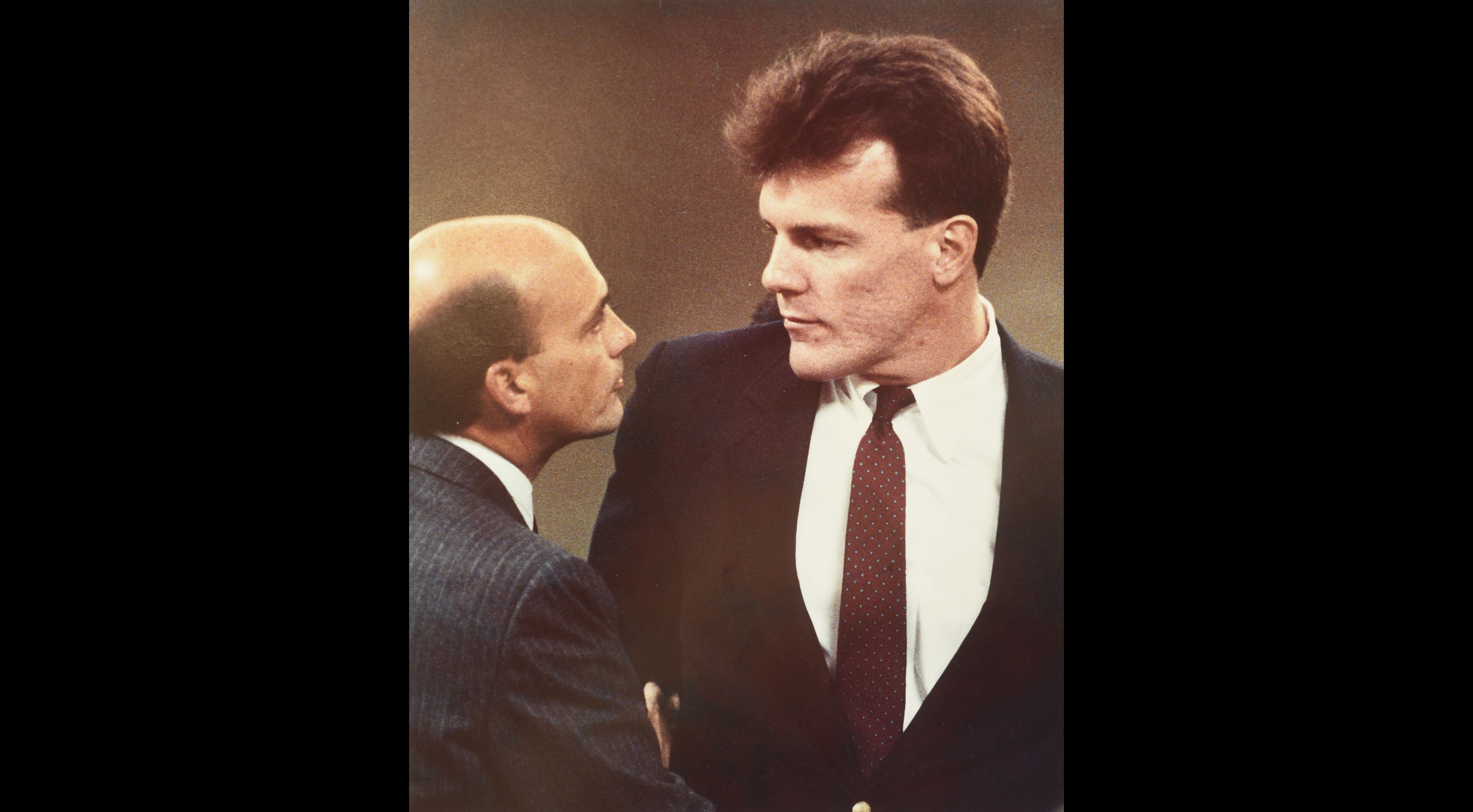
1990 photo of Brian Hood, right, with his attorney, Richard Tegtmeier, during his trial. Gazette file photo/PPLD Special Collections
Jennifer Reali with attorney Elvin Gentry in 1990. Gazette file photo/PPLD Special Collections