






Armywives
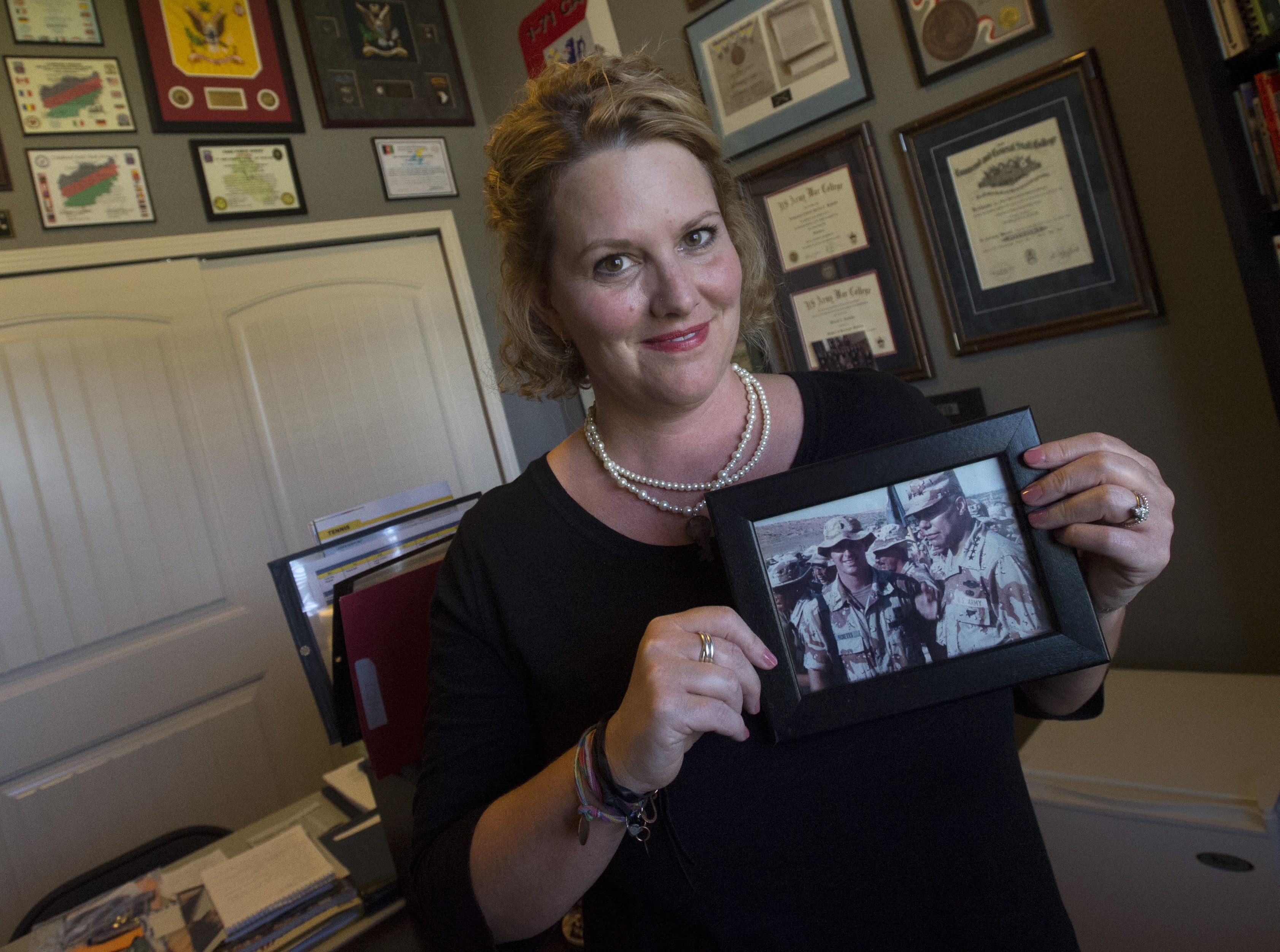
For Angela Ricketts, the life-changing epiphany came in the middle of the night on Nov. 21, 2010.
She woke up with pain in her back and shoulders. It’s just a panic attack, she thought as sweat rolled down her neck. The pain got uglier, and she started thinking about going to the emergency room on post. But an ambulance wasn’t an option (“Drama queens, attention whores, that’s who calls 911 in the middle of the night in our neighborhood”).
So she drove herself. Alone. Husband Darrin, then an infantry brigade deputy commanding officer, was three months into a 12-month deployment to eastern Afghanistan.
“When I had a heart attack, that’s when I really started to get serious about writing a book,” she says.
From that night came her memoir of life as an infantryman’s wife, “No Man’s War,” which was released July 15. The book, which she playfully subtitled “Irreverent Confessions of an Infantry Wife,” frankly reviews a life in which control is only a memory, other military wives are the backbone of everyday survival and love must be resurrected in all-too-brief spates between deployments.
But Ricketts, who lives with her family in Colorado Springs, wants to make one thing clear: She’s not whining and she doesn’t believe that military families deserve the kind of media attention given to the men and women who serve. “Not in a million years would I say that.”
But the media’s depiction of military families is one-dimensional: holding “welcome home” signs and photographed in desperate embraces. What you don’t see is what it takes to get there.
“They’re always playing Toby Keith and Lee Greenwood at these things. What we’re hearing in our head is more like (Guns N’ Roses’) ‘Welcome to the Jungle.'”
Ricketts, 44, felt that the puzzle of the homefront deserved notice, if only in one book.
“I put all my eggs in his basket, sold my soul to his (Darrin’s) dream and his demons and woke up one day and I wanted to have a voice.”
Googling her dreams
But Ricketts wasn’t a writer.
So she Googled “how to publish a book.” Step one, she found, was to find a literary agent. After she came up with a handful of well-regarded candidates, Ricketts emailed them a long, rambling pitch. She got an email from Kimberly Witherspoon, founding partner of InkWell Management, an hour later.
“My colleague Allison Hunter and I both read Angie’s query and agreed that her writing was incredibly powerful, in a raw, very natural way,” says Witherspoon. “We discussed it and agreed that there would be an audience for this book, especially given the popularity of the television show ‘Army Wives.'”
InkWell represented her by the next morning. Her book proposal sold to Counterpoint Press by August.
Next problem: This mother of three had to actually write it. Worrying and procrastinating went on for about two months. She finished it in the final 90 days before the deadline.
“Angie did an incredible job of capturing on the page the feelings and emotions of her experience,” says Dan Smetanka, executive editor of Counterpoint and her editor. “We just had to see how they could fit together to tell her story cohesively, in the strongest and most impactful way.”
You won’t find a lot of shoot-from-the-hip books like Ricketts’ on the market. Maybe none.
“Those that are out there tend to be lighter and focus more on the humorous aspects of military life,” says Witherspoon. “Angie’s is one of the few I can think of by a military wife that examines the realities of the world with a critical eye.”
A few editors, Ricketts says, passed on the book, telling her, “Americans aren’t ready to hear this.”
An advance review by Kirkus apparently disagrees: “Outspoken in her critique of the ‘Army machine,’ Ricketts celebrates the ‘secret sisterhood’ of soldiers’ wives, defiantly, desperately battling for survival. … A blunt, bold debut memoir.”
So why does Ricketts’ book stand alone in the market?
“Hesitation, fear, apathy,” Smetanka says. “I think the majority of Americans want to feel like they are supporting the troops and anything that might take away from that, or shine a realistic or unflattering light on the military experience, is initially met with skepticism, out of fear of being seen as disrespectful or unpatriotic. Angie calls this ‘drinking the Kool-Aid’ – following orders, following the mission, with no questions asked.”
Which explains what she calls the scariest thing about writing the book.
“It’s the backlash from my own little subculture,” she said about a month before the book’s release. “Surprisingly, I didn’t have any of that. I’m sure there’s a handful of people that I sort of threw under the bus.”
Life lived long distance
An Army brat, Ricketts fell in love with a stranger during a dance at a neighborhood bar. She and Darrin (whose name, like their children’s, was changed in the book) were there with other people.
They eloped in 1992, before a deployment. They planned their three children – Jack, 16, Caroline, 14, and Kathryn, 9 – around deployments. Over the course of his 31-year career in the infantry, he has been posted in Somalia, Macedonia, Bosnia, Kosovo, Afghanistan (three times) and Iraq, which was the longest at 15 months.
“The cold truth is, we wouldn’t have traded our deployments for anything; we love them,” she writes in the book. “We love the thrill of our place in history, the thrill of having something bigger than us to steal our focus.”
Still, everyday intimacies became tougher. Parenting became a volatile topic. And Darrin’s long, long-distance calls home to share his day, for example, collided with kids’ homework, base events and the everyday scrimmage of living.
Ask Darrin about how he saw home life from Somalia or Iraq, though, and he’ll say that the “operational tempo” at home was “as high or higher than ours while deployed.”
“I would get frustrated, at times, thinking the kids were not involved in as many things as I (thought) they should or that they were not being encouraged to maximize their potential,” says Darrin, now 48 and a colonel. “I did feel I was a participant (in the family) but that frequent communication usually meant mission creep for Ang – meaning the kids would come away with different things to do, which resulted in additional requirements from Ang.”
Even as she talks about the impossible dynamic now, frustration seeps into Angie Ricketts’ voice.
“This is the choice you made and you can’t have it both ways,” she says as if talking to Darrin. “You can’t have the cake and eat it, too. There were times when he volunteered to deploy. I was like, you asked for it.”
A move from Fort Drum, N.Y., where she’d lived for eight years, to the U.S. Army War College in Pennsylvania meant that Darrin was going to be around for a year. Long enough, she thought, that they could learn to fall in love again.
“We soon discover that we don’t just not know each other, but we possibly don’t even like each other,” she writes in “No Man’s War.” “The love is beyond the question. What we lack is feeling natural together. We can’t complete one another’s sentences like other couples do. We don’t have a plethora of inside jokes. Instead we have resentment and lost ground. … The desire to escape is mutual.”
How do you stay in love under those kinds of pressures?
She laughs.
“We joke that the only reason we’ve been married for 22 years is that it always keeps it new and exciting. There’s some dude that’s a complete stranger grabbing your butt in the kitchen. It’s weird. There’s this constant newness. As much frustration as there is on welcome home days – days that you wait for – the doors open and I hear all the thump, thump, thump of boots and it gives me goosebumps.”
Book garners attention
Darrin remains on active duty, although he began working with Homeland Defense in 2012. He still travels, but not as far or for as long. He finally read the book a few months ago.
“I had two priorities while reading the book,” he says. “First, fact-checking and two, reading the book through the lens of the person she was writing about. I wanted more than anything to protect her relationships.”
Some aspects hurt him, he admits.
“We love the Army almost as much as we love family. But this is her story and how she perceived things. She had to tell it her way.”
And already, even in the weeks before its release, the book was garnering attention: She’s scheduled to speak at Army installations across the country. And the piece de résistance for a newly minted book: Ricketts appeared on “Fresh Air” with Terry Gross (find it on npr.org/programs/fresh-air). She also has been interviewed by the New York Post and the Los Angeles Times. Her publisher, she says, ordered a second printing even before the book was released.
Right now, Ricketts is focused on being in one place, although Darrin might deploy again or volunteer for deployment and then return only to be reassigned, she says.
Their daughters have talked about going into the military. “But my middle daughter has a personality just like mine. She’s going to have trouble following rules.”
Their son, Jack, has wanted to go to West Point just about since forever. That’s how it works, Ricketts said: Army brats either become Army soldiers or Army wives.
And that’s OK with Ricketts. With one caveat.
“I hope there isn’t a war going on. I can’t imagine sending him to the kinds of places that I sent Darrin. That’s a whole different kind of terrible that I can’t imagine.”
Angela Ricketts holds a picture of her husband Col. Darrin Ricketts and Colin Powell, the chairman of the Joint Chiefs of Staff, inside her Colorado Springs home Tuesday, July 22, 2014. Ricketts has just written the book “No Man’s War” about being a wife while having a husband deployed in the Army. Ricketts’ husband has been deployed eight times since they were married. (The Gazette, Christian Murdock)
Angela Ricketts, pictured in her Colorado Springs home Tuesday, July 22, 2014, has just written the book “No Man’s War” about being a wife while having a husband deployed in the Army. Ricketts’ husband, Col. Darrin Ricketts, has been deployed eight times since they were married. (The Gazette, Christian Murdock)
“Homecoming day from our 15 month deployment to Iraq,” Angela Ricketts captions this photo on her website. “Do we look nervous enough?”
The day Darrin Ricketts deployed to Iraq for fifteen months happened to fall on the first day of school in 2007. Jack, Kathryn and Caroline pose with Ricketts.
The day Darrin Ricketts deployed to Iraq for fifteen months happened to fall on the first day of school in 2007.