






Spotting game with dad
Long road trips test the patience of all involved. Our family trips to Canada are no different. Typical drive time is about 22 hours, and we always do it in one shot.
With my brother nodding off by Castle Rock and my sister asleep by Wyoming, my dad and I had to figure out a way to keep our minds occupied. We combined our love of scenery with our passion for hunting and created “The Game” game.
The rules are simple: To win, you must spot more big game (elk, deer or pronghorn) than the other person. So you scan the landscape and train your eyes to focus on nothing but to see everything.
The farther north we drive, the more rolling hills, tall yellow grass, empty meadows and vast cornfields we encounter. These spots are prime areas to spot game.
One animal counts as one point and, because they travel in herds, the points come quickly when you spot them.
While game blend into the surroundings well, paying attention to the colors can land you a point. The best time to spot game is when they are moving around. Animals are looking for food and water at dawn and are looking for a spot to sleep at dusk.
Pay attention to any type of water, be it streams or ponds, because animals do get thirsty. Beneath trees is also a great spot to look because game believe they are protected there.
If you can keep your eyes trained on what is out there, you will see more game and wild animals than you’ve ever seen. Though it’s hard to beat seasoned hunters who have spent a lifetime looking for animals, you will be able to hold your own.
Two years ago, I spotted the biggest elk either of us have seen while playing “The Game” game. On the return trip from Canada, as the sun was about to set in northern Colorado, I gave one last look out the window and saw a monster of a bull elk. He stood near the highway with a 6-by-6 rack.
While we might never see another behemoth bull like that, as we gaze out the windows while the miles melt into the rearview mirror, we continue to look for him or any of his herd.
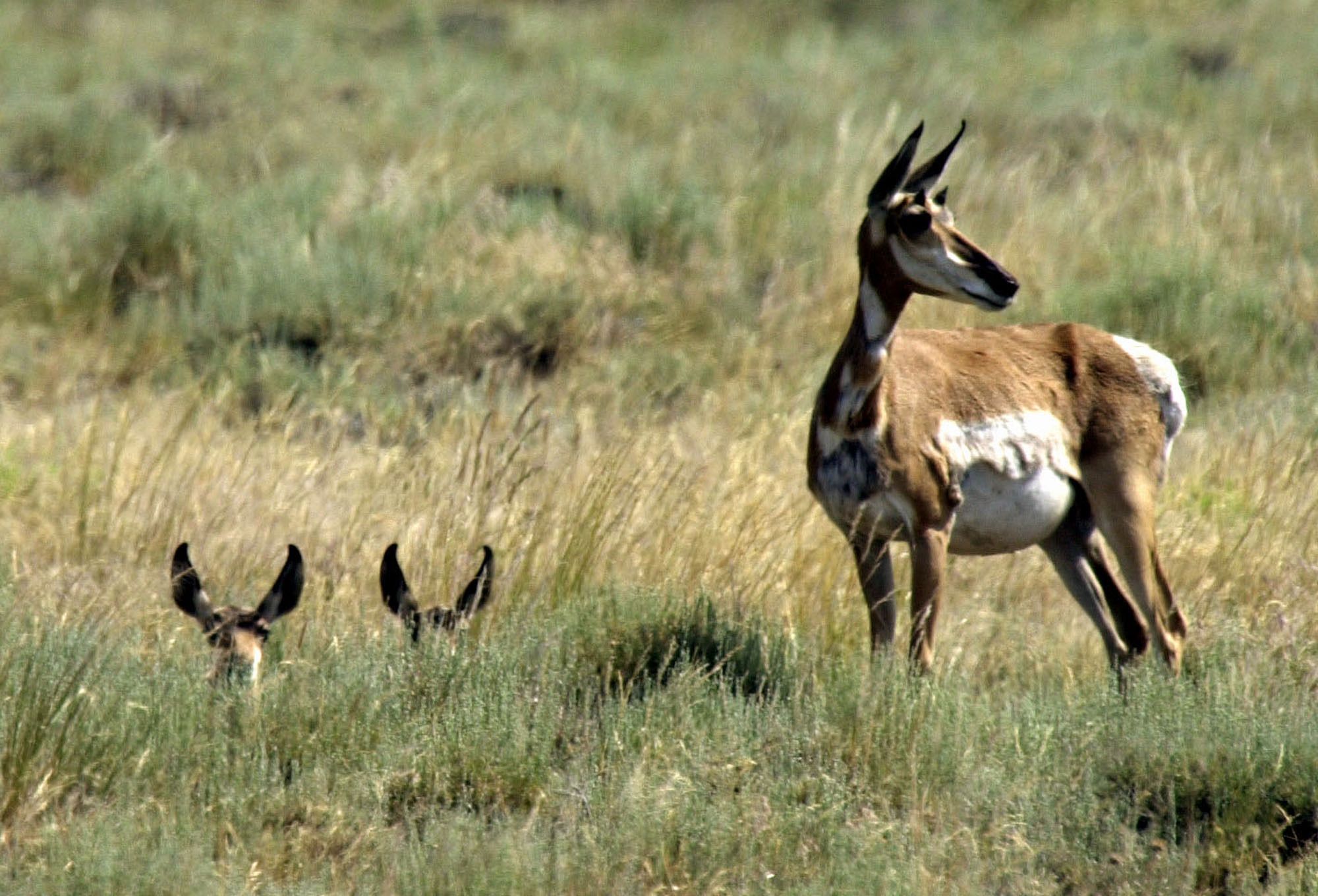
** ADVANCE FOR WEEKEND OF AUG. 9-10 ** A pronghorn antelope doe keeps watch as two fawns peer out from tall grass in the heart of southeastern Oregon’s Hart Mountain National Antelope Refuge, July 23, 2003. Sightings of pronghorn on the refuge have become commonplace, 10 years after the population dipped significantly. (AP Photo/Don Ryan)
This Jan. 21, 2010 photo shows pronghorn antelope passing by a natural gas drilling rig, background, south of Pinedale in western Wyoming. A new study will take the most detailed look yet at some 400 antelope that each year migrate between winter range in the Pinedale area, scene of heavy gas drilling, and summer range Grand Teton National Park. The antelope cover more than 90 miles each way for the longest big-game migration in the lower 48 states.(AP Photo/Mead Gruver)
** ADVANCE FOR MONDAY NOV. 8 AND THEREAFTER ** In this Oct. 28, 2010 photo, a Proghorn is seen in a natural West Texas habitat near Valentine, Texas, As Bill Miller looks across his ranch that spreads out under the vast West Texas sky, a once-common sight has became a rarity: the pronghorn. A symbol of the West, pronghorn have a body type somewhat like a deer with distinctive white stripes on their faces and necks and white markings that come halfway up their sides. And in the West Texas, where desert grasslands give way to mountain ranges, their numbers are dropping and researchers don’t yet know why. (AP Photo/LM Otero)
FILE – In this Oct. 28, 2010 file photo, male and female pronghorn stand in their natural West Texas habitat near Valentine, Texas. Researchers studying what has caused pronghorn in West Texas to die off will wait until next year to relocate more of the animals to the area because the ongoing drought complicates efforts to replenish the number of animals. Sul Ross State University in Alpine and the Texas Parks and Wildlife Department are sharing results of their efforts to determine what’s causing the drop in numbers. (AP Photo/LM Otero, File)
FILE – In this Oct. 28, 2010 file photo, male and female pronghorn stand in their natural West Texas habitat near Valentine, Texas. Researchers studying what has caused pronghorn in West Texas to die off will wait until next year to relocate more of the animals to the area because the ongoing drought complicates efforts to replenish the number of animals. Sul Ross State University in Alpine and the Texas Parks and Wildlife Department are sharing results of their efforts to determine what’s causing the drop in numbers. (AP Photo/LM Otero, File)
In this Feb. 23, 2011 photo provided by the Texas Parks & Wildlife Department, a pronghorn antelope pauses and looks around as it and others are released to their new home by Texas state wildlife officials near Marfa, Texas. Two hundred of the Texas Panhandle pronghorns are being captured over several days and transported 500 miles to the Marfa area to bolster the diminished Trans-Pecos herd and help researchers determine why the West Texas herd has been in decline in recent years. (AP Photo/Texas Parks & Wildlife Department, Earl Nottingham)
A heard of pronghorns wander through a field near Katie Canyon Loop Friday, Jan. 3, 2014 north of Laramie, Wyo. (AP Photo/Laramie Boomerang, Jeremy Martin)