






Fledgling scientists with big dreams show off their creations
If smart is the new cool, the University of Colorado at Colorado Springs was the coolest place in town Saturday.
The campus was swarmed by fledgling scientists — middle school and high school students who someday might develop new cellphone technology, design future vehicles for transportation and, if one gets his dream, create a technique for blood to be taken “without being poked.”
The north Colorado Springs campus was the site of the Colorado Science Olympiad Southern Regional competition. The event drew 36 middle school teams and 29 high school teams. The 10 or so Saturday winners head to Golden for regional competition at the Colorado School of Mines, and from there, the top winners compete nationally.
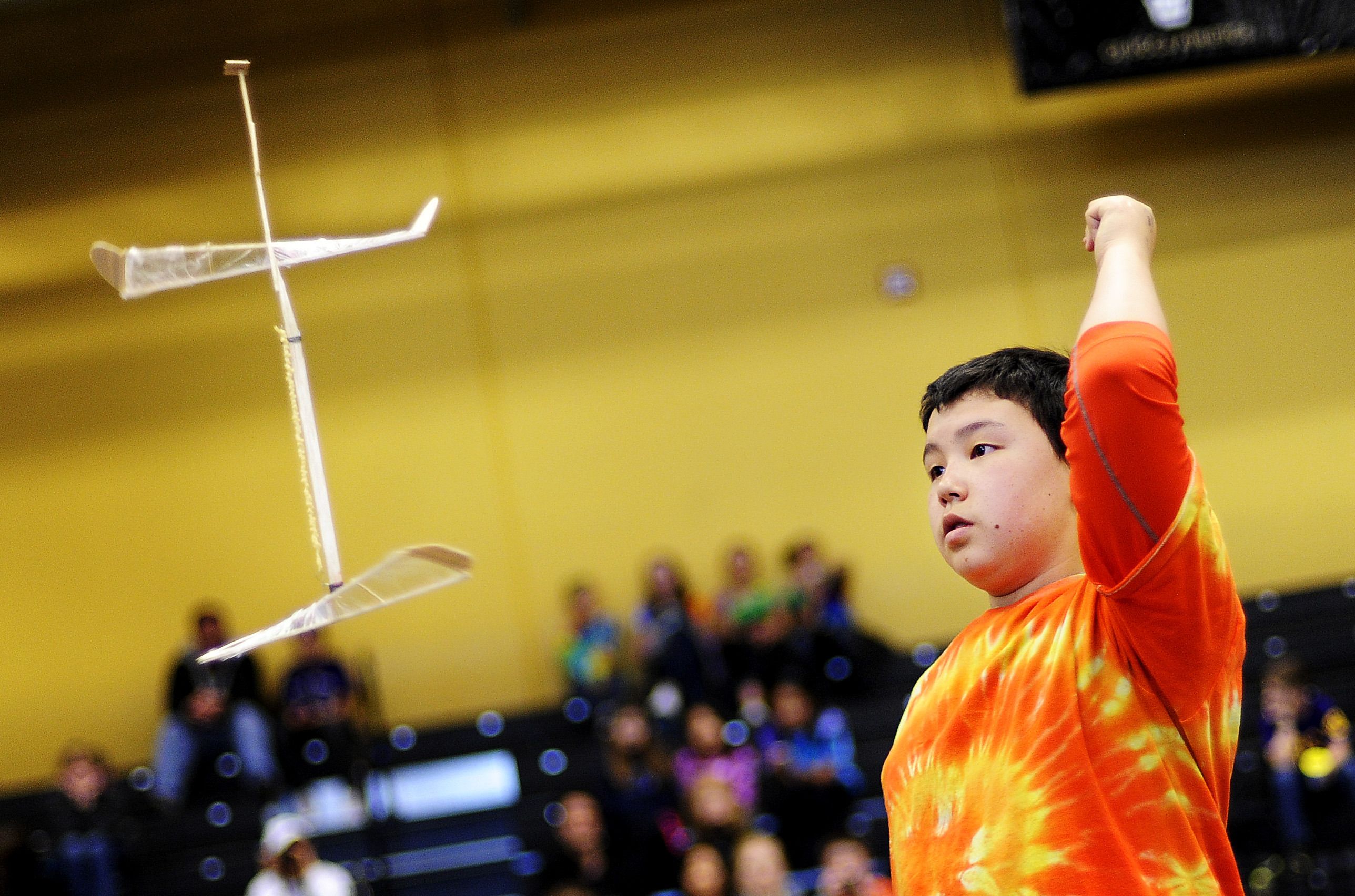
Events included Mousetrap Vehicle, in which students used kinetic energy from a mousetrap springing shut to power a small vehicle. Makeshift mechanical helicopters made of wood and paper rose to new heights in the gymnasium, and in Mission Possible, contraptions from simple to the uber-complex had to meet specific targets.
Twelve-year-old Xavier Burk, a student at Rocky Heights Middle School in Highlands Ranch, is not a fan of needles. He hopes to develop a way to draw blood without them.
That’s still in his future, but on Saturday, Xavier, with his parents, Cheryl and Tom, competed in Mission Possible and two other projects.
His contraption was simple. The goal, through measurable steps, was to elevate a battery on a platform. Each step successfully completed was worth points, and the height of the battery was measured.
The project started with a misfire, when the quarter he dropped into a slot failed to trigger a switch — which would turn on the power — which would then drive the battery upward through the use of a pulley and wheel. So Xavier triggered it, pushing a button. The 12-volt battery sitting on a platform rose slowly upward.
Xavier and his father, Tom, had about two days to develop their device. Cheryl said the duo worked until midnight Friday and woke at 4 a.m. Saturday for final touches.
David Khaliqi, director of the UCCS Center for Science, Technology, Engineering and Mathematics Education, put the competition together. He said there are plenty of lessons for these young scientists, including the importance of failure.
Failure, in science, is the pathway to learning new ways of doing, creating and developing.
In other words, it’s not a bad thing.
“That’s a huge part of life in general,” he said. “A classroom really can’t capture that.”
Platte River Academy eighth grader Jacob Kaze releases a homemade helicopter in an attempt to keep it in the air as long as possible in the helicopter event at the Colorado Science Olympiad: Southern Regional Saturday, March 2, 2013 at the University of Colorado Colorado Springs campus. Michael Ciaglo, The Gazette Photo by MICHAEL CIAGLO, THE GAZETTE