






ACLU to challenge new panhandling ban
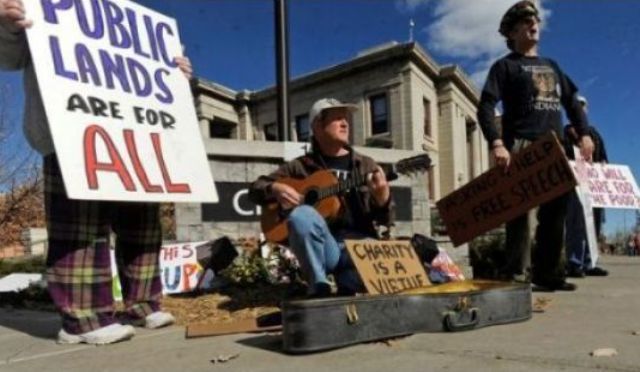
The American Civil Liberties Union has filed a lawsuit against Colorado Springs over a recently passed ban on panhandling.
The Colorado ACLU filed the suit in federal court in Denver on Wednesday morning. The suit asks for a temporary restraining order and a preliminary injunction, and describes the so-called “no-solicitation zone” as an “ill-advised ordinance that effects a breathtakingly broad suppression of First Amendment rights.”
The case’s first hearing is scheduled at 1 p.m. Friday in Denver, as a result of the ACLU’s request for an expedited hearing, said ACLU spokeswoman Jenny Davies-Schley. The group wanted to get their case before a judge as soon as possible, because the ordinance is scheduled to go into effect Sunday.
If approved, the temporary restraining order would prevent enforcement of the new law until the lawsuit is concluded, said Davies-Schley.
The no-solicitation zone was approved by City Council on Tuesday by an 8-1 vote, with Councilman Val Snider dissenting. Among other things, the ordinance would prohibit anyone from asking strangers for money.
The zone covers a 12-block radius between Boulder Street on the north, Nevada Avenue on the east, Cucharras Street on the south and Cascade Avenue on the west. The zone includes Acacia Park. The council also approved a change that forces panhandlers to stay at least 20 feet away from any business within city limits.
Plaintiff Beth Mosley, artistic director of the Star Bar Players, called the no-solicitation zone “shameful.”
“The least of us are also citizens,” Mosley said during an ACLU press conference Wednesday. “To deny us the right to reach out and help someone is morally wrong.”
Mosley said if Nazis are allowed to march in public, then the homeless should be allowed to ask for change.
City Councilwoman Brandy Williams, who supports the panhandling ban, said the ordinance has nothing to do with the poor and is aimed at increasing public safety. She cited a recent stabbing downtown, and said the area has been getting more dangerous.
“You can still speak. You just can’t solicit,” Williams said. “It’s not about poverty at all. It’s really about safety.”
Williams is wrong, said Steve Saint, executive director of the Pikes Peak Justice and Peace Commission. He said hundreds of homeless “need our help, not the scorn of downtown people.”
Saint estimated there are roughly 230 chronically homeless military veterans on the streets, and about 340 who are drug addicts. Under the ordinance, Saint said, one of the commission’s solicitation boxes, with a sign asking for a donation to help the downtrodden, would have to be removed from Acacia Park.
Councilman Tim Leigh, who also voted for the no-solicitation zone, agreed with Williams.
“The rights of the few have trumped the rights of the many, and all we’re trying to do is correct that,” Leigh said. “Finally, council did the courageous thing and stood up and retook downtown from people who were preying on people who couldn’t defend themselves.”
Colorado Springs City Attorney Chris Melcher did not return a phone call requesting comment.
The lawsuit was filed on behalf of:• Greenpeace and Pikes Peak Justice and Peace Commission• Star Bar Players, a nonprofit theater group• The Denver Voice, a newspaper• James Binder, a local musician who solicits tips with an open instrument case• Ronald Marshall, a local disabled resident who asks for change from his wheelchair downtown• Beth Mosley and Roger Butts—Contact John Schroyer: 476-4825Twitter: @JohnschroyerFacebook: Gazette John Schroyer
Eric Verlo, Daniel Kontoff, and other protestors stand outside Colorado Springs City Hall earlier this month in protest of the solicitation ordinance covering downtown. (Jerilee Bennett, The Gazette file) Photo by