






WALDO CANYON FIRE: Development plans, HOA complicate Parkside rebuilding
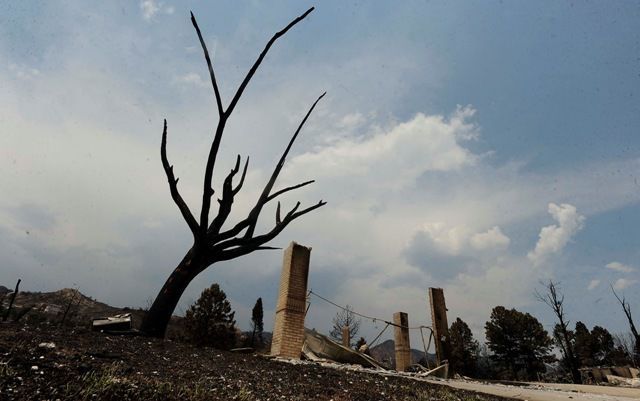
The Parkside community of 178 homes was almost entirely destroyed in the Waldo Canyon fire, leaving behind a hot-bed of development and homeowner’s association tangles that have made rebuilding unusually complicated — and for some residents, undesirable.
Before the fire, the neighborhood just east of Flying W Ranch Road and south of Chuckwagon Road was a well-cared for community that residents rarely wanted to leave.
People moved there for the protection provided by the covenants and development plans that stipulated that the tightly-spaced patio homes be built with certain floor plans, redwood decking and cedar shake shingle roofs.
When the June 26 firestorm blew through the community, it took the flames only two hours to destroy all but 37 of 178 homes, laying bare complications that had not been foreseen when the development was built nearly 30 years ago.
“The original development plan was a governing document of the city, but now it has implications for us with our rebuild,” Parkside Homeowner Association manager Chuck Fowler said in August. “It’s obsolete.”
Some residents who lost homes don’t want to rebuild according to strict architectural and developmental guidelines; other residents don’t want to rebuild at all, another prohibition of the covenants. Efforts at rebuilding have been forestalled by insurance and emotional struggles, not to mention the debates over how and what residents can rebuild. In an effort to resolve some conflicts, officials from the city Planning Commission and Parkside met regularly in the weeks following the fire to examine the covenants, Fowler said.
On top of that, Fowler, who lost his own home, must balance insurance issues and HOA concerns.
“Everything is very, very difficult,” he said. “I have to deal with HOA stuff and doing it within a structure of governing documents that we created 30 years ago when we didn’t contemplate this kind of disaster.”
The community
Twenty-seven years ago, Fowler and his wife Cindy were among the first seven people to move into Parkside. Fowler, a lot salesman at the time, heard about the patio-home project in the foothills, designed by North American homes in 1984.
North American homes intended to build 180 homes using four floor plans. Eventually, 178 homes were built, and only 144 of them by North American, which went bankrupt a few years into the project.
The homes were built in tight cul-de-sacs with each home only a few feet from its neighbor. The lots were small, with little wiggle room, and each was designed to optimize the view of the hillsides beyond. The floor plans included ranch-style and tri-level homes, and called for a minimum three-foot buffer, or setback, on each side of a home. Home exteriors — composite wood siding, for instance — were dictated by covenants, as well.
“All the houses were originally built with cedar shake — the covenants required it,” Fowler said. After wood roofs were prohibited on new construction by city ordinance in 2002, the covenants were rewritten. But about 30 homes in the neighborhood still had cedar shingles when the fire came, Fowler said.
Although troublesome now, the covenants were the main reason C.J. Moore, a longtime Parkside resident, moved there in the first place.
“There are splinters of people who want to get rid of the HOA,” Moore said, “But that’s why I bought there.”
She, like all residents, paid her monthly $130 assessments to cover maintenance of the Parkside grounds, which were landscaped with rolling lawns and trees, like a park. Moore bought her first home on Mirror Lake Court in 1985 and was devoted to her cul-de-sac neighbors, all long-time residents like herself.
“I had the type of cul-de-sac where if you didn’t have a key to somebody’s house, somebody else did,” she recalled. “I really, really, really miss that. It was such a sense of security. No community is perfect. No HOA is perfect — but it kept our neighborhood looking good,” she said.
Fowler and Moore are dedicated to rebuilding their homes just as they were, meaning they will bypass much of the controversy brewing in Parkside.
But, what if residents don’t want to rebuild, or don’t want to rebuild the exact same house, inside and out, that they lost? What if they want to change the footprint of their house or shift from a ranch-style abode to a two-story? As they stand, the HOA covenants prohibit all of that.
Obstacles abound
The destroyed Parkside homes make up more than a third of the 346 homes incinerated by the Waldo Canyon fire. While residents across Mountain Shadows grapple with similar insurance, home design and cost issues, few others must contend with the restrictive requirements in Parkside.
Parkside was a unique subdivision when it was built, and its plans and covenants almost dictate that it be rebuilt en masse. But that’s not what homeowners have in mind. To help, the city Planning Commission analyzed the original Parkside plans and in late Septebmer released a set of guidelines to help residents navigate the development plans.
“In general the document is designed to clarify some of the issues that we were facing when we were doing research with the old development plan,” said Erin McCauley, a planner with the city’s Land Use Review Division. “We were thinking, ‘Well, how in the world are we going to rebuild this subdivison?’”
The Parkside master plan worked fine when a single builder controlled development. But now, after the fire, there are several builders in the neighborhood and many neighbors want to seize the chance to customize their new homes. McCauley doesn’t blame people for wanting to divert from the original Parkside plans, which were odd, she said. Some houses had corners sticking into neighbors’ properties, and many homes were actually not placed according to the plans, she said. Some residents lived in ranch-style homes, where the plan clearly stipulated that their lot should have a two-story home.
“In one cul-de-sac, six lots were planned but nine lots were actually out there,” said McCauley, who found the plans “crazy.” The issues run the gamut, she added.
McCauley’s team determined that homeowners will skirt most issues by rebuilding on the exact footprint of their previous home. For example, a homeowner who lost a ranch-style home can rebuild the same model, even if the original plans stipulated that a two-story home be built on their lot.
Homeowners also can lower the height of their homes without issue, as in switching from two-story home to a ranch-style. But they cannot go the other way around without officially changing the planning document. If homeowners want to do something like change the footprint or raise the height of their homes, the development plan must be amended — with the approval of neighbors.
And, there’s not much space for change on the small lots, said Kyle Campbell, with the city planning department. Planning codes require a minimum distance between houses, and if one house is too big on its Parkside lot, that could impact the size of the home on a neighboring lot, he said.
“We want to make sure that no one comes in, builds a home, and causes an issue with the adjacent property owners,” he said. “To keep this from happening, the planning department has to approve all of the plans for new homes going up in the fire zone.”
The document McCauley helped prepare took precautions with setbacks between houses. While the buffers used to be a minimum sum of 10 feet, now buffers must be 5 feet on all sides of the home.
For homeowners across Mountain Shadows, rebuilding the exact same home could help them avoid insurance and financial complications. For Parkside homeowners, rebuilding the same home might be their only option unless the development plan changes.
The easiest thing for Parkside owners would be to build a house as close to the original plans as possible, said Bob Croft, of the Pikes Peak Regional Building Department.
“If someone wanted to build the exact model on the exact lot, we could issue a permit today,” he said.
Another significant issue is facing the half of the owners who have indicated they may not rebuild. The HOA must determine a course of action because covenants require rebuilding, said manager Chuck Fowler.
“Can you force people to rebuild? How are you going to handle that?…That’ll be a board decision. They have discretion.”
Overwhelming requirements
Jennifer Reise lost the home she purchased in 2009 on Hot Springs Court.
She and her 11-year-old daughter left when the neighborhood was evacuated June 24, the day after the fire started, and they took little with them.
“Cops were circulating and telling people to evacuate. And my neighbors and everyone thought that it would never hit,” she said. “They thought that Flying W Ranch would be the buffer.”
Fowler also assumed that the road, a river of asphalt, would protect their fenced-in development, and for years the community did little fire mitigation, he said.
But Parkside had all the elements in place that fire officials say made for the perfect conflagration of house-to-house ignition — tightly spaced homes, wood siding, and wood decks. When burning embers driven by winds up to 65 mph winds dropped into the neighborhood, there was little chance for the homes. Only the wooden fence enclosing the community, flanked on both sides by well-watered grass, survived.
Reise’s HOA dues, along with those of other residents who lost homes, were lowered in September from $130 to $40, she said. She does not understand why she owes the community even $40 for a home that no longer exists and that she may never rebuild. Fowler, who petitioned to have the dues re-evaluated, said that the HOA still is charged with maintaining the grounds and the sprinkler system that it owns.
After the fire, Reise discovered that she is underinsured by $72,000, and she is trying to make her way out of that quagmire before she can even consider rebuilding, or buying elsewhere.
“At this point I am just trying to get through with insurance. I can’t even make that call,” she said of deciding to rebuild. “I’m still dealing with what I’ve lost.”
Like Reise, not all Parkside owner’s share C.J. Moore’s resolve to rebuild.
“I’ve heard from a lot of people who aren’t coming back,” Fowler said. “For some people, they want to rebuild the same house quickly. On the other extreme, you’ve got people who can’t just even wrap their heads around what happened. They’re stuck. They haven’t made a decision about anything.”
In late August, Fowler guessed that half of the Parkside community planned to move on, and the other half, to stay. Those estimates were unchanged by October.
Those who decide not to rebuild face the ominous covenant dictum that they must, the only alternative being selling their properties to be rebuilt by developers.
“How can you sell a gutted property? I just got an email from an owner (in August), ‘I’m just moving on I can’t deal with this’,” Fowler said. “And he said, ‘I’m working with a builder, and I sold him the lot for a dollar, with the stipulation that they clean it up.’”
The overwhelming devastation did not dampen Moore’s rebuild-spirit, however.
“My driveway looks like it has been jack-hammered. Everything was ash and metal,” she said. “Most of our foundations will have to be replaced. And I wouldn’t want to build on that foundation anyway!”
Fowler intends to rebuild the same home that he and his wife Cindy bought years ago. But, after the emotional upheaval of his wife’s death in February and then the loss of their home in June, he’s not sure if he wants to live in Parkside anymore.
“I am mostly interested in recreating something that the market will value,” he said of his home, which he intends to sell. “I’m going to rebuild, but I’m not sure that it’d be healthy for me to live there.”
—
THE FIRE
The Waldo Canyon fire started June 23 near the Waldo Canyon trailhead and burned 18,247 acres. Thousands of people were evacuated as the fire roared toward Ute Pass, Woodland Park and Colorado Springs. It closed U.S. Highway 24 between Colorado Springs and Woodland Park for a week.
On June 26, it destroyed 346 homes in Colorado Springs and killed two people, becoming the most destructive fire in state history.
It was fully contained on July 10.
Investigators say the fire was human caused, but have not determined it it was started intentionally or accidentally.
The Waldo Canyon fire stripped the leaves from the branches of this tree in the Parkside community. Photo by JERILEE BENNETT/The Gazette file
This June photograph shows the destruction in the Parkside neighborhood. Photo by The Gazette file
The remains of two chairs sit amidst the rubble of the Parkside community on July 2, 2012. Photo by JERILEE BENNETT/The Gazette file