






Psychadelic rockers Jane’s Addiction ‘dig a little deeper’
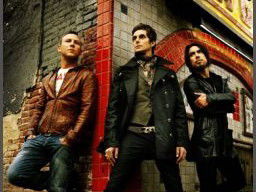
Since the mid-’80s Jane’s Addiction front man Perry Farrell along with guitarist Dave Navarro and drummer Stephen Perkins have been creating strings of vivacious vocals and psychedelic melodies.
But to simply call them alternative rockers would be putting it mildly. Jane’s Addiction, which plays the Pikes Peak Center Sunday, has written the book on rock ‘n’ roll, and their fourth album, “The Great Escape Artist,” is yet another chapter.
“Well, the music is different,” Farrell says. “We’re doing crazy things that I just absolutely love. You’ve just got to dig a little deeper.”
Not only have they sold out stadiums and raked in a few Grammys, the mesmeric men of Jane’s Addiction have painted the path for the modern day music festival by organizing and headlining Lollapalooza – a festival that originally began as a farewell tour for the band.
Today, as Lollapalooza continues, it is an avenue for alternative rock, metal, punk and hip-hop.
“We’re the ones that are really showcasing the great music,” Farrell says.
And, after all these years, it’s still Jane’s way, or no way.
Here Farrell talks about the experience of playing with great musicians, the similarities between record labels and the government, and Jane.
The Gazette: What’s it like playing with musicians like Dave Navarro and Stephen Perkins?
Perry Farrell: Well, the more I think about it the more fortunate I feel. I could very easily have gotten in with other musicians. When you’re coming up you only get to play with the people around you, in your neighborhood. I will never forget meeting those two fellows. I was so blown away. They were instantly in, to be honest with you. I feel like I’ve gotten to perform and record with two of the greatest musicians of their era. They have to be in the conversation and (are the) greatest musicians of their day.
Gazette: Has the song writing process changed at all from when you first started out as a band?
Farrell: Back in the day, we were coming out of the punk era. We loved the classic rock era, too. We wrote with that format with the acoustic guitar in hand. Hammering ideas out in your room. Today I’m much more open to a sound leading the way. And letting it lead us wherever it may. It could be a little more ambient. We’re open for collaborations. Even more people. We have people that are outsourcing sounds. It’s a great process. It’s interesting (and) it creates drama. We are always looking for sounds that you haven’t heard before. It’s very difficult to do. It takes more time, but that’s what we’re shooting for.
Gazette: What do you think has been the most significant change in the music landscape since Jane’s Addiction began?
Farrell: Well, listen, since we began I think the landscape of music is very corrupt and horrible. You don’t have, what I would say, honest definitions of music. There would be a category for pop, rock, hip-hop (and) dance. Not because of the record labels the majors (record labels) anyways. They’re horrible and corrupt and they push pop to the forefront. They just absolutely turn their back on rock music.
Same with dance. They hired these great producers to produce pop and what’s left of rock is pop rock. It’s designed for kids, it’s like kiddie music.
What’s interesting is hundreds of people are coming out. This should show the record companies something. They can sell hoodies and T-shirts. They’re atrocious. They did their best to destroy great credible music. But guess what? People will still get great credible music. The great headliners of Lollapalooza and Coachella. They’re like government. The originals were great and now it’s like, “Whatever, they’re just sellouts, just kissing each other’s ass.” For the most part, today’s government is nothing like it was in 1776. Same thing with music. It’s nothing like it was in the ’60s and ’70s. Good news is, the Internet has made it possible for the real musicians to market themselves and get their message out. You can’t stop a tour bus and that’s where we are. The great musicians of our day are touring and playing music for the people.
Gazette: Do you think music has lost its originality in recent years?
Farrell: No, there is so much originality. It’s just not being shipped out and distributed by major labels. … I need music. It’s not some incidental thing. It’s not like a little bird landing on my nose. It sinks into me, I need it. It’s out there. I’m discovering musicians. We’ve got 150 acts that play over three days (at Lollapalooza). I’ll find over a dozen that make me think, “Oh man, that’s a really great group.” I look forward to it. They’re not on major labels or on the radio.
Gazette: How has this album differed from musical projects you’ve done in the past?
Farrell: For one, we’re using more ambient sounds. … When we record we’ll record into a software package. The drums have loops they’ll use. It’s the best of both worlds, of all worlds. I don’t ever want to lose the virtuosity of Jane’s Addiction. The players are great and you don’t want to lose that. The music industry doesn’t invite you to develop and invite you to get great at that. Pop songs don’t need that.
Gazette: So, whose Jane?
Farrell: Jane was a real girl. Years and years ago, I had this white elephant house and it had nine rooms. … I put a rehearsal studio in the garage. We would wreak havoc for (the) landlord. It was a revolving door of musicians. She came in and she was at an all-female college — a very bright girl, very lost. Maybe she wasn’t so lost. She came to L.A. wanting to hang out with the underworld. She taught me about wine and cheese and we learned about drugs and sex together.
