






ARTS Light and space are explored in two new exhibits at the FAC
Light surrounds us every day. Few of us, though, ever stop to contemplate its nature or that of the space it fills.On Saturday, two exhibitions open at the Colorado Springs Fine Arts Center that explore those elemental notions. James Turrell’s “Trace Elements: Light into Space” and “Scott Johnson: Places Apart” run through Sept. 30.Both exhibitions focus on the ways in which visitors’ perception changes over an extended period of time. Every detail of the viewing environment, including the architecture, lighting, and sound, are designed to contribute to a sense of wonder and mystery.”This will be a new experience for Fine Arts Center visitors, one that they will remember for a long time,” says Blake Milteer, the FAC’s museum director and curator of American Art.Part of the Denver Art Museum’s collection, “Trace Elements” is a single piece of installation art by nationally-renowned artist Turrell. The piece will be on display along with two of Turrell’s holograms, which are on loan from Aspen’s Baldwin Gallery.”It’s about perception,” Turrell said of his work in a recent conversation with Interview Magazine. “I look at light as a material. It is physical. It is photons. Yes, it exhibits wave behavior, but it is a thing. And I’ve always wanted to accord to light its thing-ness.”
Viewers should expect to approach the work of Turrell in a new way.”Turrell’s work is very different than what one encounters with other forms of art,” Milteer says. “We are taken out of our familiar space and atmosphere and are compelled to slow down.””Places Apart” is an original exhibition by Johnson, a local artist and Colorado College art professor. The exhibit involves site-specific sculptural installations and architectural inventions. The work, Johnson says, attempts to “challenge our sense of space and light,” especially in relation to landscapes.”The work is meant to be experiential and perceptual in nature,” says Johnson. “You can’t represent it. It’s meant to be experienced in person, physically.”Milteer first discovered Johnson’s work at a Colorado College exhibition several years ago.”I was moved by the combined perceptual and tangible nature of Scott’s work when I first saw it,” says Milteer. “We then began conversations about how his art might manifest at the FAC. It was a perfect fit when I started to think about an exhibition based around perceptual art for this summer.”Johnson says displaying his work here in Colorado Springs allows him the opportunity to work more intimately with the installation than he could in a more distant location.”It’s great to be working with an institution that’s right here in my hometown. I can have a long-term conversation with the site, so to speak.”Milteer says the Fine Arts Center tries to find a balance of nationally and internationally renowned artists with regional artists. The exhibition program also strives to include a balance of media. Since the opening of the FAC’s expanded galleries four years ago, more exhibitions from regional artists have been displayed.Here, Milteer talks about the Turrell exhibit, and reflects on the ways in which the Turrell and Johnson works relate to each other.The Gazette: Can you briefly describe the exhibits? What is the focus or emphasis?Blake Milteer: This exhibition of works by James Turrell and Scott Johnson will transform the FAC’s second floor galleries into a succession of perceptual experiences.The exhibition includes multiple works of installation art, sculptural objects,NO COMMA and two-dimensional pieces that inspire experiences in which viewers slow down and immerse in the elemental qualities of light as it defines our physical and spiritual understanding and interaction.As you move through the Museum’s second floor, you will find that everything from the art to the architecture to the lighting to the sound is different from what you might expect in the galleries. There is a sense of wonder, beauty, and mystery in the experience that really opens-up our awareness of the world.Gazette: What attributes do Turrell and Johnson share? How is their work different?Milteer: Turrell and Johnson are artists who employ various media to draw viewers’ attention to the ways we perceive the presence of light, especially as it relates to the sky, earth, and architectural space. Turrell’s and Johnson’s investigations often find their most engaging form when the beauty of exterior light is recalled in a gallery, thus bringing the outside in. Both artists are concerned with the ways that viewers’ experience with perception unfolds over an extended period of time. This will be a new experience for Fine Arts Center visitors.Johnson’s work is distinguished from Turrell’s in that he looks to the role of light as it interacts with and defines material. Transition is a significant part of Johnson’s work as he creates dialogue between the viewer and landscape, time, and history. I believe that our community will find both Turrell and Johnson’s work immensely beautiful and moving. This will be an experience at the FAC that visitors will remember for a long time.Gazette: For those who may not be familiar with Turrell, what are some highlights that you think the community should know about him and his work?Milteer: Turrell focuses on experiences that draw our attention to the relationship between actual light and perceived light. He pioneered this kind of art beginning in the 1960s and has developed its language since by working with properties of both natural and artificial light. Recent installations include major works at the Crystal Bridges Museum of American Art, Rice University, and he continues work on his monumental project at Roden Crater in Arizona. Viewers may recognize Turrell from his segment on PBS’s Art 21 program several years ago.Gazette: How do you respond to Turrell’s work? What made you want to book him for the FAC?Milteer: Turrell’s work is an elemental form of experience that is very different than what one encounters with other forms of art. We often don’t spend enough time with a painting, sculpture, or photograph to become aware of how our relationship with it changes over an extended period. Coming to a Turrell work, we are taken out of our familiar space and atmosphere and we are compelled to slow down. We feel as though we’ve been taken out of context with our daily world, yet an experience with Turrell’s work activates senses that are constantly functioning , but that we become unaware of as we navigate everyday life.Gazette: Unlike Turrell, Johnson is a local artist. Does the FAC try to focus on local art, to some extent at least?Milteer: While we may like to define artists in this manner, artists themselves often do not. I look for our exhibition program to include a balance of nationally and internationally renowned artists with regional artists, both historical and contemporary. I also factor a balance of media, as well as single-artist exhibitions with thematic shows. The FAC is very proud of our exhibitions emphasizing regional artists over the past four years since our expanded galleries opened.
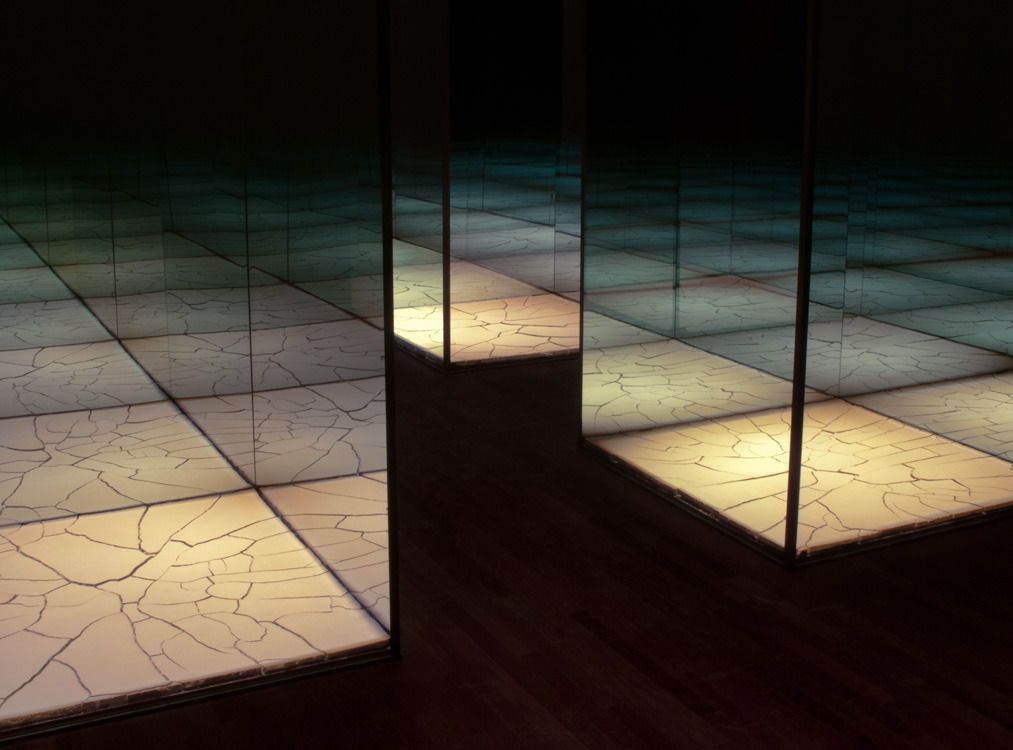
A Scott Johnson work from the “Places Apart” exhibit at the Fine Arts Center. Photo by