






INTERACTIVE MAP: More people at risk if another fire sparks
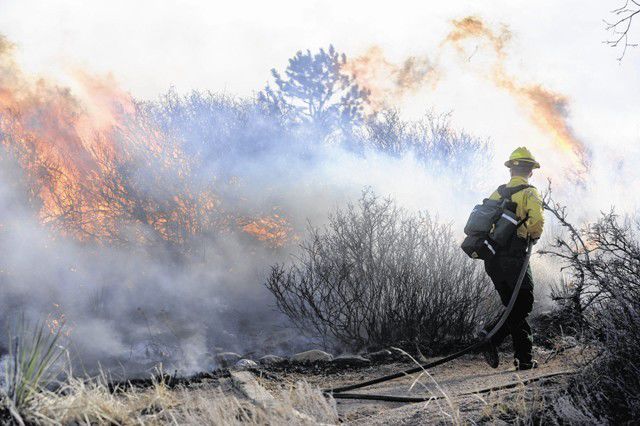
Strong winds. Low humidity. And trees so dry that they practically belong in lumber yards.
The weather conditions Colorado has seen this spring and summer are eerily similar to 10 years ago when the Hayman Fire torched 138,000 acres and destroyed 133 homes.
“With a hot, dry windy day and in the right location, it could be as devastating, maybe more so, than Hayman was,” said Jim Schanel, executive of the wildland operations section for the Colorado Springs Fire Department.
And there’s a significant difference between now and then: A lot more people and homes could be at risk.
Forest officials keep track of the homes in areas susceptible to fire danger, or what they call the red zone. Using mapping software and U.S. Census data, the Rocky Mountain I-News Network calculated how many people live in these areas and the analysis shows that El Paso County may be at a higher risk than other counties.
From 2000 to 2010, El Paso County has seen more than 40,000 people move into the red zone, according to the I-News data. That’s a population increase of 17 percent in those areas. In that same time, the total population of El Paso County increased by 20 percent.
In fact, El Paso County has far more people living in wildfire danger than anywhere in the state. According to I-News, the county has 278,334 people living in the red zone. Jefferson County, with the second-highest red zone population, has 148,310 people living in danger areas.
“On a large scale, we have a lot more infrastructure at risk,” said Schanel. “It’s not just homes. We have businesses. We have the watershed and recreation areas. It could be devastating.”
Getting prepared
More people living in the red zone means more complications if a wildfire breaks out: More congestion on the roads on evacuation routes, more reverse-911 notifications to go out and more shelter spaces needed for people and their pets.
“It makes the stakes a lot higher when you have so many people living in that area,” said Bret Waters, manager for the Office of Emergency Management in Colorado Springs.
To help, his office has run full-scale drills in wildfire-susceptible neighborhoods such as Cedar Heights, the Broadmoor, Comstock Village and Mountain Shadows. During the drills, the neighborhoods got an emergency warning call and had to evacuate. Emergency vehicles were sent in to clog up streets and make it more confusing, as it would be during an actual emergency.
“Really, it’s a way for residents to evaluate themselves,” Waters said. “We want them to be prepared and not panic.”
If a wildfire were to break out, he said people should not be entirely reliant on the reverse-911 system for notification. He said that it has been tested, but residents should also make themselves aware of what’s happening.
“No technology is ever going to be 100 percent,” he said. “Maybe you are not home. Maybe you don’t pick up the phone. There are numerous ways we will try to reach you — through the media and even door-to-door. But understand that there is never going to be one fail-proof way to reach everyone.”
Brett Lacey, fire marshal for the City of Colorado Springs, said people should have kits ready to go with important documents and supplies for the family and pets to last for 72 hours. They should also be familiar with all possible routes in and out of their neighborhoods.
“You never know when that familiar road may be blocked, and when you add in smoke and embers and traffic jams, you really have to know where to go.”
Being prepared means that people must mitigate fire risks on their property, said Lacey. The wildfire mitigation office offers free consultations to homeowners who want advice about protecting their home. The office has an online map of every Colorado Springs home in or near forest areas and ranks how much risk they face should a fire break out.
Ridding property rid of dead plants, clearing trees away from homes and thinning out vegetation can save a home, he said.
“We can’t be everywhere if a fire were to break out,” he said. “We’re encouraging people to do their work on the front end that will allow a fire to move around the house and leave the home untouched.
He said firefighters will work to save every home they can but in all likelihood, firefighters will save the house that they think can be saved, he said.
“They may have to make a tough decision of what they can protect and what they can’t,” he said.
How dry is it?
In a nutshell, pretty darn dry. The snowpack has nearly disappeared and the last time it was this low in Colorado was in 2002, according to the Colorado Basin Outlook Report, compiled by the U.S. Department of Agriculture. In fact, all that separates the two years is that the reservoir levels are higher now, because of the large 2011 snowpack.
Colorado depends on winter snow to provide moisture to plants and trees during the dry hot months. Christina Randall, a wildfire mitigation administrator for Colorado Springs, tracks the moisture of the trees and plants in the city and continually sends out updated reports to fire officials.
The fuel moisture index she tracks is a key tool for firefighters because it tells them how bad the fire potential is for a certain area. For example, if a tree was totally dry the moisture content would be zero percent. During the Hayman fire, the moisture was about 4 percent, she said.
“There’s hardly any moisture in that fuel,” she said. “That’s the lumber you’d get at Home Depot.”
The U.S. Forest Services classifies that level of moisture as “extreme fire danger.” Thus far this year, the levels haven’t been quite that bad. Randall’s measurements have shown the moisture to be in the 6-7 percent range. The forest service classifies those levels as “high fire danger.”
On June 6, a storm hit the city in the evening hours, soaking central Colorado Springs with as much as 4 inches of water in less than 2 hours and left some neighborhoods covered in several feet of hail.
Unfortunately, fire experts say, the massive storm didn’t help much in terms of moisture. For one thing, it was centralized over the city. Outlying parts of Colorado Springs, and the forests that surround it, were virtually untouched. Also, in areas that it did reach, it wasn’t enough to contend with a winter with almost no snowpack.
“When you have big gully-washers like that, it doesn’t do much of anything,” said Lacey. “When it comes down that hard and heavy, that’s not beneficial to us unless it comes day after day after day.”
Preparing for the next Hayman
In the years since Hayman, fire departments throughout the state have been subjected to the recession. In most cases, that means there’s not a lot more firefighters or equipment to take on a large fire. What they do have, Schanel said, is a worst-case scenario case study to work from. Local firefighters have studied the tactics used in Hayman to figure out what worked best and what didn’t.
“We’ve learned a lot,” he said. “We haven’t increased the size or spending but we have been able to spend some considerable amount of time and research.”
Dave Root, assistant district forester for the Colorado State Forest Service, based in Woodland Park, said that firefighters have made their biggest gains in terms of communication. When Hayman broke out, there was a disconnect between the rural and larger fire departments who were supposed to be working together, he said. That situation has been improved, he said.
“We learned that federal, state and private landowners need to cooperate a lot more closely than in the past,” he said. “Fire respects no boundaries. We can’t all work in our own world.”
Fire officials say they are prepared for the worst, but are hopeful that there won’t be another Hayman-sized fire in the Pikes Peak region. Each year, the forest service looks at potential fire conditions across the county to figure out the high-risk areas. At the moment, El Paso County, and much of the Colorado Front Range is classified as “very high” fire danger. That’s a step below the “extreme” rating it gives to Colorado’s western slope and parts of Northern Colorado, including the area of the High Park Fire in Larimer County, which has burned more than 50,000 acres and prompted thousands of evacuations.
Thus far, conditions haven’t prompted a burn ban in Colorado Springs, though that may change soon, said Lacey, the fire marshal.
“If we don’t get any moisture and humidity doesn’t pick up, we could easily be into restrictions within a week or so,” he said.
Even though conditions aren’t quite as bad as in 2002, Schanel said all it takes is for everything to line up – dry conditions, a windy day and hot temperatures – and things could get out of control.
If that happens, even the best-laid plans aren’t much help, he said.
“It’s like snow plows trying to compete with a blizzard. You can have every plow in the city out on the roads but they won’t be able to keep up with everything. Mother Nature always wins.”
Moving in
Before trees started growing over the Hayman burn scar, Tim Ferguson and his wife were searching for a house that borders wildland.
Ferguson figures that wildfires must have been on his mind when he moved nine years ago, but he doesn’t remember being too worried about it.
“We wanted to be close to wildlife and trails, that’s what we were thinking about,” said Ferguson on a recent day as he did yard work in front of his home on Cheyenne Boulevard.
They searched on the west side, in Rockrimmon and near Garden of the Gods. Ultimately, they decided on their southwest-side home surrounded by large, shady trees with Cheyenne Canyon just to the south and Stratton Open Space just a block west.
“We’re on the trails out there every day,” he said. “We love it here.”
About a year ago, Ferguson said he became worried about a fire and asked the Colorado Springs Fire Marshal to take a look at his home and give suggestions about how to protect it.
The Fire Marshal suggested that they replace the wooden shingles on the roof with fire retardant shingles, remove all of the dead wood from the property and cut down all trees within 30 feet of the home.
Ferguson said he re-roofed his home with the best shingles he could find, removed the dead wood and cut down branches that hung over the roof. Most of the trees stayed though, he said.
“We would have had to cut down every tree,” he said. “We weren’t going to that. We moved out here for a reason.”
Instead, like many of his neighbors, he’s decided to risk it.
“We know we’re taking a chance because we didn’t take all of their suggestions,” he said. “If something happens, we know the different routes out of here. This is just the reality of where we choose to live.”
—Contact Maria St. Louis-Sanchez: 636-0274Twitter @mariastlouis Facebook Gazette Maria St. Louis-Sanchez
