






REVIEW: First festival concert virtuosic, memorable if muddled
Chamber music.
You know — that stuff your grandparents would drag you to that was so boring it felt like fungus was growing on you. But they didn’t take you to the Colorado College Summer Festival‘s Festival Artists Concerts. Last night’s festival opener could have turned a burdened adolescent into a full-out fanatic.
Only a few days after arriving in Colorado Springs, faculty members of this now 28-year-old festival took stage in the almost-filled Packard Hall and put on an intense display of virtuosity. It was impressive and unforgettable. The artistic results did not fare as well.
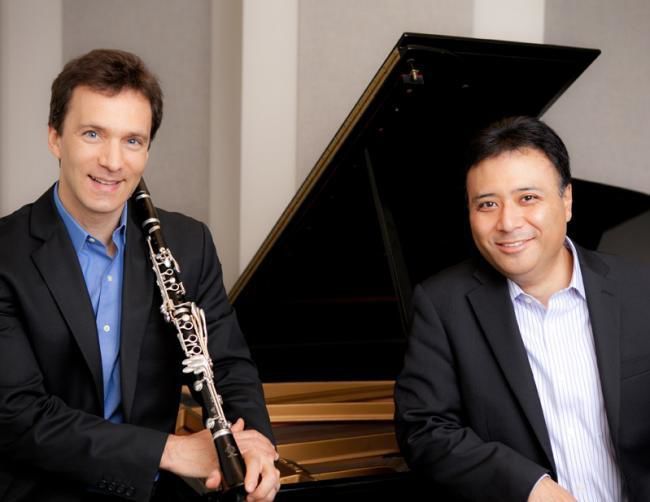
Shostakovich Trios got things started. The Russian master is known mostly for his riveting orchestral masterpieces, which boasts intensity that is matched by his string quartets — chamber music’s most quintessential expression.Yet here was some of the most inconsequential music ever composed. Still, when clarinetist Jon Manasse opened up his sound, it was obvious we were in rarefied air. His creamy tone had a bel canto-like quality as he seamlessly made his way through his instrument’s extensive range. Flutist Elizabeth Mann was featured in the second work and did all she could musically and theatrically to enliven the work’s childlike simplicity. Pianist Jon Nakamatsu finally got to break a sweat in the finale, which allowed all three musicians to show off their stuff.
The bass trombone was featured in John Rojak’s own arrangement of Chopin’s sensitive Étude Op. 25, No. 7. Seriously. One can’t blame Rojak for wanting to bring Chopin’s magic and mystery to his oft-neglected instrument, but he forged one the great musical mismatches of all time. His playing, carefully supported by Susan Grace on piano, was astounding. The aesthetic results were akin to the hippopotamus ballet from Disney’s “Fantasia.”
Then, a performance that had everything going for it. Grace was joined at the keyboard by Nakamatsu for the first and last of DvoÅ™ák’s Slavonic Dances, Op. 46. These ever-popular folk-inspired gems are known to music lovers through their orchestral versions but were actually first published for piano four hands (that is, a work composed for two pianists). Our pianists reveled in the opportunity to add engaging interpretive touches to the composer’s ebullient score. This was as delightful as music making gets.
Richard Strauss’ “Till Eulenspiegel’s Merry Pranks” is one of the great examples of musical storytelling in orchestral repertoire. It uses all the resources of a large Romantic orchestra to make its points. Last night, it depended upon only five instruments to tell the tale of its iconic troublemaker: Stephen Rose’s violin, Manasse’s clarinet, Michael Kroth’s bassoon, Michael Thornton’s French horn and Susan Cahill’s bass. In the hands of a lesser ensemble, this skeletal arrangement could easily have crashed and burned. But thanks to Cahill’s high energy underpinning, Rose and Manasse’s image-filled melody-making and Kroth and Thornton’s inspired rendering of the inner voices, the results were delightful and coherent.
One work made up the concert’s entire second half- the DvoÅ™ák Piano Quintet, Op. 81. All hopes for a truly winning evening rested upon the evening’s major offering: DvoÅ™ák’s Piano Quintet, Op. 81. Nakamtsu was back at the piano. Mark Fewer played first violin and Rose, second. One half of the world-renowned Ying String Quartet – Phillip Ying on viola and David Ying on cello – rounded out the ensemble.
The Yings were in the Springs in April as a part of the pre-festival “Blooming of Springtime Series” and gave an outstanding concert that demonstrated the inherent power of a seasoned full-time string quartet. It created a stark contrast with the formula the summer festival relies upon for its excellence: virtuosos miraculously putting performances together in a few hours of rehearsals. This quintet epitomized the risk and gain of this artistic process.
It was evident right from the start that these players really wanted this music to shine and had the chops to make it happen. This was the most energy-charged reading of the opening allegro I have ever experienced. They tore it up as each string player maximized their individual voice and Nakamatsu acted as a kind of musical arbitrator.
They were making music in the moment and did a great job of listening to one another. The beautiful second movement dumka lacked the cohesion the composer calls for but succeeded through a raw and fresh interpretation. And when the central section asked the players to cut loose in the manner of first movement, the ensemble was clearly more comfortable.
The scherzo was just right: elegant and persuasive. Nakamatsu created an ideal musical engine into which the strings joined perfectly. Even the luscious trio was ideally cast. In the finale, the ensemble was back to their highly-extroverted ways.
There was a cost to all this musical excitement. The mystery and soul that make this one chamber music’s most vital works was hard to discern.
The faculty will be back at it on Sunday with “Mostly Mozart,” which features far more traditional literature with greater preparation time. But even that is just the tip of the musical iceberg as the festival goes into full swing next week.
