






Monday’s the day for Douglas Bruce sentencing
It took seven years and lord knows how much money, but they got Douglas Bruce.
The famous (or infamous, depending on your point of view) anti-tax crusader, as he’s often called, will be sentenced Monday after having been convicted in December of tax evasion and three other related crimes. He could get up to 12 years in prison, and be fined as much as $750,000.
The conviction was a long time coming. The investigation into Bruce’s finances began in 2004, after someone at the state Department of Revenue took note of a campaign pledge Bruce made during his race for El Paso County commissioner. Bruce promised to donate his $63,000-a-year salary to charity, and that raised a red flag.
The next flag shot up when a department investigator found that Bruce declared zero taxable income on his 2005 tax return and requested a $1,600 refund.
Thus began a quest that would not end until four days before Christmas in 2011.
The investigation into Bruce’s financial dealings is outlined heavily in the indictment against him, issued in April 2011. It details the four charges: tax evasion, attempting to influence a public official, failing to file a tax return, and filing a false tax return.
The charges in the indictment are based on the Department of Revenue’s findings that Bruce lied in 2009 about his taxes, that he didn’t disclose income from a real estate deal, and interest he earned on $2 million he “loaned” to Active Citizens Together, a non-profit he founded in 2001. Essentially, Bruce tried to route money illegally through ACT, to avoid paying taxes, the indictment said.
While sifting through Bruce’s records, department investigators found an intricate web of money transfers, loans, contributions, and interest earnings, much of which had not been disclosed to the government.
After Bruce was arrested and indicted, he declared his innocence, and swore to fight the charges. And he did.
Bruce, who practiced law in California before he moved to Colorado in the 1980s, announced that he would represent himself. He filed motion after motion with the court, in attempts to delay the trial and get it thrown out.
Bruce complained that the prosecution didn’t provide him with all the evidence against him, he charged that the attorney general’s office had lied to the grand jury, he demanded the trial be moved from Denver to El Paso County, and more.
When none of that worked, Bruce faced First Assistant Attorney General Robert Shapiro before Denver Judge Anne Mansfield in a December trial.
Shapiro spent days painstakingly walking jurors through the accounts and transactions Bruce was involved in, particularly those with Active Citizens Together, which was at the center of the case.Bruce’s finances even included a corporation called Tele Comm Resources that reached from Denver to Colorado Springs to Idaho to Los Angeles and back again. TCR, according to Shapiro, was a conduit for money to flow in and out of ACT to make the transactions look legitimate.
Bruce denied that he had been in control of TCR, and said that almost none of Shapiro’s numbers were correct.
Shapiro also called witnesses who worked with ACT, and all of them identified Bruce as what they called the “central hub” of ACT. The three men who were listed on tax documents as the members of the board of ACT said they had never spoken to one another, in its nine-year lifespan.
To hear Shapiro tell it, Bruce was a financial and political puppet master.
Bruce maintained his innocence throughout the proceedings. He contended repeatedly that he had done nothing wrong, and that the prosecution was twisting the truth to get a conviction.
He also slammed Attorney General John Suthers over the length of the court case, from the indictment to the conviction, saying that the case was a political attack because the political establishment hates him.
In one of a dozen motions he filed before the trial began, Bruce noted that he had authored the Taxpayers Bill of Rights, and wrote that he was “being singled out for exercising his constitutional rights” because “most government officials publicly resent TABOR.”
After four hours of deliberation, the jury returned with its verdict: guilty, on all four counts.
The judge thanked the jury for its service, and told Bruce he would be sentenced on Monday. He has vowed to appeal.
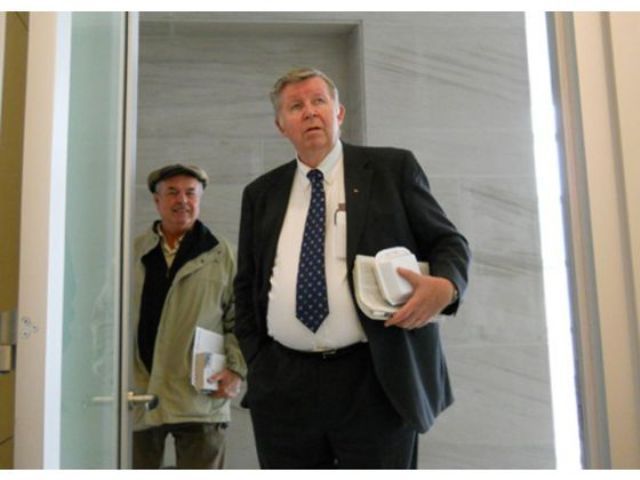
Douglas Bruce in court in December Photo by R. SCOTT RAPPOLD, THE GAZETTE FILE