






HORNER: Democracy works because we all feel part of a flawed process
In a little less than a year we will have gone through yet another election cycle. So now might be an opportune moment to stop and reflect on whether democracy actually works.
I’m not asking a specific or temporal question about whether our particular brand of government and goofy Electoral College is still functional. I’ll leave that for you to contemplate in private.
No, what I’m asking is much more theoretical: Does democracy — any form of democracy — actually work to express the will of the people? Because if democracy, no matter what its form, is incapable of carrying out its clearly defined objective of expressing the will of the people, then we might legitimately ask: Why do we put ourselves through this ordeal every few years? Why don’t we just turn the job over to a benevolent dictator and be done with it?
It turns out that except in the simplest of all possible questions, with the simplest of all possible answers, no democratic system is capable of determining the will of the people. Thus, only in a system in which everyone votes, and only up or down on questions, can a democracy adequately determine a majority’s will. And, having lived in Colorado long enough with its liberal referendum system, I can tell you that the will of the people is often fickle and contradictory. So even a pure democracy has its flaws. Perhaps that is why, as the ancient Greeks discovered, pure democracies are unstable.
But, there are a number of reasons why democratic systems don’t work for complex issues. I’m going to focus on just one. Let’s call it the Third-Party Problem. Any time a third-party candidate enters the race, they have the potential to disrupt the majority’s will. Think Nader in 2000. Neither the Supreme Court, the Electoral College, nor any number of hanging chads defeated Al Gore; Nader’s candidacy did. Without Nader in the field, Gore would have easily defeated George W. Bush in a head-to-head race.
This is one reason why plurality voting systems almost always result in a two-party system. Voters for third-party candidates are punished by electing the candidate they most reviled. And this problem isn’t unique to plurality voting systems. Any time a third option is available, it can change the dynamics of a race.
This fluke in democratic systems is particularly apparent when the array of candidates or outcomes is unpredictably complex — such as, we elect representatives that then carry out policies or enact laws that may not be knowable at the time of the election. Perhaps that is why the political dialogue in this country orders itself on a single dimension of conservative versus liberal. Once you have two or more dimensions in your political imagination, large segments of the electorate are going to feel disenfranchised by any outcome.
Given these difficulties, there is little wonder why we are often unsatisfied with the outcome of our democratic process. Because of the complexity of the individuals that make up the body politic, it will be the rare citizen that will find their wishes fully realized by our elected leaders — disappointment is almost always guaranteed. Is there anyone out there, who is fully satisfied with the state of our political system?
In 510 BCE, when Cleisthenes first proposed a democratic form of government to the Athenian people, he did it not so much to ensure that the will of the people would be carried out, as he did to break the political power of the clans that had vied for control of Athens for more than 100 years — often at the expense of those without power. Democracy gave even the powerless a say in their government. Perhaps that is why democracy works as a stable form of government — and also why it sometimes fails.
We, as individual citizens, almost never have things work out exactly as we would like, but we have a stake in what happens, and so acquiesce to imperfect outcomes from our viewpoint.
When we no longer feel a part of the whole, and so would rather see the whole destroyed, rather than see our own vision not prevail, that is when democracy dies.
Readers can e-mail the author at: jm.horner@yahoo.com
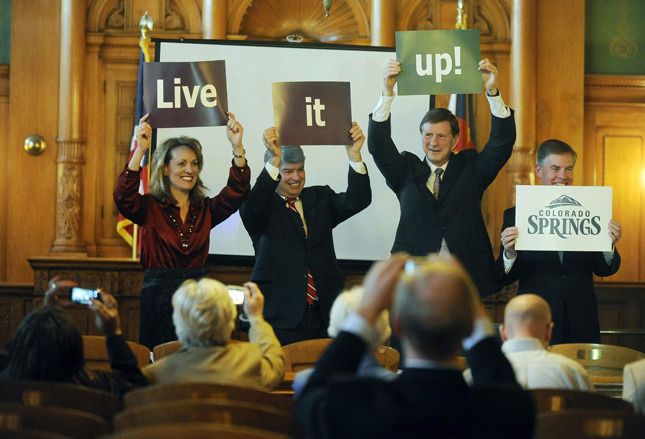
The new Colorado Springs brand and logo are displayed by El Paso County Commissioner Amy Lathen; Doug Quimby, chairman of the Colorado Springs Regional Economic Development Corp.; Mayor Steve Bach, Doug Price, president and CEO of the Colorado Springs Convention and Visitors Bureau., during an unveiling presentation at the Pioneers Museum on Tuesday, November 15, 2011. Photo by JERILEE BENNETT, THE GAZETTE