






HORNER: A complex society needs regulations to function
We live in an incredibly complex society. If you measure complexity by the number and kinds of interactions that we have with others, then the extent of that complexity quickly become apparent. Not long ago, say 10,000 years, all human societies were relatively simple. The average functioning group was anywhere from 30 to about 120 people, so you knew everyone in your group and had a limited range of interactions with them. Certainly, those interactions were fundamental to our humanity—such as between family members — and often complex — think of all the things that parents do for children and vice versa — but those fundamental interactions represented a basic set of relationships between people that still exists today.
Compare that to all the interactions both seen and unseen that you have with others in a modern society. It isn’t just the number, but all the different kinds of interactions you have that makes our modern society complex. To illustrate, imagine all the interactions it requires to do a simple act like drive your car, and you begin to understand the profound complexity that our society exhibits. As you drive down the street, you are certainly interacting with all the other drivers; you may pass literally hundreds of other people just driving to your grocery store. But these interactions, while numerous, are all of the same kind and are for the most part trivial because if we all follow the same rules, we get to where we are going with relatively few incidents. There are other people who enforce the rules of the road — not just the police who ticket violators, but a judiciary that deals our justice. So our relationships with them are different from those we have with other drivers.
But those are just the people you see. There are hosts of other unseen that also make your trip possible. For instance, those who planned, made and maintain the roads. Additionally, there are people who designed your car, built it, and shipped it to the dealer that in turn sold it to you. Others financed your car purchase, loaning you the money through yet a third-party. Likewise, the gas that powers your vehicle comes from wells, owned by some, drilled by others, in oil fields discovered by still others. The petroleum is also transported, refined, transported again and finally sold to you by yet others. All are necessary for you to take that relatively simple trip to the grocery store.
At each point, your interactions are regulated by a governmental entity. Indeed those regulations are necessary for a complex society such as ours to simply function. Imagine trying to drive without any laws regulating driving; your likelihood of actually arriving at your destination would be greatly diminished. But laws governing our driving habits are just the most obvious example. There are also rules that regulate you interactions with police that enforce those rules, and even regulations governing the judiciary. Beyond that, there are regulations that define the construction of highways, and work and safety rules for the workers who build them, regulations that define how cars are made and minimum impact standards so that cars protect you in a collision. There are regulations for financing, oil drilling, transportation and refinement of petroleum, and even the selling of cars.
Some might argue that these rules are simply stifling, but they are essential for the functioning of a complex society. Otherwise, we’d all be literally and figuratively running over one another. Without regulations, not only would car accidents be more common, but any of those interactions listed above would become fraught with unnecessary risks that would simply grind any sufficiently complex society to a halt.
Any society of sufficient complexity must recognize regulations of some interactions simply to function. We need to distinguish between these rather trivial regulations that promote efficient interactions, and others that would impinge on essential relationships that we all hold dear. I don’t really care what side of the road I drive on — as long as others are following the same rules. What I do care about, for instance, is what I teach my children about treating and respecting others, or about honoring the truth. In these more essential human matters, government rightly has nothing to say.
Readers can e-mail the author at: jm.horner@yahoo.com
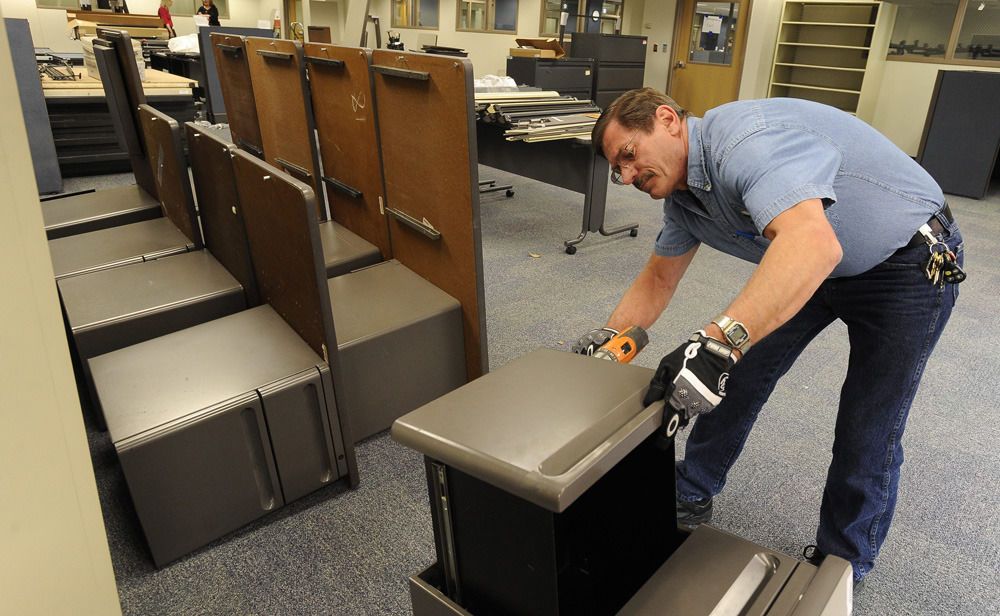
El Paso County service center workers are busy moving into their new building on Garden of the Gods Rd. this week. In the Operation Center, where voting ballots are counted, Andy Moran works on some furniture on Tuesday, Sept. 6, 2011. The massive building was formerly occupied by Intel. Photo by JERILEE BENNETT, THE GAZETTE