






Aerial photographer focuses on environment
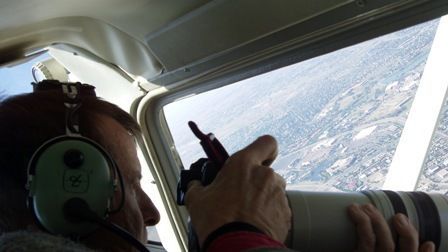
From 1,000 feet, the small black squares have a symmetry. Neatly arranged in columns and rows, they stand out in contrast against the tan ground.
And then…
“Tires! They’re burning (expletive) tires!”
Behind the lens of the camera, J. Henry Fair begins rapidly shooting. His subject is the Holcim Inc. cement plant in Portland, Colo. — specifically, the mounds of tires on the property the plant uses for fuel.
Fair is appalled. His disgust is in contrast to his objective: His photos don’t show the ugliness, but rather, the beauty.
Fair, part photographer, part environmentalist, visited Colorado Springs two weeks ago for the opening of his exhibit at Colorado College’s I.D.E.A. Space. His striking photos feature intricate patterns, bright colors and textures that reveal themselves on a closer look as coal-burning power plants, rivers discolored by toxic waste and oil spills.
“I was watching one person walk through who kept looking and trying to walk out and kept walking over and looking a little bit more,” said Jessica Hunter Larsen, the gallery’s curator. “You need to keep looking at them and thinking about it, and there’s a part of your brain that doesn’t want to because you don’t want to think about what it is.”
Fair can’t remember a time when he didn’t see the world through a lens. The desire to tell the story of man’s impact on nature has been a self-described “obsession.” For years he would sneak into refineries to capture scenes, but the resulting photographs were never as compelling as he hoped.
Then, on a red-eye flight from California, he looked out of the window and saw a river covered with fog. Rising above it were smokestacks of what Fair assumed was a coal-fueled power plant.
“I had the realization to get the pictures that I want, the answer was clearly to get above it,” Fair said.
Fair spent two hours in a Cessna on June 12, taking more than 500 photos of two coal-burning power plants and a cement plant in the Pikes Peak region.
The result from such trips are photos one viewer of Fair’s exhibit at I.D.E.A. Space simultaneously described as “beautiful” and “scary.”
“This brings it home,” said Pam Sanny, standing in front of a photo of tan, pink and red waves that a caption describes as pig feces from a hog farming factory. “It’s out there and being done. It makes you wonder if our efforts are doing enough.”
Larsen had a similar experience when first looking at Fair’s photos. Even now, after being around the exhibit for several weeks, she still finds the images “jump off the wall and demand that you pay attention.”
That is Fair’s intent. His photos are supplemented with research that tells viewers about the scenes and how they affect the environment.
“Most people in our world are not willing to listen to other points of view than the one they hold,” Fair said. “Art, on the other hand, allows us to sidestep those filters and reach people on a level they have not established a defense against.”
This is the driving hope behind Fair’s thousands of flights. And the work has had an impact. A number of Fair’s photos on deforestation in Canada for the production of facial tissues and toilet paper were used in campaigns against the company by environmental groups. As a result of the campaigns, the company has begun to change its logging practices.
Fair himself hasn’t escaped from the effect of his art. His New York home is heated by wood, he takes his own containers to the grocery store, and he catches cold water for re-use when he’s waiting for water to heat up at the faucet at home. He’s a stickler when it comes to turning off the lights.
He believes that change won’t begin with government policies but with people. And he hopes to inspire viewers to push for change with his work.
“We’re all part of the problem,” Fair said. “What are we doing to do about that?”
High above the city, J. Henry Fair snaps photos of a Colorado Springs coal-fueled power plant. Fair’s aerial photos are often striking and vague. Only when viewers of his work read his captions do they actually understand they are seeing. Photo by Emily Wilkins, The Gazette
An image in J. Henry Fair’s show “Industrial Scars,” now on display at Colorado College’s I.D.E.A. Space. Photo by