






Freestyling cioppino
LOS ANGELES • I don’t think I’ve ever written about cioppino without getting into an argument. That’s probably as it should be.
One of the definitive California dishes, cioppino is a classic soup of fish in a garlicky tomato-wine broth. And that’s probably where the agreement ends. Definitive and classic though it may be, there are as many cioppino recipes as there are cioppino cooks.
Maybe even more. Just in my own kitchen, I rarely prepare it the same way twice. Part of this, of course, is because it is based on a mixture of fish and shellfish, and rarely will you go to the market and find exactly the same proportion of the same species you bought last time, all in perfect condition.
Maybe more to the point, this is California, and here we tend to believe that, provided a good final dish, how you get there is pretty much your own business. If you need the security of definitive, classic recipes in which every ingredient and garnish is specified with no room for deviation or inspiration, pick up a copy of “Escoffier.”
Which is certainly not to say that we cioppino cooks don’t have strong opinions about what is right and wrong. Researching old recipes many years ago, I came across one from 1941 in a copy of the old Bohemian Life newsletter (published by the long-defunct brewery) written by Phil Townsend Hanna, under the nom de whisk Savarin St. Sure. In the next issue, one Vincent Quartararo wrote back, steaming mad. Seems Hanna had left out the crab. Sacrilege.
The choices for cioppino may seem endless, but don’t let that scare you. Rather than thinking of the dish as coming from a specific recipe, think of it as a matter of happenstance governed only by a certain structure.
The three absolutes in making cioppino are a wine-and-garlic-rich tomato sauce, an assortment of fish and/or shellfish, and a cooking technique that brings them together by layering the seafood in the pot, pouring the cooked sauce over the top and then heating just until the fish is done.
After that, you’re pretty much on your own. For the sauce: onions or scallions or both? Green bell peppers? Tomato paste? How much garlic? White or red wine? Celery?
Use imaginationThere’s not an ingredient that can’t be questioned, and to tell the truth, I’m pretty happy with any combination of those … except the celery and the white wine. I have to draw the line somewhere. Heathens.
In addition, I sometimes like to add cut-up squid to the sauce during the initial cooking — it braises to a silken texture and adds a lovely briny quality. Other times I’ll add a quick stock made from simmering shrimp, crab or lobster shells.
The other day I added bruised fennel seeds and dried oregano to the sauce, and I really liked that. Maybe I’ll do it again; maybe not.
However you prepare it, the sauce should be well-cooked. This isn’t your fresh-tasting marinara; the color should be brick-red so that the flavors are well-integrated.
When it comes to the seafood, the choices multiply exponentially. You want some from each of three broad categories: meaty fish (such as swordfish, albacore, shark or monkfish), flaky fish (sea bass, rockfish, halibut or lingcod) and shellfish (shrimp, clams, mussels, spiny lobster or crab). If you have a fishmonger you deal with regularly, don’t be afraid to ask for help. I’ve been buying fish for more than 20 years from Pete Siracusa of farmers market vendor J&P West Coast Fish; I can just walk up and say “Cioppino, Pete,” and he’ll hand over the best combination from what he has.
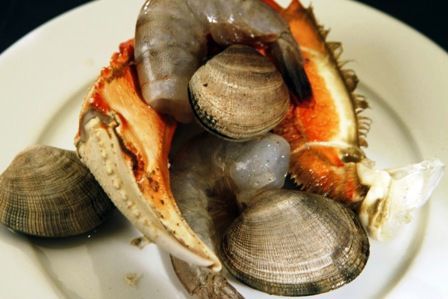
Generally, I aim for two parts meaty to one part flaky — and just as much shellfish as I can fit in the pot; nothing else delivers as potent a smell of the sea.
Until recently, I had never added crab to my cioppino (some heir of Quartararo’s is probably pecking out an angry e-mail on his iPad right now). To me, Dungeness crab is one of the greatest of all foods, and I like mine straight. But so many good cooks have recommended it for cioppino that I decided I had to try it.
It was good, but I’m still not sure it’s a necessity — certainly not as much as shrimp, clams and mussels. Still, it’s pleasurable in a sloppy, digging-out-crab-with-stained-fingers kind of way. It’s like an Italian version of the crab with black bean sauce you get in Chinese restaurants.
The crab issueIf you’re going to use crab, I’d recommend buying it pre-cooked from the market (because it’s going to be bathed in so much tomato sauce, the gain in flavor from cooking your own is not worth the hassle). Clean it, crack the legs and cut the body into sections.
Cut the fish into generous bite-size pieces. Peel the shrimp or not, depending on your whim. Generally, I peel unless I’ve been lucky enough to find hard-shelled cold-water shrimp — their shells really add flavor.
Ladle enough of the tomato sauce into the bottom of the pan to cover it well. If you’re using crab, arrange the pieces like a rack across the bottom. Layer the meaty fish and then the delicate fish on top. Scatter over the shrimp and then the mussels and clams.
Finally, pour the remaining sauce over the top and give the pan a good shake to distribute it. The sauce should just cover the fish. It may not look like you have enough to make a soup, but remember that the fish will exude moisture as you’re cooking it.
Cover tightly with a lid and set over medium-low heat. Shake it from time to time to stir (gently — you don’t want to break up the fish — and be sure to keep a firm grip on the lid).When the clams and mussels have cooked enough to spring open, the soup is done. Sprinkle generously with parsley (seriously, it’s part of the flavor, not just a garnish), shake again and ladle it into wide, shallow soup bowls (all the better to pick out the various shelly things).
Make sure there’s plenty of toasted bread to soak up all the juice. It’s even better if you rub each slice with a cut clove of garlic while it’s still hot.
Or not. It all depends on what you feel like. Let’s face it: Almost any way you fix it, cioppino is delicious. So why get bogged down in silly details?
CIOPPINO—Yield: 8-10 servings
3 tablespoons olive oil1 3/4 cups chopped onion (about 1 onion)1 cup chopped green bell pepper (about 1 pepper)1/2 teaspoon crushed red pepper2 teaspoons fennel seed, crushed8-10 cloves garlic, chopped (about 3 tablespoons), divided3 tablespoons tomato paste1 (750-ml) bottle fruity red wine2 (28-ounce) cans crushed tomatoes2 teaspoons salt, plus more for seasoning1 bay leaf3/4 teaspoon crumbled dried oregano1 teaspoon freshly ground black pepper2 pounds firm, meaty fish such as shark, yellowtail, monkfish or sea bass1 pound delicate, flaky fish, such as rock cod or snapper3/4 pound shrimp, in shell1 (1 1/4- to 1 1/2-pound) Dungeness crab, cooked, cleaned and cracked1 pound small clams and/or mussels, scrubbed clean1/2 cup chopped parsley
Procedure:1. In medium saucepan, heat olive oil over medium heat. Add onion and bell pepper and cook until soft, about 5 minutes. Add crushed red pepper, fennel and half the garlic; cook until fragrant, about 3 minutes. Stir in tomato paste and cook about 3 minutes. Add red wine and simmer until reduced by a third to a half, about 20 minutes. Add crushed tomatoes, 2 teaspoons salt, bay leaf, oregano and pepper; simmer gently until sauce is a dark brick red, about 45 minutes. You should have a little more than 6 cups. (Recipe can be prepared to this point up to 2 hours in advance, or more if tightly covered and refrigerated.)2. While sauce simmers, cut meaty fish and flaky fish into bite-size chunks, keeping separate. Season both types of fish and shrimp with remaining chopped garlic and a little salt; cover tightly and refrigerate.3. In separate large saucepan, one that is taller than it is wide, arrange fish. First, ladle in a thin layer of sauce. Then arrange cracked crab in a layer. Begin stacking fish on top of crab in order of how long they will take to cook: start with meaty ones, then flaky, then shrimp, then clams and/or mussels.4. Pour remaining sauce over fish and give the pan a good shake to distribute sauce evenly. Cover and place over medium heat. Cook until clams and mussels are open, about 20 minutes. From time to time, shake pan vigorously (hold the lid on tight!) rather than stirring, to avoid breaking up the fish.5. When ready to serve, taste and add more salt if necessary, gently stir in parsley and ladle stew into warm bowls.
Nutrition data per each of 10 servings: 379 calories; 40 grams protein; 20 grams carbohydrates; 4 grams fiber; 10 grams fat; 2 grams saturated fat; 130 mg cholesterol; 3 grams sugar; 907 mg sodium.
Don’t be afraid to be generous when adding shellfish to cioppino. Photo by MCCLATCHY