






Focaccia, straight up or blue
When a television series has devolved so far from its original premise that it reaches a kind of nonsensical absurdity, we say it has jumped the shark. That’s usually a good time to go back and take a fresh look at what made the original work so well.
The culinary equivalent might be something getting used in a fast-food sandwich. And so it’s time to get back to basics with focaccia.
I ordered a sandwich at my local lunch counter the other day and the guy asked me what kind of bread I wanted: “White, whole wheat or focaccia,” the latter a flattish white bread topped with what appeared to be sliced tomatoes, onions, cheese and lord knows what else.
In going public with these kinds of complaints, there’s always a danger of coming off all Andy Rooney-ish. I’m neither that old nor that perturbed. So I’m going to take the high road, praising true focaccia without stooping to condemn “focaccia bread.” I’ll leave it up to you to decide which you prefer. I know you’ll do the right thing.
Real focaccia is a lot closer to pizza than it is to anything that could be used to make a sandwich. In fact, if you imagine a slightly thicker, crisp-crusted, rectangular pizza with very restrained toppings, you’re just about there.
But though pizza can stand in for a meal, focaccia is more of a snack, or at most an appetizer. In Italy, it’s a popular walking-around food.
Also, though cold pizza may have a certain raffish charm, focaccia really needs to be eaten when it’s hot to be at its best. It goes stale very quickly. Though I’m enjoying the slice of focaccia topped with Gorgonzola that I’m eating for lunch while writing this, in no way is it nearly as good as it was last night right out of the oven.
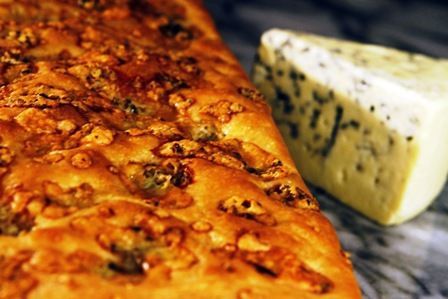
Then, I served it with champagne to start a dinner party. Served warm, the crust was crisp while the interior, rich with olive oil, was tender. The cheese had melted and browned, and the flavor was much more mellow than you might expect from a blue cheese. The whole thing was deeply savory and made a perfect foil served alongside radishes from the garden and some thinly sliced dried sausage.
It was also really easy to make because, thanks to a couple of weeks of focaccia experiments, I had a blob of already-made dough sitting in the freezer. After defrosting, I just stretched it into a well-oiled jellyroll pan (a generous hand with the olive oil gives a crisper crust), then scattered half a pound of crumbled Gorgonzola on top and baked it. That was all there was to it.
Most focaccias aren’t any more complicated than that, because the toppings tend to the austere: thinly sliced onions drizzled with olive oil, pitted olives, cubed pancetta with a scattering of rosemary leaves. To complicate a focaccia topping is to misunderstand its elemental appeal.
But don’t mistake simplicity for lack of flavor. My favorite focaccia is topped with nothing more than good olive oil and coarse salt. Made the Genovese way — with plenty of olive oil and white wine in the crust — it’s so delicious I could eat it all day.
Of the half-dozen recipes I tried, my favorite comes from Carol Field. For those of you who love Italian cooking, that probably will come as no surprise, as her “The Italian Baker,” published more than 25 years ago, is still the definitive book on Italian breads. This recipe is from a small book she did 15 years ago called simply “Focaccia.” The dough’s easy to make and very silky to work with. Even better, unlike many focaccia recipes, it doesn’t require an overnight rise, so you can knock it together with a minimum of forethought — always a plus at my house, where meal planning tends to go on an hour-by-hour basis. Ornamenting this focaccia with a topping of some sort would obscure its main pleasures: the crunchy crust and the pure flavors of olive oil, wheat and salt.
For focaccia that will be topped, I prefer a plainer dough, such as the one Peter Reinhart includes in his ode to pizza, “American Pie.” Whereas Field’s book is based in the first wave of artisanal home bread baking, Reinhart’s is right up to the cutting edge. His focaccia is based on one of those “retarded” doughs — refrigerated overnight to slow the fermentation and allow a longer period of enzymatic action, resulting in more complex flavors. He also uses a minimum of handling to keep from deflating the dough. And stylistically his focaccia is thicker and “breadier” than Field’s.
Focaccia doughs in general tend to be fairly fluid — particularly if you’re used to making heartier breads. Bread bakers talk about percentage of hydration — the ratio of water to flour. If you have 10 ounces of flour (about 2 cups) and add 6 ounces of water (weight, not volume — about three-quarters cup), you’ll have 60 percent hydration. Though most bread doughs are around 60 percent, focaccias generally run 70 percent and higher. I even tested one that was more than 100 percent.
Doughs this wet feel almost like batters, but that is the secret to focaccia’s delicious crispness. It also facilitates the shaping. If you’ve struggled stretching out perfect pizza rounds, focaccia will be a welcome relief. Essentially, all you do is spread the dough into a jellyroll pan. If it doesn’t fit perfectly at first, just set it aside for a couple of minutes to let the dough rest and it shouldn’t give you any more trouble.
After it’s stretched, dimple the dough by lightly tapping it all over with your fingertips. Remember, you’re dimpling, not indenting, and certainly not piercing. After a second rise, dimple again and you’re ready to top and bake.
There are a couple of other things that help make a crisper crust. Bake the focaccia on a pizza stone set on a rack in the middle of the oven. And slide a pan of water onto the floor of the oven to help with crispness and improve “oven spring” — that final rise that happens after the bread starts to bake.
The bread is done when it is well-browned on top and on the bottom. If you oiled the pan sufficiently, you should be able to use a spatula to lift a corner of the bread to see. Let it cool for just a couple of minutes, and then cut it into slabs.
Just out of the oven, the crust gives off a warm fragrance of good olive oil. It crunches lightly when you bite into it, but the interior is still tender and just chewy enough to be interesting. The salt adds a sharp contrast.
Eat it as a snack, serve it as an appetizer, however you like. But if you turn it into a sandwich, I don’t want to know about it.
FOCACCIA FROM GENOA—Total time: 1 hour, 15 minutes, plus rising timesYield: 1 loaf (10-12 servings)
SPONGE2 1/2 teaspoons (1 package) active dry yeast2/3 cup warm water1 cup (4.9 ounces, or 140 grams) unbleached flour
DOUGH AND ASSEMBLY1/2 cup water1/3 cup dry white wine1/3 cup extra-virgin olive oil, plus about 2 tablespoons for drizzling2 1/2 cups plus 2 teaspoons (12.7 ounces, or 360 grams) unbleached flour, plus 1-2 tablespoons as needed2 teaspoons coarse salt, plus 3/4-1 teaspoon for sprinkling
Procedure:1. For sponge: Sprinkle yeast over warm water in large mixing bowl; stir it in and set aside until creamy, about 10 minutes. Stir in flour and beat until smooth. Cover tightly with plastic wrap and set aside to rise until puffy and bubbling, about 30 minutes.2. For dough: To sponge in bowl, add water, wine and 1/3 cup olive oil; stir to combine.3. If mixing by hand, whisk in 1 cup flour and 2 teaspoons salt, then beat in remaining 1 1/2 cups flour until you have a dough that is very soft and very sticky. Knead on lightly floured board with the help of a dough scraper and 1-2 additional tablespoons flour, until dough comes together nicely and is silky and shiny, 6-8 minutes; it should remain soft but not wet.4. If using a mixer, use paddle attachment to beat together water, wine, 1/3 cup olive oil and sponge. Add flour and 2 teaspoons salt and mix until the dough comes together (it will be very soft). Change to dough hook and knead 3 minutes at medium speed, stopping once or twice to press dough into a ball to aid in the kneading. Remove dough from bowl and knead by hand using 1-2 additional tablespoons flour to finish, 6-8 turns at most. It should remain soft but not wet.5. Place dough in large, lightly oiled container, cover tightly with plastic wrap and set aside until doubled, about 1 hour.6. Dough should be soft and full of air bubbles, and should stretch easily. Press it into a well-oiled (17-by-12-inch) jelly roll pan, dimple it well with your fingertips or knuckles, cover with a towel and let rise until puffy and doubled, about 45 minutes. If dough springs back before it is completely stretched, set it aside to “relax” the dough for a few minutes, then stretch again; the dough will stretch more easily after it is rested.7. At least 30 minutes before you plan to bake, preheat oven to 425 degrees, with a baking stone inside on the lowest shelf. Once again, dimple top of dough with your fingertips or knuckles; drizzle remaining 2 tablespoons olive oil over dough so that it pools in the indentations; sprinkle with remaining salt. Place pan directly on stone and immediately reduce oven temperature to 400 degrees. Place shallow metal container of water on floor of oven to make steam.8. Bake until focaccia is golden (lift bread to check underneath), 25-30 minutes. Immediately remove from oven and cool briefly on rack. Serve warm or at room temperature.
Nutrition data per each of 12 servings: 231 calories; 5 grams protein; 32 grams carbohydrates; 1 gram fiber; 9 grams fat; 1 gram saturated fat; 0 cholesterol; 0 sugar; 420 mg sodium.
Adapted from “Focaccia” by Carol Field.
GORGONZOLA FOCACCIA—Total time: 1 hour, plus overnight rising and proofing timesYield: 1 loaf (10-12 servings)
5 3/4 cups (26 ounces) unbleached bread flour, more if needed2 teaspoons salt2 1/4 teaspoons instant yeast2 1/2 cups ice-cold water1/4 cup olive oil, plus more for brushing1/2 pound crumbled Gorgonzola or other blue cheese
Procedure:1. With large metal spoon, stir together flour, salt, yeast and water in 4-quart bowl or bowl of an electric mixer until combined.2. If using a mixer, fit it with paddle attachment and mix on low speed until ingredients are hydrated and begin to form a wet ball of dough, about 2 minutes. Set dough aside to rest 5 minutes. Switch to dough hook, add 1/4 cup olive oil and resume mixing on medium-low speed until all the oil is incorporated and dough is sticky, supple and smooth; it should clear the sides of the bowl and stick just a little to the bottom. This should take 3-4 minutes. If dough seems like a batter and does not have sufficient structure to hold itself together, mix in more flour by the tablespoonful.3. If mixing by hand, repeatedly dip one hand or the spoon into cold water and use it much like a dough hook, working dough vigorously as you rotate the bowl with your other hand. As all the flour is incorporated and dough becomes a wet ball, after about 3 minutes, stop mixing and set dough aside to rest 5 minutes. Then add olive oil, dip your hand or spoon again into water and continue to work dough 3-4 more minutes. Dough should be very sticky, but should also have some texture and structure. If dough seems like a batter and does not have sufficient structure to hold itself together, mix in more flour by the tablespoonful.4. Form dough into ball and place it in bowl brushed with olive oil. Turn dough to coat it with oil, cover bowl with plastic wrap and immediately refrigerate it overnight. The next day the dough should have nearly doubled in size. Allow it to come to room temperature, about 2 hours, before baking.5. To bake, line 12-by-17-inch jellyroll pan with parchment or a silicone liner and oil well. Wet your hands and gently scrape dough from bowl onto pan; be gentle with dough to deflate it as little as possible.6. Using only your fingertips, press down on dough, creating dimples and pockets all over its surface. Do not press dough outward toward edges of pan; instead, simply press downward at only a slight angle toward edges. The dough will spread on its own; any attempt to force it toward the pan edges will tear it and cause uneven sections. The dough will probably fill the pan a little more than half full before it begins to become elastic and spring back toward the center. When this occurs, stop pressing, cover loosely with a damp cloth or plastic wrap, and set aside for the dough to relax at room temperature, about 15 minutes.7. Repeat dimpling process, beginning at center and gradually working out toward edges of pan. This time the dough will nearly fill the pan. Try to keep dough somewhat even across the top. Again, cover and set aside to relax at room temperature for about 15 minutes.8. Repeat dimpling, again. This time the dough should fill the entire pan (if it does not quite fill the corners, don’t worry, it will when it rises). Do not deflate dough any more than necessary as you spread it. Set aside to rise again until it fills the pan, about 2-3 hours.9. Preheat oven to 500 degrees. Just before baking, sprinkle Gorgonzola over dough. Place pan on middle shelf of oven, lower oven temperature to 450 degrees and bake 20 minutes. Rotate pan and continue baking until top and underside are golden brown and slightly crisp, 10-20 minutes longer.10. Using metal spatula or pastry blade, loosen focaccia from sides of pan. Slip spatula between focaccia and parchment or baking liner and lift edge of focaccia. Then jiggle focaccia out of pan onto a rack, leaving liner in pan. Pour any oil left in pan over focaccia. Cool focaccia briefly before cutting and serving.
Nutrition data per each of 12 servings: 330 calories; 12 grams protein; 45 grams carbohydrates; 2 grams fiber; 12 grams fat; 5 grams saturated fat; 17 mg cholesterol; 0 sugar; 650 mg sodium.
Adapted from “American Pie” by Peter Reinhart.
Gorgonzola Focaccia. Although its cousin, pizza, can stand in for a meal, focaccia is more of a snack, or at most an appetizer. Photo by MCCLATCHY