






Planting seeds: Teacher Lois Ellen Frank works to keep Native American foods alive
The American menu today is crowded with many cuisines: Italian, Chinese, French, Japanese, German, Ethiopian, Irish, Vietnamese. With so many kinds of cooking, it can be easy to forget what is the most important cuisine of them all, that of American Indians. These foods from throughout the Americas are the foundation of what we eat today.
“American cuisine is a combination of immigrant cuisines in conjunction with Native American cooking,” said Lois Ellen Frank, a chef, author, teacher, food historian, culinary anthropologist and photographer working to keep the foodways of American Indians alive and thriving.
Frank, based in Santa Fe, N.M., has a valid point. Just think what our kitchens would be like without tomatoes, beans, squash, chocolate, vanilla, pineapples and, most of all, corn. These foods of the New World rapidly circled the globe after 1492, in what’s called “The Columbian Exchange.”
She believes eating indigenous foods is not only good for you but good for the planet because many of these foods can be locally grown or sourced, often by American Indians. To that end, she seeks to encourage the incorporation of traditional Indian foods into modern life via her books, including the James Beard Award-winning “Foods of the Southwest Indian Nations,” articles, classes and a catering company.
Her thrust was clear during a talk in the fall at the Association of Food Journalists conference in Santa Fe. The title: “Seeds of Health: The Return to The Ancestral Diet.”
While touting the benefits of indigenous food, Frank doesn’t snub foods introduced into the Americas. One of her fall cooking classes also made use of lamb, goat cheese and wheat flour.
An Indian medicine wheel serves as a symbol to her of the intermingling of people, cultures and foods.
“One-quarter of the wheel is yellow, white, black and red,” she said. “Mix the colors together and it becomes speckled corn. Most of us are speckled corn.”
Frank personifies the analogy. She is half American Indian. Her mother is from the Kiowa nation, which was relocated to a reservation in what is now the state of Oklahoma in the mid-19th century. Her father is a Sephardic Jew, whose mother came from Europe as a small child. Frank, born in New York City, grew up on Long Island.
Today, indigenous foods are a part of all Americans, no matter where their ancestors came from. For Frank, what’s important now is to make sure the foods, and the recipes, are accessible to all and enjoyed.
“Recipes only remain alive if people cook from them,” she said.
LAMB-STUFFED CHILIES WITH TOMATO PUREE—Yield: 6 servings
12 firm green mild chilies, New Mexican or Anaheim1 tablespoon olive oil1 yellow onion, finely chopped3/4 pound ground lamb1 large ripe tomato, diced2 cloves garlic, minced1 bay leaf1/2 cup bread crumbs1/2 tablespoon chopped fresh tarragon, or 1/2 teaspoon dried1 teaspoon salt1/2 teaspoon each dried thyme and black pepper
TOMATO SAUCE AND TOPPING1 tablespoon olive oil6 cloves garlic, minced1 1/4 pounds tomatoes, coarsely choppedSour cream, optional
Procedure:1. Roast chilies, turning often, on stove-top grill until charred on all sides, about 15 minutes; peel. Cut off stem; slice chilies lengthwise to open like a book. Remove seeds.2. Heat oil in large skillet over medium heat. Cook onions, stirring, until translucent, about 4 minutes. Add ground lamb; cook, stirring, until browned, about 15 minutes. Drain off excess fat. Add tomato, garlic, bay leaf, bread crumbs, tarragon, salt, thyme and pepper. Reduce heat and simmer 15 minutes. Cool.3. Meanwhile, for tomato sauce, heat oil in saucepan over medium-low heat. Cook garlic, stirring, 1 minute. Add tomatoes; cook, stirring often, until liquid evaporates and sauce is reduced, 15 minutes. Pour sauce through fine sieve. Keep warm.4. Preheat oven to 350 degrees. Spread chilies open on work surface. Top each with lamb mixture. Close chilies around lamb. Place stuffed chilies, open-side down, on oiled baking pan. Bake until hot, about 10 minutes. Serve with tomato puree. Garnish with sour cream, if desired.
Nutrition data per serving: 249 calories, 46 percent of calories from fat, 13 g fat, 4 g saturated fat, 38 mg cholesterol, 21 g carbohydrates, 14 g protein, 303 mg sodium, 3 g fiber
Lois Ellen Frank makes her own prickly pear syrup, but you can buy it online.
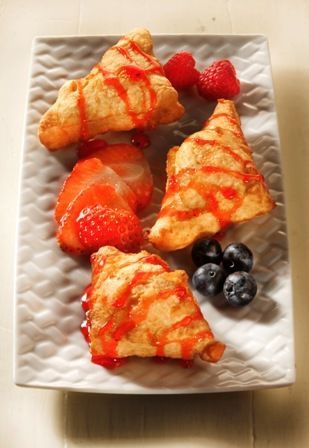
FRY BREAD WITH SEASONAL BERRIES AND PRICKLY PEAR SYRUP—Yield: 8 servings
4 cups flour2 tablespoons baking powder1 teaspoon salt2 cups warm waterVegetable oil for frying1 cup prickly pear or other fruit syrup or honeySeasonal berries and confectioners’ sugar
Procedure:1. Mix flour, baking powder and salt in large bowl. Gradually stir in water until dough becomes soft and pliable without sticking to bowl. Knead dough on lightly floured surface, folding outer edges toward the center, about 5 minutes. Return dough to bowl; cover with clean towel and let rest at least 30 minutes.2. Shape dough into egg-size balls. On lightly floured board, roll each into a1/4-inch-thick square. Cut each dough piece into four small triangles.3. Heat about 1 1/2 inches oil in skillet over medium heat until oil is hot but not smoking, about 350 degrees. Carefully place 1 piece of dough in oil. Cook, turning once, until dough turns golden brown on both sides and puffs, about 3 minutes. Remove; drain on paper towels. Repeat frying with each piece of dough. Keep warm between two clean kitchen towels in low oven.4. To serve, drizzle some prickly pear syrup onto each plate. Top with fry bread. Scatter with berries and sprinkle with confectioners’ sugar or drizzle with more sauce.
Nutrition data per serving: 391 calories, 18 percent of calories from fat, 8 g fat, 1 g saturated fat, 0 mg cholesterol, 74 g carbohydrates, 6 g protein, 560 mg sodium, 2 g fiber
Cuisine in America is influenced by immigrants from around the world, but all tie into to the cooking styles and ingredients of Native American food, such as this Fry Bread with Seasonal Berries and Prickly Pear Syrup. Photo by MCCLATCHY
Teacher Lois Ellen Frank prepared traditional Native American, including Lamb-stuffed Chilies with Tomato Puree. Photo by MCCLATCHY