






Power puffs: Yummy gougeres can be ready fast
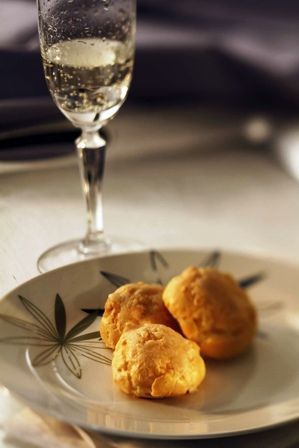
As a cook, I am prone to enthusiasms, and sometimes, perhaps more often than occasionally, they can be a bit excessive. I readily admit that. But, please, trust me on this one: Frozen gougeres were the best thing I discovered last year. No, really.
Doubt me? Think about this: a crisp, crusty savory cream puff, lighter than air but rich with the utterly irresistible fragrance of browned Gruyere cheese. And here’s all you have to do to fix them: Remove from freezer; place on cookie sheet; bake for a half-hour. All of the hard work — making the dough, piping it into puffs — can be done well in advance.
Amazing. This could be to holiday entertaining what the discovery of electricity was to indoor lighting.
Never heard of gougeres? Don’t feel bad. Until relatively recently, they were one of those ultraregional French specialties, a typical little bite in the bistros of Burgundy.
The first time I remember having them was at the French Laundry a decade or so ago. At this restaurant, famous for perfecting the art of refined luxury, here’s how a great meal starts: You gather at dusk on the patio in the garden. One waiter brings crystal flutes of a crisp rose Champagne. Then another brings gougeres, swaddled in linen to preserve their fresh-from-the-oven warmth. A bite of crackling cheese puff, a sip of brisk bubbles, the shadows lengthen … and now you’re ready for dinner.
Perfect, right? And until now perfectly out of reach. The gougeres (pronounced GOO-zhair) from the French Laundry are made right before being served. And whereas at the French Laundry Thomas Keller has an army of cooks to take care of those kinds of things, at home I’m pretty much on my own.
So while I’ve always regarded gougeres as an ultimate appetizer, I’ve never gotten around to making them regularly. In the hour before a dinner party starts, I’ve got better things to do than beat cream puff paste.
But thanks to Dorie Greenspan, that’s no longer necessary. While testing recipes from her splendid new book, “Around My French Table,” I noticed that she claims her recipe for gougeres can be frozen before baking. You pipe out the cream puff dough in advance, freeze it on the cookie sheet, transfer it to a bag or box for long-term storage, and then pop it out whenever you’re ready. And she says they take only an extra four or five minutes to bake, straight from the freezer.
This seemed too good to be true. So I tried them, baking half of the puffs right away and then freezing the remainder (a typical recipe for gougeres will make three to four dozen). The first batch was great, of course. But the real news was the next day, when I put the leftovers from the freezer straight into a hot oven. Half an hour later they were done.
And they were perfect.
I was so excited I started e-mailing everyone I knew. Some of my correspondents were equally jazzed. Others, less so. My pal Michael Ruhlman, who co-wrote “The French Laundry Cookbook,” among others, just said, “You are such a geek.”
Yes, I replied to myself, but now I’m a geek with gougeres!
Still, I wasn’t quite done. As good as Greenspan’s recipe for gougeres is (and it is very good), I wanted to try some more. Would this freezing technique work with others?
So I gathered recipes from some of my favorite cookbook writers and went to work.A few pounds of flour and a couple of dozen eggs later, I can safely say that freezing does work with all of them (and, interestingly, by extension, it should work with other cream puff dough recipes as well … perhaps an area for future exploration).
If you’ve never made cream puffs at home, you really should give it a try. After you get the hang of a couple of tricky steps, it’s really easy.
You start by bringing water, butter and salt to a boil in a saucepan. Dump in a bunch of flour and start beating the mixture with a wooden spoon.
Have all the ingredients measured and ready before you start, because this part goes very quickly.
At first, it’ll look like a mess, but within 15 to 20 seconds the mixture will begin to come together to form a smooth, shiny, very resilient dough ball that pulls cleanly away from the sides and bottom of the pan. Keep cooking and stirring for a couple of minutes — you want to cook out as much of the water as you can to ensure the lightest, crispest puffs.
Transfer the dough to a stand mixer (it’ll look like a thick paste, which is what professional bakers call it). Beat on medium speed for 20 to 30 seconds to cool it slightly. Then beat in the eggs, one at a time (with most recipes, I’ve found that you can add the eggs all together, but that proved problematic in a couple of instances, so I think it’s just safer to do it this way).
You can also mix all of this by hand, but you’d better have the shoulders of an NFL linebacker. That paste is dense.
When all the eggs have been fully incorporated, add the cheese. That’s just about it. The only thing that’s left is forming the individual puffs. The easiest way to do this is with a pastry bag fitted with a three-eighths- to one-half-inch round nozzle. You’ll want to squeeze out roughly 1-tablespoon mounds, about the size of a small walnut. If you don’t have a pastry bag, you can form the puffs with a soup spoon (wet it occasionally to keep the dough from sticking).
Form the balls on a cookie sheet lined with parchment paper or a silicone pastry sheet, so they don’t stick. Now just put them in the freezer.
They’ll be frozen solid in a couple of hours, at which point you can transfer them to a tightly sealed plastic bag or food container for longer storage. (They’ll keep for at least a few weeks.)
When you’re almost ready to serve, place as many of them as you want onto a lined cookie sheet and bake — first at high heat to get the puff and set the structure, then at lower heat to finish the interior. That’s all there is to it.
Cooking through several recipes shows just how flexible the technique is. The basic ratio is roughly 1 cup of liquid to 1 cup of flour and 4 eggs. Butter can vary from 3 tablespoons (Judy Rodgers’ from “The Zuni Cafe Cookbook” are almost supernaturally light and crisp) to 7 tablespoons (from “The French Laundry Cookbook,” which compensates with an extra quarter-cup of flour).
Most recipes call for water, though Greenspan’s uses half milk (it improves the browning). Noted teacher and cookbook writer Madeleine Kamman uses chicken stock (for a more rounded savory flavor). And, of course, you can experiment with cheeses, using cheddar or Parmesan. I even read about one variation with blue cheese.
In the end, though, my tasters were unanimous and unequivocal in choosing the “French Laundry” puffs as their favorites; they are light and crisp but have a profound, rich roasted cheese flavor.
Did I mention the most significant fact?
All of this tasting took place during a weeknight dinner, after a long workday, while watching the Lakers on TV. With a green salad, it was a terrific light supper that required almost no effort at all.
Imagine that: gougeres, once the ultimate luxury, now converted to a fast-food staple.
GOUGERES—Yield: 4 dozen
1 cup water7 tablespoons (3 1/2 ounces) butter1 tablespoon kosher saltPinch sugar1 1/4 cups (5 ounces) flour4-5 eggs1 1/4 cups (5 ounces) grated Gruyere, dividedSalt & freshly ground white pepper
Procedure:1. Preheat oven to 450 degrees. Line 2 baking sheets with silicone baking sheets or parchment paper.2. In medium saucepan, combine water, butter, salt and sugar; bring to boil over high heat. Add flour all at once, reduce heat to medium and stir with wooden spoon 2 minutes, or until dough forms a ball and excess moisture has evaporated (if ball forms more quickly, continue to cook and stir a full 2 minutes).3. Transfer mixture to bowl of stand mixer fitted with paddle and beat about 30 seconds at medium speed to cool slightly. Add 4 eggs and continue to mix until completely combined and batter has a smooth, silky texture. Stop machine and lift up beater to check consistency of batter. It should form a peak with a tip that falls over. If too stiff, beat in white of remaining egg. Check again and, if necessary, add yolk. Finally, mix in 3/4 cup Gruyere and adjust seasoning with salt and white pepper.4. Fill pastry bag fitted with a 3/8-inch plain pastry tip with gougeres batter. Pipe batter into 1-tablespoon mounds on baking sheets, leaving about 2 inches between gougeres, as mixture will spread during baking. Sprinkle top of each gougere with about 1/2 teaspoon remaining grated cheese. (At this point, the gougeres can be frozen on baking sheets until solid, then stored in freezer in tightly sealed container.)5. When almost ready to serve, transfer frozen gougeres back onto lined baking sheet and bake until they puff and hold their shape, 7-8 minutes. Reduce heat to 350 degrees and bake until a light golden brown color, an additional 20-25 minutes. When you think the gougeres are done, break one open; it should be hollow, and the inside should be cooked but still slightly moist.6. Remove pans from oven and serve gougeres while hot.
Adapted from “The French Laundry Cookbook,” by Thomas Keller and Deborah Jones
Gougeres can be made beforehand. Pipe out the cream puff dough in advance, freeze it on the cookie sheet, transfer it to a bag or box for long-term storage, and then pop it out whenever you’re ready. Photo by MCCLATCHY