






Chinese dissident Liu awarded Nobel Peace Prize
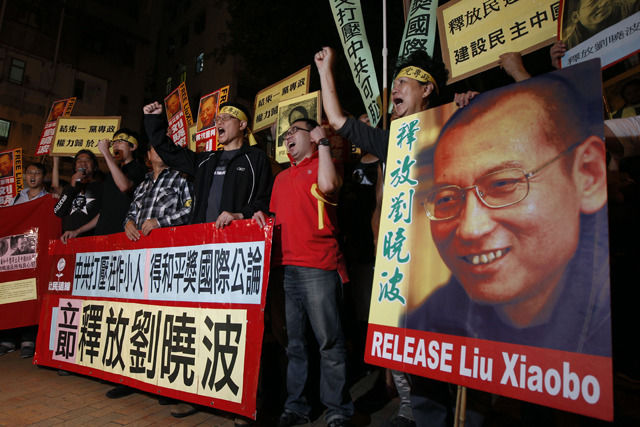
Kin Cheung
BEIJING — Imprisoned Chinese dissident Liu Xiaobo was awarded the Nobel Peace Prize on Friday, a bold stroke that highlighted the economic giant’s continuing repression of free expression — and its toxic distaste for criticism from abroad.
The award came in spite of threats from Chinese officials who attempted to dissuade the judges from honoring Liu, a 54-year-old writer who has remained unbowed in his decades-long fight for freedom of expression and democratic reform. Liu’s writings have brought him lengthy stints in prison, labor camp and house arrest, and have stripped him of the right to publish or teach in his homeland.
“The campaign to establish universal human rights … in China is being waged by many Chinese, both in China and abroad,” Norwegian Nobel Committee Chairman Thorbjoern Jagland said. “Liu has become the foremost symbol for this wide-ranging struggle.”
The Chinese government, which often wields its economic might to quash criticism of widespread human rights abuse, now finds itself in the uncomfortable position of holding a Nobel laureate prisoner. On Friday, defiant officials in Beijing called the award a “blasphemy” and warned that relations with Oslo would be damaged in retaliation, summoning Norway’s ambassador in Beijing to lodge a protest.
“Liu Xiaobo is a convicted criminal who broke Chinese law,” Foreign Ministry spokesman Ma Zhaoxu said in a statement published on the ministry website. “If the Nobel Peace Prize was awarded to such a person, it absolutely disobeyed the spirit of this prize and it is a blasphemy to the prize.”
Liu was most recently imprisoned last year after helping to write and publish a demand for reform that infuriated the Communist Party. Signed by hundreds of critics across China, the now-banned manifesto known as Charter 08 called for an end to single party rule and the establishment of a democracy marked by rule of law and human rights.
Liu was convicted of inciting subversion against the state and trying to overthrow the government, and sentenced to 11 years behind bars. Nine years remain in his sentence.
“The government was using the fist to fight against the tongue,” said Li Datong, a journalist who was among the government critics who signed Charter 08.
As jubilation broke over China’s dissident community on Friday, some observers hoped aloud that the government would be compelled to look for face-saving opportunities to release Liu ahead of schedule.
“We’d like the government to set him free. It wouldn’t even be too bad if they’d let him travel to receive the award and then exile him, like they used to do in the Soviet Union,” said Dai Qing, an outspoken activist and longtime friend of Liu’s who was with him on Tiananmen Square in the 1989 government-crushed protests. “The worst possible outcome is that the government just blames everybody else. That would be really stupid.”
Other supporters were less optimistic.
“I hope that he’d be released earlier because of the prize,” Liu’s lawyer, Shang Baojun, told CNN. “But in reality, that will not happen.”
The award poses a difficult test for a government whose censors have prevented many citizens from even hearing Liu’s name or catching a glimpse of Charter 08.
Having gone so far to stifle Liu, China’s leadership, perpetually sensitive to slights and embarrassment, can’t turn back now, many observers predicted. The public face would remain unmoving, they added, and state media would strive to convince an increasingly nationalistic citizenry that the Nobel committee was indulging in a bout of China-bashing.
“The free-thinking intellectuals will be encouraged. The government will be ashamed. Within their closed circle, the intellectuals will discuss it,” journalist Datong said. “And then people will forget all about it. This is China.”
Still, for many people who have taken risks and paid the price in relative isolation for years, the award came as a stroke of validation from the rest of the world.
“His friends repeatedly told me that they thirsted for Liu Xiaobo to win the prize more than he himself did because they think it would be an opportunity to change China,” Liu’s wife, Liu Xia, told Reuters.
At the very least, the naming of Liu as a Nobel laureate will provoke ordinary Chinese people to find out more about his life — and to take an interest in the document that led to his imprisonment.
There is also some hope that hardliners in the Communist Party will lose ground against their more moderate counterparts as the government comes to understand that its efforts to repress Liu instead turned him into a figure of martyrdom.
China’s anxiety over the Nobel was evident as the announcement drew closer. During the summer, as rumors of the frontrunners began to fly, a senior Chinese diplomat met with Nobel Institute Director Geir Lundestad in Oslo to dissuade him from naming Liu.
China’s Deputy Foreign Minister Fu Ying warned Lundestad that honoring Liu “would pull the wrong strings in relations between Norway and China,” the Nobel official told Norwegian news agency NTB.
It wasn’t the first time China has sent diplomats with warnings, Lundestad added, but the committee would not be swayed.
The arrest of dissidents is a commonplace event in China, often blacked-out by state-controlled media at home and treated with cursory attention by the international press.
(EDITORS: STORY CAN END HERE)
But human rights monitors have long regarded Liu’s case as a crucial test, measuring both Beijing’s tolerance for dissent and the international community’s appetite to challenge their ally or trade partner.
When Charter 08 was published, investigators fanned out to question those whose names had been affixed to the document. Some were placed under house arrest; others were imprisoned.
As for Liu, he was at first held incommunicado, then detained while awaiting trial. During those months, the Chinese government was trying to decide how to proceed, and foreign pressure was badly needed, argues Nicholas Bequelin, a Hong Kong-based researcher for Human Rights Watch.
But foreign governments failed Liu, Bequelin says. He is especially critical of U.S. Secretary of State Hillary Clinton, who visited Beijing during that period — and made plain, in public statements, that the United States was prepared to put human rights on the back burner in the interests of forging better relations with China.
“Our pressing on those issues can’t interfere on the global economic crisis, the global climate change crisis and the security crisis,” Clinton said at the time.
“It was so incredibly damaging. There was a direct link between this statement and the outcome of Liu’s case,” Bequelin said. “The diplomatic community was always unwilling on a certain level to really fight on this case.”
On Friday, President Obama, himself the 2009 Nobel Peace Prize winner, hailed the committee’s selection, saying Liu “has been an eloquent and courageous spokesman for the advance of universal values through peaceful and non-violent means.”
“Over the last 30 years, China has made dramatic progress in economic reform and improving the lives of its people, lifting hundreds of millions out of poverty. But this award reminds us that political reform has not belt pace,” Obama said in a statement released by the White House. “We call on the Chinese government to release Mr. Liu as soon as possible.”
Foreign ministries from nations including France, Germany, Italy and Britain also praised Liu’s selection.
As China’s economic clout grows — it recently dislodged Japan as the world’s second largest economy — Beijing has increasingly used a mix of threats and incentives to press territorial disputes and to keep domestic critics from winning plaudits abroad.
Beijing has blocked invitations to the Dalai Lama, Tibet’s spiritual leader, who last year was denied a visa by South Africa to attend a peace conference. And when a film festival in Melbourne last year tried to show a film about Rebiyah Kadeer, the exiled leader of the minority Uighers, all Chinese films were withdrawn and many sponsors pulled out, presumably fearful of Chinese retaliation.
On Friday, China’s state media avoided mentioning Liu’s honor. Even foreign satellite channels were, at times, abruptly yanked to black. Special sections created to cover the Nobel Prizes were suddenly scrubbed from top Chinese news websites.
But word was getting out, all the same.
“You can bet that right now all over China there are people trying to Google Liu’s name and Charter 08,” said Sophie Richardson, Asia advocacy director for Human Rights Watch. “There is no way they can keep this quiet.”
———
Los Angeles Times reporters Barbara Demick in Donhuang, China, and Janet Stobart in London contributed to this report.
———
(c) 2010, Los Angeles Times.
Visit the Los Angeles Times on the Internet at http://www.latimes.com/
