






REVIEW: ‘Wall Street’ sequel offers big payoff
“Wall Street: Money Never Sleeps,” which borrows its title from a line in the first film, joins “The Godfather: Part II,” “Aliens,” “Terminator 2: Judgment Day” and “Star Wars: The Empire Strikes Back” as one of the great cinematic sequels.
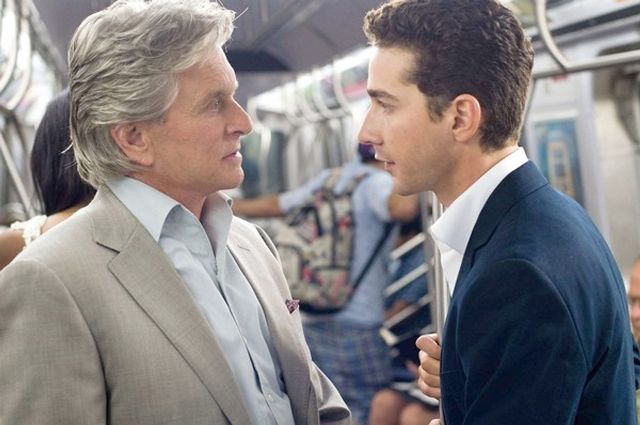
Following an eight-year prison stint for money laundering, racketeering, and securities fraud, Gordon Gekko’s (Michael Douglas) only ambition is to repair his relationship with his estranged daughter Winnie (Carey Mulligan). Behind her back, Gekko forms a relationship with her finance, Jake (Shia LaBeouf), an ambitious young investment banker. While Jake comes to see Gekko as a mentor, he will ultimately learn the hard way that the master manipulator will stop at nothing to achieve his goals.
“Wall Street: Money Never Sleeps” opens in 2007, just before the housing bubble bursts. (This time around, insider trading is soooo Martha Stewart). “Someone reminded me that I once said that greed was good,” Gekko tells a gathering of college students at a book reading. “Now it seems it’s legal.” The film keeps most of the historical facts, changing the names of those involved. Lehman Brothers becomes Jake’s employer, Keller Zabel. Generally, when recent history is dramatized, it elicits knowing laughter from the audience. Not so here. Rather than chuckle, we wince. Like Stone’s 2006 film, “World Trade Center,” the events are too recent and too painful for us to do otherwise. Don’t worry if you don’t understand all the financial technobabble. This is a character study, not Econ 101. If you can read the emotional cues the film is very good about feeding you, you will know everything worth knowing.
“Wall Street: Money Never Sleeps,” which dances to the same narrative beats as the first film, feels like a genuine continuation of the original story, rather than the parodic spoof some might assume. It is also one of the best directed films of the year. Stone has outdone himself. When scenes call for restraint, he shows dazzling control and self-discipline. When the moment suggests wild abandon, Stone delivers with indulgent, ferocious excess powered by split screens and hyperkinetic, endlessly creative camerawork. He duplicates the iconic look of New York City from the original film, yet turns it on its side, giving it an almost hyperrealist feel.
Much credit for the film’s success is due to Michael Douglas reprising his most iconic role. When we first see Gekko, he is being discharged from prison. After collecting some amusingly antiquated personal effects (like a mobile phone the size of a brick), he finds no one waiting from him outside the barbed wire fence. Gangsters get limousines but the once great Gekko can only hail a cab. He is a humbled and forgotten man (and against our better judgment, our hearts go out to him). The sophistication money once purchased is gone. His edges are no longer polished. He’s let himself go just a bit. He was clearly broken and put back together in such a way that the pieces don’t all fit together quite right. On the outside looking in without power or wealth, his life becomes about influence—he takes on the role of the sage at the top of the mountain, the master in search of an apprentice. He’s lost everything but his brains and quite possibly his hunger for the game. He may be a dinosaur, but even old dinosaurs have teeth. Winnie alone suspects her father. He doesn’t fool her, even when he is clearly fooling us. In the end, Gekko remains someone we love to hate. Or is it hate to love?
“Wall Street: Money Never Sleeps” reviles in much less debauchery than first film—there are no drugs and meaningless sex, though one has the feeling they are available if one wants them. The film doesn’t possess the same sort of naked ambition. This is mainly because Jake has more heart and a stronger moral center than his cinematic predecessor, Bud Fox. (Charlie Sheen has an awkward yet revealing cameo). It is enjoyable watching Jake move through scenes with supreme confidence. He is further along in his career than Fox was and has long since expunged most of his diffidence, insecurity and kissass. He is in a committed relationship and already doing well for himself; there is far less need for seduction as there was in the first. Here the mentor lures with the promise of knowledge not raw power or cold hard cash. It’s good to see LaBeouf acting against something other than a giant CGI robot. With “Money Never Sleeps,” he proves at last that those who retained their faith him, despite a string of regrettable films, did it with good reason.
At its center, “Money Never Sleeps” is a revenge story, though its moral seems to be little more than all this has happened before and it will all happen again. These are sobering words given the current economic collapse, as well as the disposition of Gekko himself. The end of the film feels rushed and far too tidy, though perhaps this is a Stone in-joke, a warning to his characters. “I will not sting you,” assured the scorpion to the fox when asking for a ride across a swollen river. But of course, halfway across the water, the scorpion impaled his spiked tale into the fox’s flesh. When the dying fox asked why he would do such as thing, the scorpion replied, “I can’t help myself. It’s my nature.”
GRADE: A-
Directed by: Oliver Stone
Starring: Michael Douglas, Shia LaBeouf, Frank Langella, Carey Mulligan, Josh Brolin, Susan Sarandon, Eli Wallach
Rated PG-13 for brief strong language and thematic elements.
Running Time: 127 minutes
Photo by