






SHRIMP SMARTS: How to buy and prepare America’s favorite seafood
Look below story for: • more about choosing and using shrimp • recipes
America’s favorite seafood? Shrimp. It’s easy to see why; shrimp are available fresh or frozen, shell-on and peeled, raw and cooked. Shrimp lend themselves to countless dishes, from curries to gumbos to kebabs to stir-fries.“Mom and I loved shrimp,” celebrity chef John Besh recalls in “My New Orleans,” a combination cookbook, memoir and tribute to Louisiana’s food culture. “Dad enjoyed them but Mom and I loved them, just because they are so easy to cook.”Louisiana is the major source for domestic shrimp. The state’s shrimp industry was socked hard by hurricanes Katrina and Rita in 2005, as Besh noted in his book (written before the oil-spill disaster in the Gulf of Mexico), and has been battered by cheaper foreign competition.For Besh and others, shrimp is more than a food; it’s a way of life.“It’s not just the critters we need to protect here but also the spirit of our shrimping community,” Besh wrote.The region’s shrimpers are the equivalent of the family farm to Besh. “In our neck of the woods, that means everything,” he said in a telephone interview.Besh, whose restaurants include August, Luke, Domenica and Besh Steak, is not the only New Orleans chef gung-ho on the local product.“I think it’s important to know where the shrimp are from because I personally think the Gulf shrimp are the tastiest and the best,” said Susan Spicer, who, as chef/owner of Bayona restaurant, has made a reputation for using underused and underappreciated fish species on her menus.In terms of having environmental cred, wild and farmed shrimp from the United States and Canada get the nod from the Monterey Bay Aquarium’s Seafood Watch program. Seafood Watch recommends avoiding shrimp from other countries.Which shrimp is which? Consumers should ask at restaurants and retail outlets, said Sheila Bowman, outreach director for the California-based program. “The seafood supply chain has good information available that will tell you how it was caught, where it was caught,” she said. “If a restaurant or a retailer can’t tell you, it’s because they haven’t made it a priority to understand or know about the information.”“Not all shrimp are created equal,” Besh insisted. “Domestic shrimp are much more scrutinized. Take the Gulf of Mexico for instance, where the shrimping season has just begun.Never have there been waters more controlled or tested on such a regular basis.“They are making sure shrimp caught in these waters are not polluted.”Of course, as the Gulf situation keeps unfolding new advisories or warning could be issued.Spicer relies on a shrimper who goes farther west in the Gulf of Mexico, near Morgan City, La., to get shrimp.“He delivers several times a week — which means he shrimps all night, then drives back to New Orleans and delivers to his restaurants all morning and afternoon. I don’t know when the guy sleeps,” she said.Spicer likes using the Gulf’s brown and white shrimps.“I usually use a 16-20 count, which means there are between 16 to 20 shrimp per pound,” she said. “If the shrimp are headless, a count of 21-25 is a good size. The smaller the number, the bigger the shrimp and the higher the price.”Besh uses both the brown shrimp, which tends to arrive at the market in May and June, and the larger white shrimp, which can be found from August onward. While larger shrimp are more popular, they also pose somewhat of a challenge.“They’re more prone to be tougher and chewier,” he said. “If you go for medium-sized shrimp they’ll be more forgiving and, frankly, there’s sometimes less of that iodine flavor.”Whatever shrimp you buy, make sure to enjoy them to the max and showcase them for all their worth. For, as Bowman notes, the best way to treat the world’s shrimp population may be not to eat them so often but to relish them more.“We have this all-you-can-eat-shrimp mentality,” she said. “Shrimp is not a commodity that can withstand that kind of demand. We have to rethink overeating seafood like the salmon, tuna and shrimp that we love. We’re loving them to death.”
HOW TO BUY SHRIMPNew Orleans chef John Besh offers tips on what to look for.Color: Dark brown heads, legs or tails can mean old shrimp. The color should be light, “almost transparent in a way,” Besh said.Timeframe: Use fresh shrimp immediately, if possible, or within a day.Look: Whole, fresh, head-on shrimp should still have antennae attached; shrimp without them were likely frozen.Smell: Shrimp should smell fresh and briny from the sea. Perform a “sniff test” at the counter, most stores will allow it.Shells: Buy shrimp with the shells still on; use them to make a shrimp stock for use in recipes. Fresh or frozen: Frozen shrimp can be as good as fresh according to Besh. He prefers shell-on shrimp because they’re less prone to freezer burn. He also prefers to thaw the shrimp when he’s ready to use them, rather than buy thawed shrimp at the market.Precooked: Avoid precooked shrimp. You are at the whim of someone else cooking your food.Ralph Brennan’s New Orleans Seafood Cookbook
‘GREEN’ SHOPPINGStumped about what type of shrimp is the most environmentally sound choice? For more information on shrimp and other sustainable seafood choices: montereybayaquarium.org.Also available online is a pocket-size Seafood Watch guide for your area of the country.
Best choices• Freshwater prawnU.S. farmed — also known as giant river prawn, Malaysian prawn• Pink shrimpOregon wild-caught — also known as bay shrimp, cocktail shrimp, ocean shrimp, salad shrimp, ebi• ShrimpU.S. closed systems, inland ponds — also known as Pacific white shrimp, West Coast white shrimp, ebi • Spot prawnBritish Columbia wild-caught — also known as prawn, spot shrimp, amaebiGood alternatives• Northern shrimpU.S., Canadian Atlantic Ocean wild-caught — also known as bay shrimp, cocktail shrimp, salad shrimp, ebi• Rock shrimp U.S. wild-caught• ShrimpU.S. open systems — also known as Pacific white shrimp, West Coast white shrimp, ebi • ShrimpU.S. Gulf of Mexico and South Atlantic wild-caught — White shrimp, brown shrimp, pink shrimp, rock shrimp, ebi• Spot prawnU.S. Pacific wild-caught — also known as prawn,spot shrimp, amaebiAvoid• ShrimpSteer clear of all imported shrimp, whether farmed or wild-caught — also known as black tiger shrimp, tiger prawn, white shrimp or ebiMonterey Bay Aquarium Seafood Watch program
HOW TO PEEL SHRIMP1. Twist off head if present.2. Pull off small legs running down underside of shrimp.3. Peel off shell with your fingers. Start at the top; work your way back to the tail.4. Take off the “fan” of the tail, if you wish. Pinch or cut the “fan” and pull the shrimp gently away.5. Devein large shrimp by running a sharp knife down the back. Pull out the dark vein. Rinse the shrimp with cold running water; drain.BY THE NUMBERSNames can change, but numbers are immutable when it comes to buying shrimp. The “count” tells you the size of what you’re buying. It is based on the number of shrimp (sans heads) per pound often written on packaging and store signs.• 10-12 Colossal• 11-15 Jumbo• 16-20 Extra-large• 21-30 Large• 31-35 Medium• 36-45 Small• 46-100 MiniatureGULF SEAFOOD SAFE, fda saysThe BP oil spill in the Gulf of Mexico is a major environmental disaster that has left chefs, consumers and experts wondering and worrying over the region’s rich aquatic bounty. While a survey by the University of Minnesota’s Food Industry Center found 44 percent of respondents wouldn’t eat seafood from the Gulf, others are consuming it while keeping a watchful, waiting attitude.The U.S. Food and Drug Administration says on its website that the Gulf situation and its impact on seafood safety are being closely monitored.“Although crude oil has the potential to taint seafood with flavors and odors caused by exposure to hydrocarbon chemicals, the public should not be concerned about the safety of seafood in stores at this time,” the FDA noted. “Fish and shellfish harvested from areas unaffected by the closures are considered safe to eat.”Chefs Collaborative, a Boston-based national network of chefs working on sustainability issues, has advised members to continue supporting Gulf fisheries.While a huge quantity of oil was spilled, John Besh, the New Orleans-based restaurateur, said most people don’t realize just how big the Gulf of Mexico is.“The spill happened 45 miles offshore in water over 1 mile deep,” he said. “That’s not where the shrimping is done.”“A large portion of the fisheries is not affected,” Besh said. “We need to spread the message the food here is good to eat.”
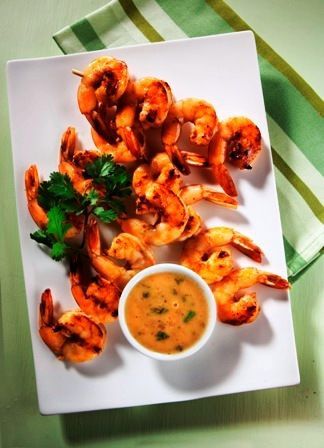
GRILLED SHRIMP WITH CORIANDER SAUCE—Yield: 4 servings
SHRIMP2 tablespoons olive oil1/4 teaspoon ground coriander, divided1/4 teaspoon salt, divided1/4 teaspoon each chili powder and ground red pepper16 medium shrimp, peeled, deveined and tails left on
CORIANDER SAUCE1 shallot, finely chopped1/2 cup white wine1/2 teaspoon grated orange zest1/4 cup orange juice2 tablespoons sherry wine vinegar1/2 teaspoon ground coriander5 tablespoons butter, softened2 tablespoons chopped cilantro1/4 teaspoon saltFreshly ground pepper, to tasteProcedure:1. For shrimp, combine olive oil, coriander, salt, chili powder and red pepper in medium bowl. Add shrimp and toss. Refrigerate while you make coriander sauce. Soak four 6-inch skewers in hot water.2. For sauce, place shallot, wine, orange zest and juice, vinegar and coriander in small saucepan; bring to simmer over medium heat. Cook until liquid is reduced to about 3 tablespoons, about 20 minutes. Whisk in softened butter by the spoonful until sauce is emulsified and creamy. Stir in cilantro; stir in remaining salt and pepper, to taste. Keep warm.3. Prepare grill broiler for high heat. Thread four shrimp onto each skewer. Grill or broil shrimp until just cooked through, 2-3 minutes per side. Drizzle with sauce.Susan Spicer, of Bayona restaurant in New Orleans
GARLIC LEMON SHRIMP—Yield: 6 servings
CITRUS VINAIGRETTE1/2 cup chopped fresh Italian parsley3 tablespoons each freshly squeezed lemon juice and key lime juice2 tablespoons finely chopped fresh garlic1 1/4 cups extra-virgin olive oil1/4 teaspoon salt1/8 teaspoon black freshly ground pepper
SHRIMP1/4 cup olive oil30 jumbo shrimp, peeled and deveined1/2 teaspoon each salt and freshly ground black pepper3 lemons, halvedProcedure:1. For vinaigrette, mix parsley, lemon and lime juices and garlic in large bowl. Gradually add olive oil in a thin, steady stream, whisking constantly until all is incorporated and mixture looks creamy. Whisk in salt and pepper. Refrigerate overnight in covered container.2. For shrimp, heat olive oil in large skillet over high heat until just short of smoking, about 2 minutes. Add as many shrimp as possible in single layer. Sprinkle salt and pepper over shrimp. Cook, without stirring, 1 minute. Reduce heat to medium-high; turn shrimp. Cook until pink, about 3 minutes.3. Add 1 1/2 cups vinaigrette to pan. Cook until vinaigrette just begins to bubble and shrimp are barely done, about 45 seconds, moving shrimp around so vinaigrette flows evenly around all shrimp. Remove from heat; let shrimp sit in pan 30 seconds. Pour shrimp and sauce into large, shallow pasta bowl or serving platter. Garnish with lemon halves.“Ralph Brennan’s New Orleans Seafood Cookbook,” by Ralph Brennan
CHARRED CHAYOTE SOUP WITH ADOBO SHRIMP—Yield: 4 servings
2 1/2 pounds chayote squash, peeled, halved and seeded1 tablespoon oil1 3/4 teaspoons salt, divided1/4 teaspoon freshly ground black pepper1 pound medium shrimp, peeled and deveined2 teaspoons sauce from canned chipotles in adobo sauce2 tablespoons unsalted butter2 yellow onions, chopped1 clove garlic, minced1/2 teaspoon ground cumin1/4 teaspoon crushed red pepper1 quart chicken stock or canned low-sodium chicken broth1 tablespoon finely chopped fresh cilantro leavesProcedure:1. Prepare grill or grill pan for medium heat. Combine chayote, oil, 1/2 teaspoon salt and black pepper in large bowl; toss. Grill chayote, in batches if necessary, until slightly charred on both sides, 8-10 minutes per side. Cut into 1/2-inch dice; set aside.2. Combine shrimp, 1/4 teaspoon salt and adobo sauce in bowl. Let stand 10-30 minutes.Heat butter in medium stockpot over medium-high heat. Add onions and remaining 1/2 teaspoon salt. Cook until onions soften, about 3 minutes. Add garlic. Cook, stirring, 30 seconds. Add reserved chayote, cumin and crushed red pepper. Stir in chicken stock; bring to boil. Reduce heat to medium-low; simmer until chayote is tender, about 8 minutes.3. Add shrimp. Cook until pink, about 2 minutes. Remove soup from heat; stir in cilantro. Serve hot.“Farm to Fork — Cooking Local, Cooking Fresh,” By Emeril Lagasse
Grilled Shrimp with Coriander Sauce Photo by MCCLATCHY