






2,457 cars stopped at DUI checkpoints over Labor Day weekend
In this summer’s 100 Days of Heat campaign, in which 84 law enforcement agencies around Colorado stepped up their DUI enforcement, officers caught 293 suspected drunken drivers at sobriety checkpoints.
Colorado Springs police arrested 54 people for drunken driving at checkpoints held on four nights between May 28 and Sept. 4, second to Denver’s 59 drivers arrested during six checkpoints
Colorado State Patrol troopers arrested 1,855 drivers at checkpoints and during patrols between May 28 and Sept. 7, 140 of those in El Paso and Teller counties.
These arrests are a fraction of the 30,000 DUI busts in Colorado every year, but law enforcement officials say the public campaigns are key to educating the public on their no-tolerance stance on drinking and driving.
“When we do a blitz with the media we hope that people do seek alternate (transportation) methods. DUI is an absolute 100% preventable crime,“ said Colorado Springs police Lt. Catherine Buckley, who oversees DUI enforcement in the city.
At the two Colorado Springs police checkpoints Sept. 3, 2,457 cars were stopped and four drivers were arrested. At last year’s Labor Day checkpoints, 1,440 cars were stopped and 19 drivers were arrested.
In 2009, 191 people were killed in alcohol-related crashes on Colorado roads.
While some question the legality of pulling over drivers without probable cause, the U.S. Supreme Court ruled 20 years ago that checkpoints are constitutional in Michigan Department of State Police v. Sitz, in which the defendant claimed checkpoints were a temporary seizure and an infringement on a driver’s privacy, constituting a violation of the 4th Amendment.
The Supreme Court’s reasoning in upholding the constitutionality of checkpoints is that, so long as no one group is targeted, it serves a greater social good to inconvenience and temporarily detain the innocent if there is a chance of taking a drunken driver off of the road, said Professor Alan Chen, who teaches Constitutional law at Denver University’s law school.
The issue is similar to airport screenings, Chen said.
“Police just have to show that the intrusion on people being stopped is minimal,” Chen said.
Sobriety checkpoints are illegal in 11 states: Alaska, Idaho, Iowa, Michigan, Minnesota, Oregon, Rhode Island, Texas, Washington, Wisconsin and Wyoming.
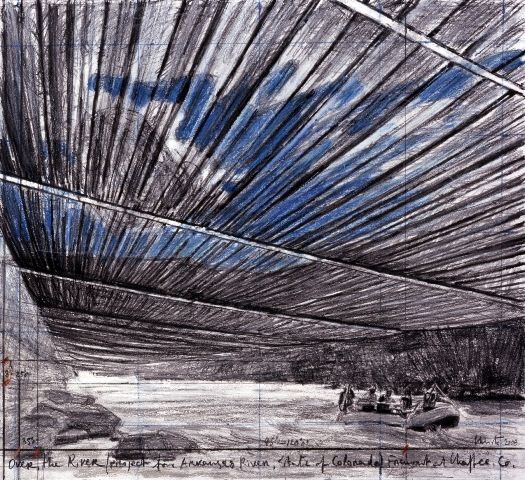
Plans for Christo’s “Over the River” project, which, if approved by the Bureau of Land Management, would be erected over the Arkansas River. Photo by Courtesy of Christo and Jeanne-Claude