






Developer pleads for relief from county fees
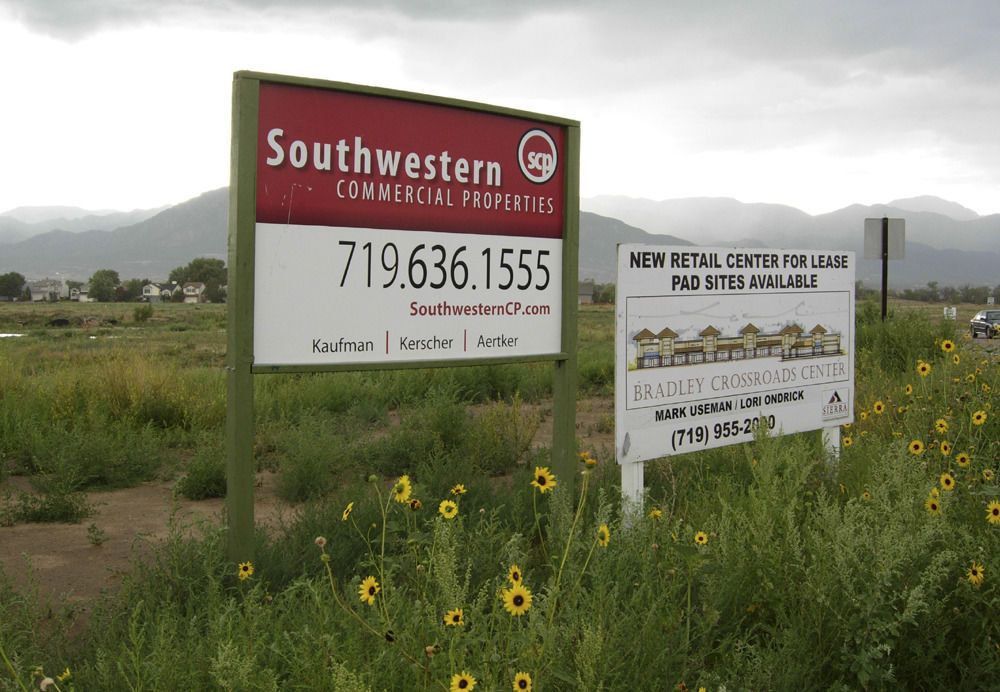
When Brian Schumann, managing member for Bradley Crossroads, an 11.2 acre development in Security, appeared before the El Paso County commissioners this week, he had an all-to-familiar story to tell.
In 2006, his development, located at the corner of Bradley Road and Hancock Expressway, was being touted as a new retail destination for Security’s growing neighborhoods.
Brush was cleared, a road built, other traffic improvements made. Then came the real estate crash. The project stalled, and Schumann said his parcel lost more than 75 percent of its value.
Now, Schumann is ready to begin again. But he says a countywide program that requires developers to pay thousands of dollars in transportation improvement fees may jeopardize his plans.
Schumann is the first commercial developer to be assessed the fees since the interim fee program was approved by the commission in February 2010, county officials confirmed. If all seven businesses planned for his development are constructed, he will have to pay roughly $265,000 , according to a table he provided The Gazette.
At the county commission’s regular meeting Thursday, Schumann asked board members to suspend the fees. “Levying new fees/taxes on new developments, especially in today’s economy, will be the stake that is driven through the heart of every developer that is trying to make things happen in the current real estate market,” he added in a letter.
Pam Cherry, an associate of Schumann’s, also spoke against the fees. “The transportation impact fees are going to stop this project. You won’t have the property taxes, you won’t have the sales taxes and you won’t have the jobs,” she added.The genesis of the transportation improvement fee program began eight years ago when residential developments, big-box stores, gas stations and other retail shops were proliferating in unincorporated areas of the county.
County officials, with developers, began searching for a fair and equitable way to pay for the new roads, curbs, gutters, sidewalks, turning lanes and traffic lights needed to accommodate the increased traffic. “The principle is that development and new growth should pay for itself,” explained county spokesman Dave Rose.
Eventually, county officials and their counterparts in the private sector came up with the transportation improvement fees, which are based on the total costs of improvements needed for the development divided by the number of trips that the new businesses are expected to generate.
Those trip numbers are determined by the Institute of Transportation Engineers, said Victoria Chavez, the county’s principal transportation planner, in an interview after the meeting. “We literally take them out of a text book,” she said of the trip numbers.
A committee of county officials, landowners, developers and consultants still working out details of the program. An updated fee program is expected to be submitted to the county commissioners by the end of this year.
Schumann maintains that the county is using the fees to build “a pool of money” to construct roads in other parts of the county.
Chavez disagreed. “This is not a way to fund other county improvements,” she said.
“Fees, by law, can only cover and be no more than the improvements on the roads caused by the development.”
Those fees can be considerable. In Schumann’s case, for example, the county wants to assess him $45,000 for a gas station with convenience store; about $22,000 for a self-service car wash, $51,000 for a fast-food restaurant with a drive-through window; $46,000 for a drive-in bank, $31,000 for a mini-warehouse, and $27,000 for another neighborhood commercial business.
The funds, which are due before building permits are issued, will be held in a restricted account. Some of those fees will be refunded to developers such as Schumann if any of the improvements benefit the county’s regional transportation system.
The commission ultimately denied Schumann’s request. “It’s not our job as commissioners to favor one development over another but to ensure everybody is treated fairly,” said Commissioner Wayne Williams.
Added Commissioner Dennis Hisey, “I really want this project to go forward, but it’s important that this board treat everyone the same.”
Photo by