






Some Pueblo, Springs officials not happy about gravel pit vote
A gravel pit that will be located along Fountain Creek has Pueblo officials worried.
“It was a very regrettable decision,” Pueblo County Commissioner Jeff Chostner said of the decision last week by the El Paso County Board of County Commissioners to allow Lafarge, a multinational company, to remove 30 million tons of gravel and sand from an area adjacent to Fountain Creek during the next 15 years or so.
“The vote,” Chostner said, “goes against the spirit of cooperation that Colorado Springs and Pueblo have been trying to cultivate over the last two years.”
Lawrence Atencio, president of the Pueblo City Council, agreed. “That kind of industry on the creek is not a good idea,” he said.
The approval of the gravel pit comes after a years-long effort by some Colorado Springs and El Paso County officials to improve relations with Pueblo that had soured over erosion and pollutants in Fountain Creek.
Pueblo County last year agreed to issue a permit for the $1.4 billion Southern Delivery System water pipeline.
In exchange, Colorado Springs Utilities agreed to spend millions on upgrades to prevent flooding and send less pollutants downstream, including $50 million on Fountain Creek improvements.
“They were reluctant, but willing if we fixed Fountain Creek,” said Richard Skorman, a former Colorado Springs City Council member.
El Paso County Commissioners Dennis Hisey, Amy Lathen and Wayne Williams last week voted to approve Lafarge’s mining request. Commissioners Sallie Clark and Jim Bensberg left before the final vote was taken, saying they had personal business.
The mining, which is not scheduled to begin immediately, will occur on a 514-acre parcel on the east side of Interstate 25 just south of the Pikes Peak International Raceway.
Hisey said it was the commission’s job to first determine whether the mining operation would damage the creek and second, to determine whether the operation would affect neighboring property values.
“They (Lafarge) made a good case that it will have no effect on the creek and opponents couldn’t show harm to the creek,” he said. “They’re not going to mine in the 100-year flood plain. And they’re not going to touch the riparian area where the birds nest and the deer play.”
Hisey also said the gravel pit will not adversely affect neighboring property values, nor the ability of other landowners to pursue their ranching or farming interests.
The pit’s processing center will be almost a mile from the nearest house, he said, and noise levels should not exceed levels found on Interstate 25.
“It’s really not a bad place for a gravel operation,” he said.
In approving the gravel pit, the commission overturned decisions by the Fountain Creek Watershed, Flood Control and Greenway District and the El Paso County Planning Commission. Both governmental entities last fall voted against giving the company a permit to erect an asphalt batch plant or a permit for the mining operation.
Opponents say the gravel pit will be located in one of the most beautiful and stable parts of Fountain Creek and will tarnish plans to make the area into what Ken Salazar, former United States senator and now Interior Secretary, said could be one of the region’s crown jewels. “Sticking a gravel pit in the middle of Fountain Creek is not going to do much to enhance any crown jewel,” said Pueblo’s Atencio.
Officials from Colorado Springs also condemned the commissioners’ vote in interviews this week. Larry Small, Colorado Springs vice mayor who also serves on the Fountain Creek District board, said he was both surprised and disappointed. “We felt a gravel pit was inconsistent with strategic plans,” he said.
Even though Lafarge officials have said they will build a slurry wall to keep contaminants from escaping into the creek, Small said members of the Fountain Creek board weren’t convinced. “We were worried about residual discharges and risks to wetlands and wildlife.”
Skorman, said the three commissioners were thinking only of short-term gains. “Jobs are important. Gravel’s important. But to take an area and sterilize it for decades is short-sighted.”
The decision came down to a balancing act, Hisey wrote in an email. “The final conclusion of the three commissioners remaining at the end of the hearing was that not allowing the gravel operation to go forward would violate the rights of that landowner far more than what we perceived to be minimal impacts to the neighbors,” he wrote.
“This is one of those votes you cast knowing that it will be years before the verdict is in on whether your assessments were correct, and by then there is no turning back.”
—Call the writer at 476-4825.
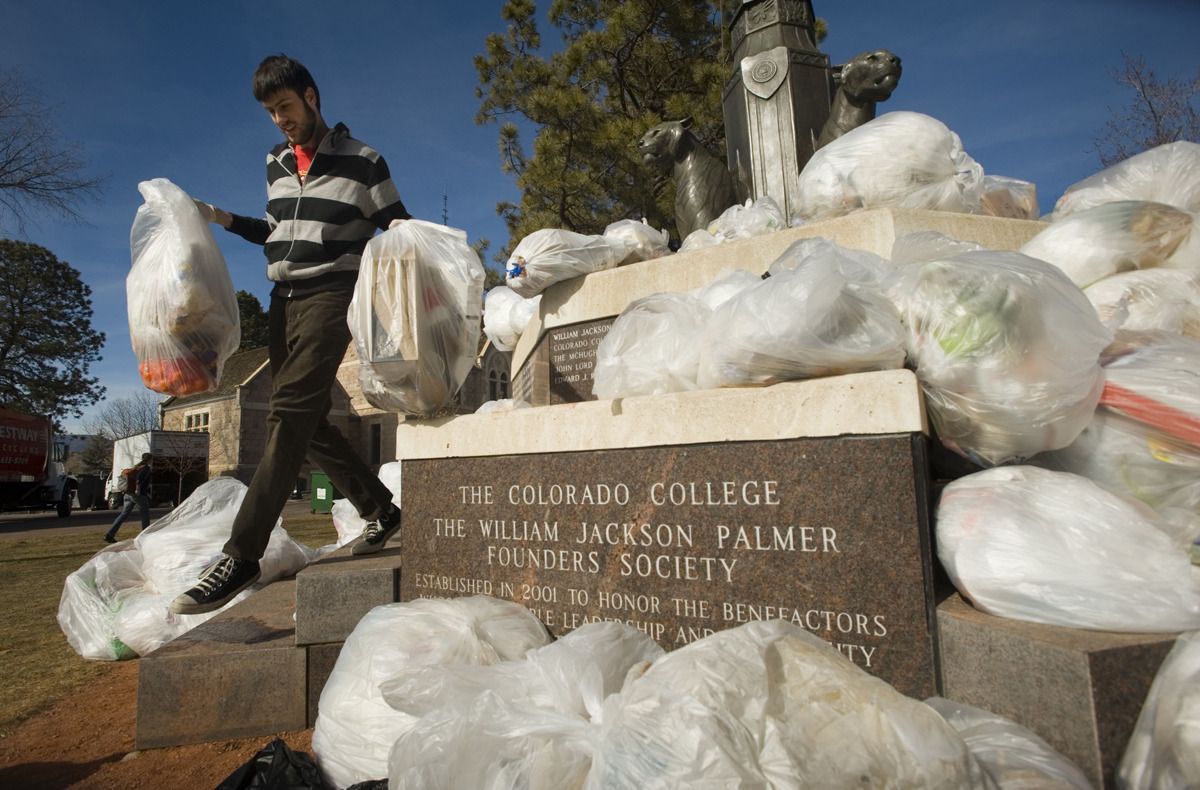
Colorado College senior Alex Wick pulls a bag from a giant pile of garbage surrounding the school’s flagpole Tuesday, February 2, 2010 during a project aimed at promoting recycling. CC’s office of sustainability placed one day’s worth of campus trash there and students sorted through the bags to remove and display items that should have been recycled. Awareness events like this have helped raise the campus waste diversion rate from 15 percent to more than 45 percent. Photo by Mark Reis, The Gazette. Photo by MARK REIS, THE GAZETTE