






Local docs head for Haiti: ‘They’re either going to die, or somebody is going to help them’
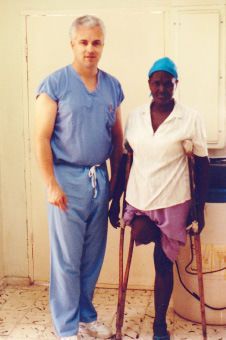
Dr. Steven Foley, a Colorado Springs gynecologist, usually spends his days treating women in comfortable, well-equipped exam rooms at his Nevada Avenue practice.
For the next week, he will most likely be amputating gangrenous arms or legs in a school yard.
Foley left for Haiti today with a team of 15 doctors aboard an Amway plane to provide medical care and supplies for earthquake victims.
“Amputations aren’t exactly my specialty,” he said earlier this week, as he packed to leave Colorado Springs for Grand Rapids, Mich., where the relief flight was to depart, “but if you’re a surgeon, you’re a surgeon. They’re either going to die, or somebody is going to help them.”
Foley and his wife, Dr. Diane Foley, also a gynecologist at Advanced Gynecology, have provided volunteer medical care in Haiti annually for about 20 years. Diane Foley, who is not accompanying him on this trip, grew up on the island in a missionary family.
Haiti’s health care system has always been bad, but Foley expected no previous work in the Third World would compare to what he was about to take on — lines of victims with crush injuries and open wounds and no decent place to treat them.
“What little health care they had has been destroyed,” he said.
He’s not the only area doctor to reschedule patients in order to catch a flight to the disaster zone.
Dr. Brian Crawford, an emergency medicine specialist at Penrose Hospital, flew out Wednesday with an emergency response team from International Medical Corps. He said he will be in Port-au-Prince working on treating traumatic injuries, wound care, fighting infectious disease, and helping with chronic diseases.
Crawford said the collapse of the Haitian health care system means even the more mundane diseases such as diabetes, malaria, measles and pneumonia are causing deaths because they’re going untreated. And chronic underlying conditions in Haiti, like malnutrition, make the situation worse.
Crawford is unusually qualified for the mission, with a master’s degree in public health and a fellowship in disaster medicine. He went to Asia in the aftermath of the 2004 tsunami that killed tens of thousands, so he’s seen mass death and devastation before.
“The most difficult aspects are the logistics, getting supplies in and out, coordinating aid. Even good intentions can make the situation worse,” he said. After the tsunami, he recalls heavy trucks sent in to help that ended up cracking water pipes with their weight and further damaging the water sanitation system. “It’s a fine act to try to make this go well. It’s a chaotic situation to begin with.”
But the best part, for him, is the people he treats.
“The people are very gracious, very appreciative,” he said. “It really lets you get back to the simple things — food, shelter, water, family and friends.”
“Also, I was amazed how resilient children are in the situation as well. They’re able, despite all their injuries and medical problems, to remain positive.”
A Pueblo doctor, Dr. Jim Smith, arrived in Haiti several days ago and has been blogging about his experiences at http://health4haiti.wordpress.com.
“We’re doing 30 amputations per day here,” he wrote in a blog post Wednesday. “Limbs that have now become gangrenous. Running out of sterile gowns and drapes for surgery, casting materials, iv fluids, antibiotics, bandages, and drinking water.”
Foley, Crawford and others are sure to be put to good use. The Associated Press reported today that patients are dying of sepsis and untreated wounds. Dr. Greg Elder of Doctors Without Borders said, according to AP, that some clinics have a backlog of patients up to 12 days.
—
Call Newsome at 636-0198. Visit the Pikes Peak Health blog at www.pikespeakhealth.freedomblogging.com and the Gazette’s Health page at Gazette.com/health
Dr. Steven Foley, a Colorado Springs gynecologist, with a Haitian woman who he treated during one of his previous trips to the country. Photo by Special to The Gazette