






Troubled teens get straight talk from ex-con
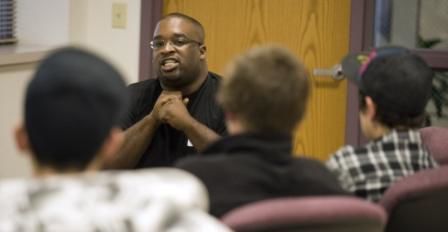
Tillman Clifton sits down with eight teenagers in a room in Colorado Springs municipal court.
The kids, who range in age from 13 to 17, have been sent here by Teen Court for offenses ranging from shoplifting to fighting to marijuana possession.
They look like there are plenty of places they’d rather be. Two brothers slouch in their chairs, never taking off their coats. A young girl sits anxiously on the edge of her seat. One boy, sitting the farthest away, is wearing a pair of woolen gloves. He swivels his chair constantly.
But when Clifton starts to speak, the youngsters seem riveted on every word as the 35-year-old ex-convict and former Chicago gang member tells them his life story as part of a program called “Straight Talk.”
He tells them his mother was a crack addict. He and his brothers and sisters went to live with her after their parents split up.
“We had Christmas 12 times a year — at the beginning of each month when the food stamps came in,” he explains. On those days, his mother would bring back buckets of Kentucky Fried Chicken and videos.
By the end of the month, the kids learned to beg food from neighbors, he said.
When a friend was badly beaten by a drug dealer, his friends started walking the streets in twos and threes for protection. When they got a chance to inflict payback on the dealer, they took it.
“So before we realized it, we had become a gang. We weren’t just a group of friends anymore,” he said. “We quickly forgot what we had started for and became what we didn’t want to be.”
Before long, they were the ones stealing cars, selling drugs and moving from juvenile hall to jail and then to prison.
He talks about his first car theft, a heist that backfired when they got caught in a brief high-speed chase that ended when they crashed what had been a police dispatcher’s car.
He talks about his last car theft — the one where the buyers turned out to be federal agents who were busting a southern Illinois chop shop for stolen car parts.
He concludes by telling them how he watched the Sept. 11, 2001, terrorist attack while in jail on a misdemeanor warrant. As he watched the World Trade Centers collapse, he realized there was no way he could serve his country, not with the long arrest history he had accumulated by then.
“You guys are lucky, because you’re here,” he tells the group. “A lot of you haven’t seen handcuffs and fingerprints yet – congratulations.”
In between telling his life story, Clifton — who goes by the nickname “Cliff” — asks the kids about their crimes, drug use and how it has affected their relationship with their parents.
He warns them not to make the mistake of believing they can just stop doing what they’ve been doing when they turn 18. It doesn’t work that way, he said.
“You screw up the rest of your life, which is kind of what I did,” he said.
Today, Clifton is married with four kids. His family moved to Colorado Springs so he could study to become a minister. His wife Carrie is studying to become a youth counselor.
His wife volunteered him for this new role of telling his story to teen offenders. Teen court officials had approached Carrie, who manages a store at The Citadel mall, to take part in a panel that talks to kids about the impact of shoplifting.
You should hear my husband’s story, she told them. His first talk drew a packed house. He’s been doing it ever since — once a month — two sessions per night.
With some kids, Clifton said it’s clear he’s not getting through — like the youngster who complained that the 90-minute session cost him $60 plus a basketball practice.
But then there are others, like the boy in foster care, who broke down and started crying during the session. Kids like that give Clifton hope that he’s making a difference.
Others seem to think so too. At a recent Teen Court breakfast, officials surprised Clifton by presenting him with one of their top volunteer awards.
In a banquet room filled with judges, prosecutors and the attorney general of Colorado, Clifton said he was feeling uncomfortable. The award caught him completely off-guard.
“While I appreciate what Teen Court did, I don’t feel I’ve done anything to deserve an award,” Clifton said. “I’ve done a lot of wrong in my life and I think that for me to talk to these kids is enough.”
“If I can stop one of these kids from going out there and doing something, I kind of feel like it makes up for one of the victims for whom I caused pain and suffering.”
Tillman “Cliff” Clifton talks to young offenders at Colorado Springs Municipal Court Monday, November 9, 2009, about the night at age 13 when his mother, a crack addict, choked him with a bicycle chain. He spoke with the teens about his early life of crime and his years in juvenile hall, jails and prison. Photo by Mark Reis, The Gazette
