






AFA football: Defense has advantage with strong cornerbacks
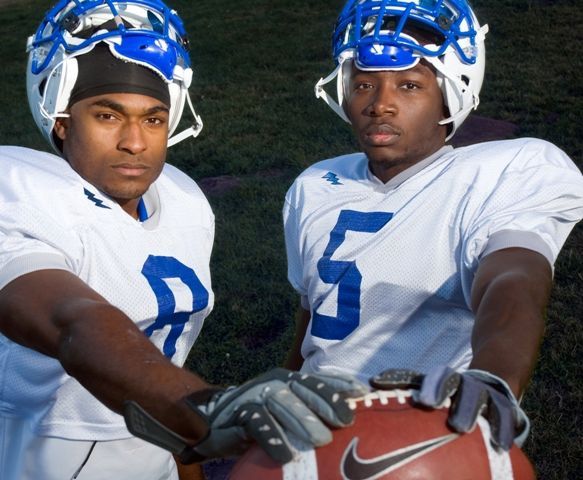
Air Force cornerbacks Reggie Rembert and Anthony Wright Jr. have provided big plays, touchdowns and turnovers for the Falcons this season.
But perhaps more importantly, they’ve given their coaches uncommon luxuries.
Starting a pair of good cornerbacks on the football field is like pulling two pawns off a chess board and replacing them with two rooks. Not only are you immediately less vulnerable, but you have far more strategic options.
“When you have corners that you feel really good about being able to at least match up reasonably with (the opponent’s) two best receivers, it completely changes the way you play,” said coach Troy Calhoun, whose Falcons play host to Wyoming at noon today. “It gives you the flexibility to play snug on receivers, and it gives you flexibility when you play zone coverage, too.”
Individually, Rembert, a 5-foot-8 junior, and Wright, a 5-10 sophomore, are two of the most athletically gifted cornerbacks who have been at the academy in some time.
Together, their value to the defense and those coming up with its schemes increases exponentially.
“Since I’ve been back (at Air Force), and most places I’ve been, you have one kind of a lock-down corner and the other one you kind of try to hide,” defensive coordinator Tim DeRuyter said. “We don’t have to hide either of these guys.”
Nor do they want to be hidden.
“Both of those guys are not out there saying ‘I hope they don’t throw it my way,’” secondary coach Charlton Warren said. “They’re both saying, ‘Coach, what side of the field can I be on that they’re throwing to the most.’ They both want the ball thrown their way.”
Both Rembert and Wright are fast (Rembert finished seventh in the 60-meter dash at the Mountain West Conference Indoor Track Championships). Both have good technique (Wright is known for studying videos of pro cornerbacks). Both can read receivers’ routes and anticipate passes. And both possess good enough ball skills that they could play receiver.
But perhaps most importantly for cornerbacks, they play, according to DeRuyter, “with a swagger.”
“I think if you have that mentality, ‘I’m better than this person, I’m going to whup him the whole game,’ I think it will definitely pay off,” Rembert said.
“You need to let the receiver opposite you know that he’s in for a game,” Wright added. “That you showed up to play.”
Wright and Rembert have shown up so far this season for an Air Force defense that leads the MWC and ranks fifth in the nation against the pass (150 yards allowed per game).
Wright has picked off three passes (tied for second in the MWC), two of which he has returned for touchdowns. He also has made 30 tackles (third on the team), including two for losses.
Rembert, despite missing the first two games because of a suspension, has picked off two passes, forced two fumbles and recovered two others, including one he returned for a score.
The corners will need to be playing their best in the second half of the regular season. Four of the Falcons’ last six opponents, including Wyoming, play some version of the spread offense. And one of the other two, Colorado State, throws the deep ball as well and as frequently as any team in the MWC.
But with Rembert and Wright, there is more hope than in the past that the Falcons can hold high-powered passing offenses in check.
“These guys are really, really good,” senior safety Luke Hyder said. “And that’s huge for us to be able to run man coverages and be able to leave them out and trust them to play the way that they can.”
Air Force has a “really good” cornerback duo in Reggie Rembert, left, and Anthony Wright Jr. Photo by KEVIN KRECK, THE GAZETTE