






10 adventures close to home
I’m standing at the water’s edge at Eleven Mile State Park. Stark white gulls wheel overhead, squirrels chatter from the depths of ponderosa pines, and waves lap at the gravel shore.
I’m only a mile from where I parked my car and about 25 miles from home, but the cove, with a backdrop of granite boulders and a sweeping view of a tiny island in the water, feels like it’s a world away from civilization.
This is a backcountry campsite at Eleven Mile, where you can hike in or float in on a boat. The concept of boating to a cove for some overnight camping is a kind of Lake Powell thing, but here you can do it without the long drive and the exorbitant houseboat rental prices.
The breeze blows, and a white pelican floats gracefully over the water as I consider my luck at finding this place deserted on a sunny early-summer morning.
Colorado is a land of recreational opportunity and natural wonders that still can surprise me after living here almost 30 years. And the more I explore, the more I ask myself: Why would I ever want to leave?
Intrigued with the Sahara Desert? Visit Great Sand Dunes National Park. Never going to make it to the Great Wall of China? Walk across the Royal Gorge Bridge. Got a Stonehenge fantasy? Marvel at the natural granite castles in the Lost Creek Wilderness. Dream of a stay at storied Everest Base Camp? Plan an expedition up Pikes Peak with a stop at Barr Camp.
To pay homage to Colorado and help you save your adventure dollars, we are offering this list of ways to have world-class experiences in your backyard.
1. Who needs a giant houseboat?
Take your boat and cruise to your backcountry site at Eleven Mile State Park.
The park surrounds a sprawling 3,400-surfaceacre reservoir on the South Platte River. The lake is stocked with kokanee salmon and cutthroat and rainbow trout, with northern pike and carp in the shallow inlets. The backcountry campsites are tucked in pockets of trees and rocks along the water.
Cost for one of 25 backcountry camping sites is $12 a night. The folks at Eleven Mile Sports and Marina will transport all your camping supplies to a backcountry site for $40; all you have to do is walk there, gear-free.
The park and reservoir are six miles south of Lake George. For more information, call the park at 748-3401 or visit parks.state.co.us. For the marina, call 748-0317 or visit www.11milesports.com.
2. Also grand
Grand Canyon National Park is impressive, but if you don’t have the time or money to get there, a trip to Black Canyon of the Gunnison National Park will elicit just as many “oohs” and “aahs.”
Dark crystalline rock gives this canyon a more menacing look than the red- and orange-hued Grand Canyon. Combine the Black Canyon’s depth, 2,722 feet at the deepest point; width, just 40 feet from rim to rim at one point; and length, 48 miles, and you have a memorable dark slash through the landscape outside Montrose.
The canyon divides the state’s southern Rocky Mountains on the east from the Colorado Plateau on the west and has the highest cliff in the state — Painted Wall, with a 2,240-foot vertical rise.
Activities there: camping, picnicking, technical climbing, hiking, sightseeing. For more information, call 1-970-641-2337 or visit www.nps. gov/blca.
3. Get your ocean fix.
Find the right spot in the Curecanti National Recreation Area, and you would swear you were gazing at the ocean. The area contains three reservoirs — 26-mile-long Blue Mesa, Colorado’s largest body of water; Morrow Point, where the Black Canyon of the Gunnison begins; and Crystal, the site of the Gunnison Diversion Tunnel.
Activities include camping, fishing, boating, hiking, exploring a 5,000-acre archaeological district, a narrow gauge train and remains of 6,000-year-old dwellings. Swimmers who feel like braving the water (surface temperatures rarely exceed 65 degrees) should head for the Bay of Chickens, 1.2 miles west of Elk Creek; Dry Creek, 1 mile east of Elk Creek; and Old Highway 50 beach, adjacent to the Elk Creek Campground.
For information, call 1-970-641-2337 or 1-970-641-2337, ext. 205, or visit www. nps.gov/cure.
4. Destination: Base Camp
Sure, Mount Everest has a certain cachet, but most of the adventurers who travel to Nepal never make it past base camp, so why not re-create that experience here?
Like Mount Everest, Pikes Peak is one of the most wellknown mountains in the world. It’s not the highest peak in Colorado, but it offers something most of the other mountains here don’t — a camp along the way.
Barr Trail takes hikers 12.7 miles from Manitou Springs to the summit of Pikes Peak. The camp, built in the 1920s, is about halfway up. More than 20,000 people visit it each year, some stopping by for a water break or shelter and others staying overnight in the bunkhouse-style main cabin, a private cabin, lean-to or tent sites.
The camp is a great spot for resting or people-watching, and the deck on the main cabin offers a great vantage point for watching activity on Barr Trail.
For more information, visit www.barrcamp.com or e-mail barrcamp@direcway.com.
5. Dune dynasty
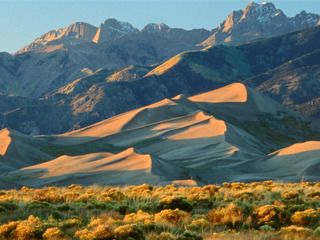
You say you’ve always wanted to test your stamina on the great sands of the Sahara? Do a test drive in Colorado first. The Great Sand Dunes National Park & Preserve features tawny dunes that cover 30 square miles and reach more than 700 feet into the sky. For contrast, there’s a backdrop of snow-capped mountains, the Sangre de Cristos.
The Great Sand Dunes offer miles of sandy hiking. Trails aren’t marked because the surface is always shifting, but that also means park officials don’t have to worry about erosion. Take your shoes if you’re planning a walk — the soft sand can be a toeblistering 140 degrees on the surface.
Hike to the top of Star Dune and you’re standing on the highest sand mountain in North America (750 feet from base to top); that hike is about 5 miles.
Activities in the park include hiking, swimming (in the early summer, when Medano Creek swells with snowpack melt), camping, picnicking and four-wheeling.
For information, call 1-719-378-6300 or 1-719-378-6399 or visit www.nps.gov/ grsa.
6. You say wall, I say bridge.
Sure, the Great Wall of China was built more than 2,000 years ago. But the Royal Gorge Bridge spans a canyon that drops 1,053 feet to the Arkansas River below. Sure, the wall stretches almost 4,000 miles, but it’s in China and it’s so stationary. The Royal Gorge Bridge, a classic suspension design with a wooden surface, rolls and sways in the breezes that move through the gorge, creating just enough stomach turning to keep it exciting.
Activities include a trip across the bridge by car or by foot, the world’s largest singlespan aerial tram, the world’s steepest incline railway and a Skycoaster that rivals anything at any amusement park.
For information, call 1-888-333-5597 or visit www.royalgorgebridge.com.
7. Sticks and stones
It is thought that the mysterious ruins known as Stonehenge in southern England were a work in progress for more than 1,400 years.
The rock cities and castles that lie in Pike National Forest were millions of years in the making. The Tarryall Mountains are made of eroded and wind-sculpted granite spires and walls of pink Pikes Peak granite. To see a colossal collection of house-sized boulders and slabs, take the Goose Creek Trail down along the creek for about four miles.
To get to the trailhead: Take U.S. Highway 24 west to Woodland Park; Colorado Highway 67 north to Deckers, and County Road 126 north from there. Watch for the Goose Creek sign along the road, turn left and follow signs up to the trailhead.
8. Which came first, Machu Picchu or Mesa Verde?
Actually, the ancient Puebloans were living in their cliffside dwellings from 600 A.D. through 1300 A.D.; the Incans in Peru didn’t get their city going until about 1460.
Both offer unparalleled views of ancient cultures; Mesa Verde is a collection of elaborate stone villages built into the canyon walls. The cliff dwellers thrived in the area, but the mystery remains: Why did they vanish within one or two generations in the late 1200s?
Ponder the mystery and explore Mesa Verde on your own or with a tour guide. Activities include hiking, camping, sightseeing, nature walks, and wildlife and bird watching.
For information, call 1-970-529-4465 or visit www. nps.gov/meve.
9. Just thru-hike it
Hiking the Appalachian Trail is an epic adventure that attracts thousands of people a year. Just up the road from Colorado Springs, the Colorado Trail offers a boast-worthy trail of more modest proportions.
The AT stretches along the eastern seaboard, offering 2,144 miles of low-elevation hiking through dense, buggy forests. The Colorado Trail spans Colorado, reaching almost 500 miles from Waterton Canyon in Denver to Durango. It winds through dense forests and technicolor meadows and crosses eight mountain ranges, seven national forests, six wilderness areas and five river systems.
For more information, call 1-303-384-3729, e-mail ctf@coloradotrail.org or visit www.coloradotrail.org.
10. Safari away
Lions? Got ’em. Tigers? Nope, but we’ve got bears. And a moose can trump an elephant any day. If an African safari is on your dream adventures list, try a Colorado version.
A predawn trek into Rocky Mountain National Park often becomes a safari, Coloradostyle. Rocky Mountain bighorn sheep perch on steep mountainsides. Golden eagles catch the currents and soar overhead. Black bears forage for nuts and wild raspberries. The park’s massive elk herd congregates in the lush willows of Moraine Park and Horseshoe Park. Add in mule deer, moose, coyotes, mountain lions, hawks and a veritable army of ground squirrels and chipmunks, and you’ve got a wildlife-watching extravaganza.
Activities include hiking, camping, biking (on the roads), fishing, climbing, horseback riding, bird- and wildlife watching, and sightseeing.
For information, call 1-970-586-1206 or visit www. nps.gov/romo.
Photo by nationalgeographic.com