






Obama challenges U.N. to act; Gadhafi offers an earful
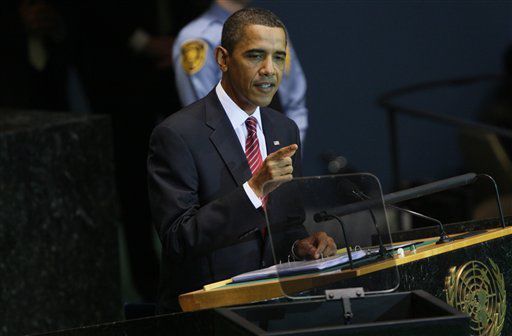
UNITED NATIONS, Sept. 23 — President Obama pledged a new willingness to work with the world’s nations in his first address here Wednesday, but he demanded of them in return a renewed sense of responsibility about confronting the globe’s crises.
From the moment he started speaking, the new American president made clear his determination to repair the “skepticism and distrust” he said had built up under his predecessor. He said George W. Bush’s tenure fed a “reflexive anti-Americanism, which too often has served as an excuse for our collective inaction.”
Obama touted the actions of his young administration as initial steps toward progress — and greater cooperation — on intractable world problems, drawing applause when he declared that he had banned the use of torture. He also urged his counterparts to do likewise, calling for an “era of engagement based on mutual interest and mutual respect.”
“Make no mistake: This cannot solely be America’s endeavor,” Obama said. “Those who used to chastise America for acting alone in the world cannot now stand by and wait for America to solve the world’s problems alone.”
The president’s speech was an attempt to forge a new compact with the world’s nations while recognizing that old problems — of war, nuclear proliferation, economic distress and environmental crisis — still command attention.
The speech was Obama’s first address to the General Assembly. His audience included several foreign leaders his administration is seeking to face down on the diplomatic front, among them Iran’s president, Mahmoud Ahmadinejad, who has rebuffed other countries’ calls to stop enriching uranium and has thumbed his nose at criticism of his human rights record, his hostility toward Israel and his support for terrorism.
Ahmadinejad sat without reacting obviously in the fifth row as Obama publicly chided his country for its pursuit of nuclear weapons, saying Iran’s actions — and similar efforts by North Korea — “threaten to take us down this dangerous slope” that makes the whole world less secure.
“If they are oblivious to the dangers of escalating nuclear arms races in both East Asia and the Middle East — then they must be held accountable,” Obama said. “The world must stand together to demonstrate that international law is not an empty promise, and that treaties will be enforced. We must insist that the future does not belong to fear.”
Saying he is committed to pursuing peace in the Middle East, Obama made clear that his administration intends to push Israelis and Palestinians toward a final negotiation on creating two viable countries in the war-torn region.
In unusually blunt remarks for a U.S. president at the United Nations, Obama said that Palestinians have “legitimate claims and rights” and that America’s “unwavering commitment” to Israel’s security must be coupled with an insistence that Israel recognize them. But he also said the world must urge Palestinians to “recognize Israel’s legitimacy and its right to exist in peace and security.”
Both statements were greeted with warm applause, a reflection of, at least, a new politeness toward the United States’ leader. Bush rarely received applause in the chamber, especially toward the end of his tenure.
On climate change, Obama again declared that a new era had dawned in which America would no longer be an obstacle to action. “The days when America dragged its feet on this issue are over,” he said, a clear reference to the Bush administration.
But he repeated his demand for responsibility on the part of developing countries, which he said could do more to reduce their air pollution without inhibiting their economic growth.
Obama cited his status as the first black U.S. president in issuing a call to respect human rights and democratic government around the globe — an apparent reference to Ahmadinejad’s violent clampdown on public demonstrations after a disputed presidential election in Iran this summer.
“True leadership will not be measured by the ability to muzzle dissent or to intimidate and harass political opponents at home,” Obama said. “The people of the world want change. They will not long tolerate those who are on the wrong side of history.”
“As an African-American, I will never forget that I would not be here today without the steady pursuit of a more perfect union in my country,” he continued. “That guides my belief that no matter how dark the day may seem, transformative change can be forged by those who choose the side of justice.”
Also present was Libyan leader Moammar Gaddafi, who recently reignited American anger by extending a hero’s welcome to the Lockerbie bomber after his release by Britain, and Hugo Chávez of Venezuela, whose friendly greeting and handshake with Obama at a summit in Trinidad was a public relations gaffe for the president.
Gaddafi, who spoke after Obama, began his speech with a gracious greeting to the U.S. president, whom he referred to as “our son Obama.” He said Africans “are proud that the son of Africa” had been elected to the White House and allowed that he would be “happy and content if Obama can stay for ever as president of America.”
Gaddafi also applauded Obama’s commitment to seek the elimination of nuclear weapons and work closely with other nations to solve the world’s problems. “This is the beginning for great change,” he said.
But the melodramatic Libyan leader went on to deliver the kind of divisive speech that the Obama had just urged U.N. members not to make.
Gaddafi railed about the “dictatorial” powers given to the United States and the other four permanent members of the U.N. Security Council, saying they have established a “feudal” order that terrorizes poor countries with economic sanctions and military force.
“It should not be called the Security Council, it should be called the terror council,” said Gaddafi, dressed in a flowing brown robe and a black beret, and repeatedly referring to what appeared to be a small copy of the U.N. charter that he held in his hands.
Gaddafi’s speech — which was supposed to last 15 minutes but clocked in at 98 — went on so long that the United Nations had to change interpreters in the middle of his address and a protocol officer twice delivered a piece of paper, apparently urging him to wrap it up. He crumpled up the first note and threw the second over his shoulder, eliciting a laugh from his interpreter.
The speech was not, however, the longest delivered at the U.N. General Assembly. That honor goes to Cuba’s Fidel Castro, who once spoke for 269 minutes, according to U.N. staff members.
Gaddafi — who spoke with much less focus than Obama — sharply criticized the United States for enforcing its will on the world with superior military power, specifically recalling the Reagan-era decision to strike Libya with laser-guided missiles. That strike, which killed one of Gaddafi’s daughters, was carried out in response to Libya’s sponsorship of terrorism.
He called for an investigation into the U.S. invasion of Iraq — which he called “the mother of all evils” — and the U.S. missile attacks in Somalia and for war crimes probes into alleged U.S. atrocities committed during the long-ago Korean and Vietnam wars. Gaddafi also called for the release of former Panamanian military strongman Manuel Antonio Noriega, who was jailed on drug charges following the U.S. invasion of Panama nearly 20 years ago.
Nor was that all. “Who killed Patrice Lumumba?” he demanded, a reference to the Soviet-backed Congolese independence leader who was assassinated in 1961. African leaders have long suspected he was killed by the United States and Belgium, Congo’s former colonial ruler.
U.N. Secretary General Ban Ki-moon opened Wednesday’s session by reciting a grim litany of crises the world has confronted in the past year — food and energy shortages, global recession, global warming and pandemic flu — to highlight the need for a “spirit of renewed multilateralism.”
“Now is our time,” he said.
Ban urged the world leaders to secure a pact on climate change, approve a ban on nuclear testing and reverse the slide into grinding poverty of workers who are already teetering on the edge of economic instability.
“Markets may be bouncing back, but incomes and jobs are not,” Ban said. “An estimated 100 million people could fall below the poverty line this year.”
Ban chided Burma for failing to release detained Burmese opposition leader, Aung San Suu Kyi, saying the military junta’s recent decision to release of dozens of political prisoners did not go far enough. And he said that issues of “justice and accountability” during Israel’s invasion of Gaza last winter need to be addressed.
The United States recently opposed a proposal by a U.N. rights investigator, South African judge Richard Goldstone, to open a war crimes investigations against Israel and Hamas. The United States and Israel both said Goldstone’s mandate was biased.
Ali Treki, a senior Libyan official who is serving as president of this year’s 192-member General Assembly, delivered a measured opening statement — notable because it did not single out the United States or Israel for criticism.
“We are determined to work together for effective and strengthened organization that is responsive to the daunting challenges facing the world today,” he said.
President Barack Obama addresses the United Nations General Assembly, Wednesday, Sept. 23, 2009. Photo by AP Photo/Charles Dharapak