






Default deluge
Foreclosures and short sales weren’t the only reasons home prices fell in dozens of Colorado Springs-area neighborhoods last year. But they were the biggest reasons, several local real estate experts say.
In The Gazette’s fourth annual analysis of El Paso County Assessor’s Office records and home prices in the area, 52 of the county’s 80 single-family residential neighborhoods saw prices decline in 2008. The number of neighborhoods with falling prices jumped to 68 when distressed properties were added. And of the 80 neighborhoods, 47 had at least 20 percent of their home sales composed of distressed properties.
“There’s no protected neighborhood as far as short sales or foreclosures,” said Joe Clement, owner of Re/Max Properties in Colorado Springs.
But the influx of distressed properties has created opportunities for buyers, too.
Twenty years ago, commercial developers bought deeply discounted parcels during the area’s last real estate downturn. Now, it’s homebuyers’ turn. If they’re confident about holding onto their jobs, and if they buy within their means, the area’s lower prices and rock-bottom mortgage rates are giving residential buyers their choice of home styles and neighborhoods, the experts say.
“For people to buy a property now, and take advantage (of homebuying opportunities) and hold it, I think it’s going to be very good,” said Bill Hurt, president of ERA Shields Real Estate.
Neighborhoods with distressed properties are everywhere, in older areas with inexpensive housing that appeals to lower-income residents; in middle-class and fast-growing sections of Colorado Springs and El Paso County; and in some of the region’s pricier areas, where home prices run in the mid- and upper six figures:
In unincorporated Security-Widefield, south of Colorado Springs, 45.9 percent of last year’s home sales were classified by the Assessor’s Office as foreclosures and short sales, according to The Gazette’s analysis. The Security-Widefield area’s median home price of $159,900 in 2008 was unchanged from the previous year. When distressed properties were added, the area’s price fell to $140,000, a 12.4 percent decline from 2007.
A few miles to the north, in a posh Broadmoor hotel neighborhood, foreclosures and short sales accounted for 16.1 percent of the area’s sales in 2008, according to Assessor’s Office records. Last year’s median sales price in the area was $673,500, a 13.1 percent decline from the previous year; add the sale prices of distressed properties, and the 2008 median in the area fell to $600,000, or 22.6 percent down from 2007.
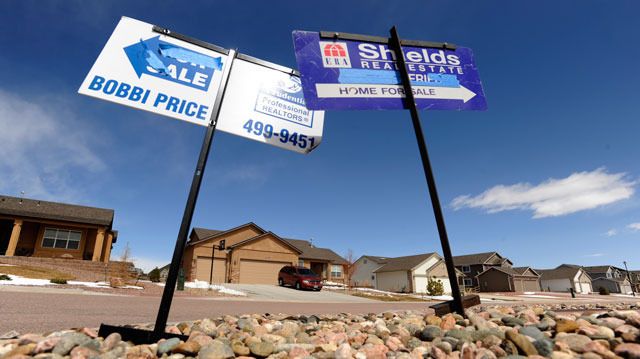
In unincorporated Woodmen Hills, northeast of Colorado Springs, distressed properties made up 27.4 percent of all home sales. The median price last year of $269,900 was down 1.9 percent from 2007; when distressed properties were factored in, the median price in 2008 dropped to $254,950, or 7.3 percent below the previous year.
Not all neighborhoods were as bad off, however.
In the historic Old North End, north of downtown Colorado Springs, 6.1 percent of last year’s home sales were distressed properties; prices there increased 3.6 percent to $430,000 when compared with $415,000 in 2007.
In other areas, double-digit percentages of distressed properties didn’t translate into double-digit declines in home prices.
In the Westside Subdivisions north of U.S. Highway 24, foreclosures and short sales accounted for 38.5 percent of last year’s home sales, but 2008 prices fell only 6.7 percent when distressed properties were included with traditional sales.
And of the county’s 80 neighborhoods, one had no foreclosures or short sales in 2008: Greencrest, a secluded area southwest of Academy Boulevard and Austin Bluffs Parkway. Home prices there increased 3.2 percent to $309,500 in 2008 when compared with 2007.
Past Gazette studies excluded foreclosures and short sales, instead focusing on home prices based on traditional sales between buyers and sellers. But because local foreclosure filings broke records in 2007 and 2008, The Gazette used El Paso County Assessor’s Office data to determine how foreclosures and short sales affected prices in 2008 (see the analysis explanation on Page 12).
Increasingly, foreclosures and short sales have influenced both the asking and selling price of nondistressed properties, say local real estate experts.
Appraisers use foreclosed and short sale prices to help determine the amount a bank will lend on a home purchase and, therefore, how much a buyer will offer. That puts sellers in a bind; not only must their homes be the best-looking, but they’ve got to be the lowest-priced, said Brian Maecker, of Re/Max Advantage in Colorado Springs.
But even after a competitive asking price is set, it often becomes a moving target, Maecker said. As additional short sales and foreclosures come on the market, they force sellers to drop their price even lower to keep pace, he said.
Another problem: Foreclosed homes often sit vacant for months before they’re sold, becoming targets of vandalism and theft and hurting nearby property values, said Vince Rusinak, co-owner of Rusinak Real Estate with his wife, Nancy. When buyers come along, they see the nearby, unkempt homes and are reluctant to buy nonforeclosures, he said.
“You may have four (foreclosures) out of five (homes) on a street,” Vince Rusinak said. “So if you have four out of five on a street and you have one (nonforeclosure) house sitting there, who wants to buy that house? I mean, you really have to dump the price on that house because of the ones that are around it.”
Many buyers ignore homes in great condition and look for less expensive foreclosures and short sales, even though such properties might need repairs and upgrades, said Becky Gloriod of Gloriod & Associates in Colorado Springs.
“I have houses that I know are, in the long run, priced better than a foreclosure, because they’re ready to move into,” Gloriod said.
“They’re immaculate. There’s no surprises, there’s no maintenance issues, there’s no structural issues. If I could advertise them as a foreclosure, that would be false advertising, but if I advertised them as a foreclosure, they’d probably sell.”
That’s why some real estate agents say they have advised clients to wait for the market to rebound before selling because of stiff competition from distressed properties. Nancy Rusinak said she recently told five out of six clients, “don’t sell.”
Thousands of additional soldiers are coming to Fort Carson later this year, and they’re expected to help slash the area’s housing inventory. Likewise, investors are expected to snap up distressed properties to re-sell or rent.
Still, more foreclosures are on the way, predicted El Paso County Public Trustee Tom Mowle, whose office processes foreclosure filings. He said filings could set a record for the third straight year and top 5,000; last year’s record total was 4,602.”We’ll continue to see foreclosure pressure this year,” Hurt said. “We have not, by any stretch, seen the light at the end of the tunnel.”
Contact the writer at 636-0228
For-sale signs on the corner of Del Rio and Rio Secco roads in Woodmen Hills. The newer east-side development north of Falcon, complete with golf course and family-friendly cul de sacs, has seen its share of foreclosures. Photo by CAROL LAWRENCE, THE GAZETTE