






Experts: Potential for fire danger is high
Wildfires that sweep across the Pikes Peak region often inspire breathless accounts from people who try to describe them.
At the start of the region’s most deadly fire, in January 1950, a writer for The Gazette reported the Camp Carson blaze this way: “Whipped by mile-a-minute winds, a fire roared up the side of Cheyenne Mountain and fanned out over grasslands to the south and east today, burning tinder-dry brush and evergreens despite efforts of hundreds of men to stop its advance.”
There’s little doubt, wildfire experts say, that similar accounts will be written again.Maybe not on Cheyenne Mountain. The next blaze could ignite in the Rockrimmon area on the city’s western fringe, or it could eat up neighborhoods in the city core near Palmer Park. Both areas are in what firefighters call the wildland-urban interface, where the population is relatively dense and fuel for a fire is plentiful.
Experts are cautious about predicting how bad the next fire season could be, but so far the signs are grim. Moisture tests completed April 2 on vegetation that could fuel a fire found the risk of a rapid burn is high if something ignites a blaze.
“Things are not stacking up in our favor,” said Christina Randall, the Wildland Risk Section manager for the Colorado Springs Fire Department.
The 1950 fire that started on Cheyenne Mountain burned 50 square miles, a quarter the size of Colorado Springs today, and torched 109 buildings on Camp Carson, now called Fort Carson and one of the nation’s chief Army bases. It took 10 lives, including nine Army soldiers and one civilian, a 14-year-old boy who volunteered to help battle the blaze. Damage at the Army base was estimated at $3.55 million, which today would be worth $31 million.
Authorities at the time said a safety flare that was part of construction of a new golf course at The Broadmoor hotel might have ignited the blaze, but hotel officials disputed the idea.
The Camp Carson fire might be the deadliest in the history of the Pikes Peak region, but it’s nowhere near the largest. The biggest is known as the Big Burn, a blaze in 1853 or 1854, the details of which are mostly lost to history. Colorado Springs author Herbert Sommers wrote a booklet about the fire, reporting that it swept across 70 miles, starting in the area that became Fort Carson and ending three weeks later at Wilkerson Pass. An American Indian of the Cherokee tribe named Who You related to Sommers that the fire was started by “bad Indians.” There were no reports of fatalities.
Big or deadly wildfires aren’t just artifacts of distant history. Many residents remember the Hayman Fire of 2002, which has also been called the largest in Colorado history. It destroyed 215 square miles across four counties, including 600 structures, and forced more than 8,000 people to evacuate.
During the Hayman Fire, ash rained from the sky for many miles around, and giant plumes of smoke spread across multiple states.
Official reports listed no casualties from the blaze, but a Florissant resident died of an asthma attack tied to smoke from the fire, and five workers from an Oregon forestry company were killed in a traffic wreck as they rushed to battle the Hayman.
It was a forceful reminder of how dangerous wildfires can be, but seven years later it’s easy to get complacent, Randall said.
“For a lot of residents, the Hayman’s a distant memory,” she said.
Wildfires continue in the Pikes Peak region, although none has had the lasting impact of Hayman. In April 2008, a pilot helping douse a blaze at Fort Carson died when his plane crashed after dropping slurry.
Colorado Springs recorded 633 acres of land burned in wildland fires from 1993 to 2006.
The El Paso County Wildland Fire Crew has records going from April 2005 to March 2009. During that time the crew responded to 50 fires that consumed about 20,000 acres.-Call the writer at 636-0187
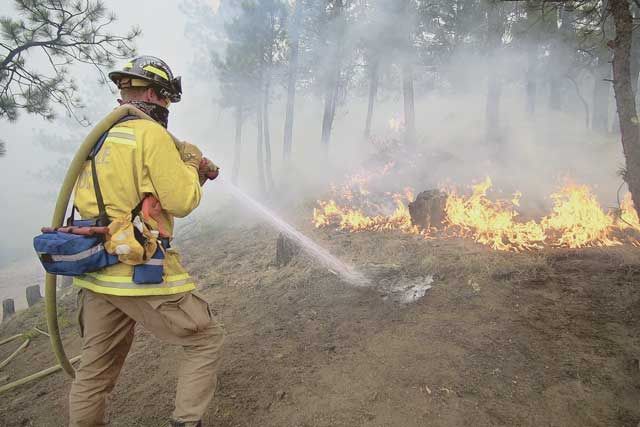
Castle Rock Fire Rescue firefighter Scott McKenna defended a home on Colorado 67 near Deckers from the approaching Hayman Fire in June 2002. Photo by THE GAZETTE FILE PHOTO