






VIDEO: City, county are hard up for cash
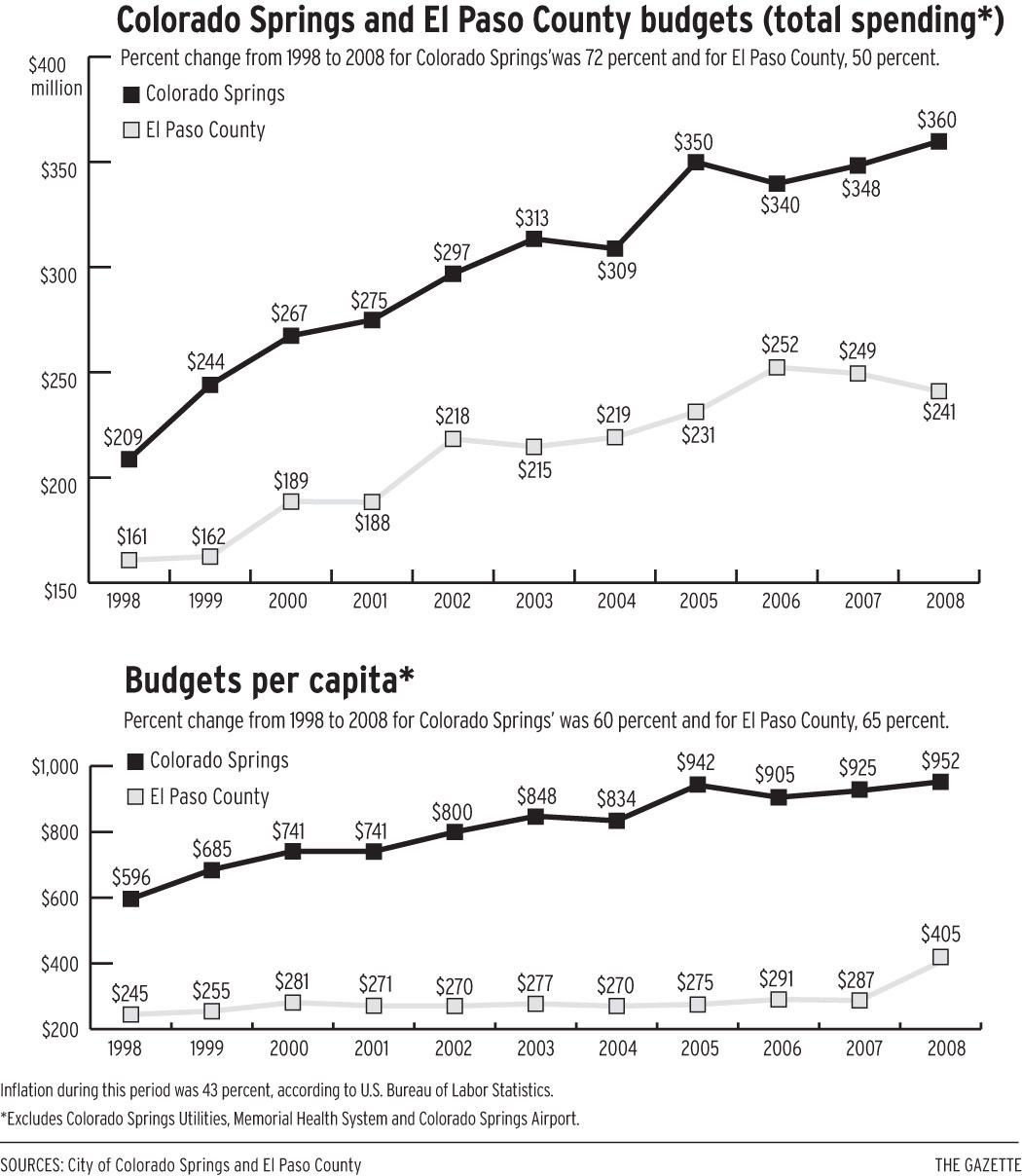
Colorado Springs and El Paso County are broke, beset by plummeting revenues and spending restrictions that handcuff their ability to fix roads, crack down on criminals and keep buses running.
It’s a familiar refrain from local officials, but it wasn’t persuasive enough to sell voters on agreeing to pay an additional 1 percent county sales tax in last fall’s election.
The city’s April 7 mail-ballot election puts several revenue and tax requests to voters, whose decision will probably hinge on how they answer the question, Is government crying wolf, or has it reached the end of its rope?
There’s no denying that the city and county are being squeezed by an array of forces – increasing demands for services, more employees making higher pay, rising health care costs and inflation.
The city and county have slashed spending by millions of dollars and laid off hundreds of workers in recent months. Some residents have criticized officials’ priorities in making cuts, but, generally, the reaction has been everyone needs to tighten their belt in tough times.
In the past, the city and county could afford essential services, plant flowers in medians and subsidize the Pikes Peak Center while taxes remained among the lowest in the state because of growth and a buoyant economy.
Those days, officials say, are over.
Increasing demand for service
As the region’s population grew, residents’ demands for service exploded.
Since 1998, the county has added 174 miles of roads. There’s less money in the budget now to maintain roads, though, than a decade ago and it has less money for maintenance than it had a decade ago. At the same time, residents’ calls for such services as signs, traffic signals and fixing potholes tripled.
“Just look at the urbanization of eastern El Paso County,” County Administrator Jeff Greene said. “Eight years ago, you had just a Safeway in Falcon. Today, you have Wal-Mart and thousands of individuals living in that area. They don’t distinguish between city-related and county services.”
Among those is Laura Robedee, who moved to Woodmen Hills in October from Colorado Springs. She expects the same service in the county as she received in the city – snow plowing roads, law enforcement and pothole repair. For the most part, she said, she’s satisfied.
Her biggest complaint is dogs barking, which isn’t likely to abate, because the county recently curtailed animal control due to budget woes.
Although the county has siphoned off revenue from roads for other priorities, the city’s Public Works Department budget increased 61 percent as it added 232 miles of road and the snow removal and repairs that go with them.
But William Jebb, a long-time resident who lives in Mountain Shadows in northwest Colorado Springs, said the city is doing more than it needs to.
“Why waste the gas when you only have an inch or two of snow?” he said. “Most all of us could drive in four inches of snow” without the city plowing or sanding roads.
Jebb will get his wish, and more. The City Council imposed budget cuts in February that will mean no snow plowing and sanding in residential areas until at least six inches of snow has accumulated.
Law enforcement stretched
Law enforcement is a growing citizen concern, again due largely to urbanization of rural areas. El Paso County Sheriff Terry Maketa saw calls for service shoot up 67 percent from 1998 to 2008, even as serious crime in the county barely budged.
“We’ve gotten calls for things we didn’t used to get calls on,” Maketa said, citing someone parking in a neighbor’s driveway and a 14-year-old out of control.
Although Maketa’s budget grew nearly 50 percent since 1998, most of the extra money went to staff a jail that opened in 2005 and the jail’s mounting medical and food bills.
That’s left less money for patrol. Even as the unincorporated area’s population grew more citylike around Falcon and Black Forest, the number of deputies answering calls stayed at 60.
Spreading the same number of personnel over a population that boomed by 50 percent during the decade meant something had to give. One casualty was response times, which have eroded from an average of 9.3 minutes for top priority calls a decade ago to 14.2 minutes today.
Still, Jennifer Bordelon, who lives 25 miles east of Colorado Springs in Ellicott Springs, hasn’t noticed a reduction in service. Saying she sees deputies frequently near her home five miles south of Ellicott, she warned, “If you’re one mile over, he’ll get ya.”
Although Maketa said he’s been able to keep things running with $3 less per capita today than in 1998, he worries that when vehicles and computer networks “start to crumble,” there’s no money for replacements.
The Colorado Spring Police Department’s budget rose 81 percent from 1998 to 2008, due in part to the Public Safety Sales Tax passed by voters in 2001.
The extra money paid for hundreds of new hires and two new police stations during an era of rising demands. Calls for service skyrocketed by 73 percent as the city’s population inched up only 8 percent from 1998 to 2008.
Over the decade, the city raised per capita spending on law enforcement by 68 percent, but few residents would consider Colorado Springs a safer city than 10 years ago.
The additional resources helped make police responses about a minute faster, and serious crime dropped by 14 percent, although police say the decline is apt to change as officers enter more case reports for 2008.
Faster response times might also be tied to police imposing a more strict definition of top-priority calls and requiring residents to file their reports online or by phone for crimes – vandalism, theft, minor traffic crashes, for example – that used to bring an officer out to take a report.
Costs keep going up
There are other reasons why the city’s spending grew by leaps and bounds and the county’s went up by half.
Consumer prices rose 43 percent since 1998, according to the U.S. Bureau of Labor Statistics.
Escalating fuel prices, rising payrolls and spiraling health care costs also took a big bite.The city paid 210 percent more for fuel in 2008 than six years earlier, and the county’s fuel bills came to nearly $3.2 million last year, a five-fold increase over 1998.
The county added 322 workers from 1998 to 2008 and paid cost-of-living raises six of the past 11 years. The city increased its work force by a quarter, hiring 506 more workers.
Most city workers got raises every year since 2002, except for 2005, when the city froze salaries, Chief Financial Officer Terri Velasquez said. Overall, the city’s payroll increased by nearly half.
Like many private businesses, the city and county are victims of the steady upward march of health care costs.
At the county, health care costs soared by 251 percent to nearly $12.8 million since 1999 and now account for more than 5 percent of the budget, compared with 2 percent a decade ago.
Greene blamed the rising payroll and health care costs on a graying work force, which earns more and has more expensive health claims. The average age of county workers is 45, compared with the average age of 39 for all workers in El Paso County, Census Bureau data show.
Like the county, Colorado Springs is self-insured, meaning it maintains a fund for health claims to which it and employees contribute.
City Risk Manager Mark Anderson said the number of large claims is increasing. Claims rose from $18 million in 1998 to $28 million in 2008, and in both years the premiums from employees and the city weren’t enough to cover the cost. City officials tapped employees to make up the difference. This year, employees’ and the city’s share of health care costs rose 18 percent.
Rethinking priorities
Those pressures have caused the city and county to rethink what they do and how.
The county left the entertainment business in 2005 after the Pikes Peak Center, county fair and Penrose Equestrian Center gobbled $3.1 million in subsidies from 1998 through 2004. That money was used, instead, to help fund a courthouse expansion and build a jail.
The county also is revamping its snow removal plan, reducing investment in information technology and not jailing misdemeanor offenders.
In contrast, the city has hung on to the City Auditorium, despite its $465,145 operational deficit from 1998 to 2008. Officials hope higher fees imposed this year will close the gap.Councilman Randy Purvis said he wants to see the City Auditorium become self-sustaining, but he views that as a tough goal given the shape the building is in. A consultant’s report found the auditorium needs a $15 million rehab – money the city doesn’t have.
“It reflects part of the city’s history. It’s a grand old building that has many memories for a good part of our population,” Purvis said. “The building has a bright future if we can just find the money to do the rehabilitation.”
The city also has expanded parks and recreation offerings, funded in part by a sales tax voters approved in 1997.
With city tax revenues lagging due to the limp economy, the council wants to divert some of the sales tax money tagged for open space and use it for park maintenance.
It’s one of four measures on the April 7 city ballot that could provide the city with more money and perhaps stave off more layoffs.
Vice Mayor Larry Small said, after recent cuts, the 2009 budget is only slightly higher than it was in 2004.
“We have lost five years,” Small said. “If we don’t take some small action to correct the situation, our city will find itself in a death spiral.”
• • •
April 7 city ballot measures
• Question 1A, to extend a property tax that’s scheduled to expire and use the estimated $3.2 million to help businesses and promote new jobs.
• Question 1B, to let the city keep up to $1.2 million in extra revenue collected in 2008 to be used for “essential city services.” The money would otherwise be refunded to taxpayers.
• Question 1C, to change how the city uses its Trails, Open Space and Parks tax, increasing the amount allowed to be used for maintenance from 6 percent to 15 percent for five years.
• Question 1D, shifting the definition of a city “enterprise” to allow agencies such as the airport to take federal grants without the money counting toward a limit for enterprises.The city will begin mailing ballots Tuesday.COMING UP ONLINEPlease join Gazette reporters and El Paso County Commission Chairman Jim Bensberg from 8 to 9 a.m. Monday for a discussion of city and county government in a live chat at gazettedev.gazette.com. City officials have declined to participate.
Photo by
Photo by
Photo by