






Iraqi wounded seek help in Jordan hospitals
AMMAN, Jordan – In November 2006, Ali Mizhir was on his way to a market in Baghdad to buy some slippers. As he walked alongside the road, a car bomb exploded – blowing away much of his lower left leg.When Mizhir, then 11, was brought to a nearby hospital, doctors told his father they would have to amputate his leg. His father refused, arguing his son’s leg could be saved.After five failed operations in Iraq and Iran, Mizhir and his father came to a hospital in Jordan last July, run by the medical charity Medecins Sans Frontieres.”If I had not left Iraq, I would have lost my leg,” Mizhir said. “All the doctors that I saw in Iraq wanted to cut it off.”Mizhir cannot yet walk, and he still has a large gap in his leg where the muscle and tissue have been torn away. But his doctors are optimistic. They have fitted “tissue expanders” in his leg that stretch the skin, encouraging tissue and muscle growth. The doctors hope to grow out the muscle and skin enough so that they can reattach the nerves and bones properly in a few months.Since 2006, the international charity’s ward in Amman has been treating civilian victims of Iraq’s war mangled by wounds too complicated to be dealt with in the overburdened, undersupplied hospitals of Iraq.Its staff, almost entirely Iraqi doctors and nurses, specialize in reconstructive surgeries and have provided free treatment to more than 650 patients. Through its network of doctors in Iraq, MSF – also known by its English name Doctors Without Borders – scans Iraqi hospitals for patients who might benefit from a medical trip to Jordan.Most of the Iraqi staff are themselves casualties of the war, having fled Iraq as doctors increasingly became targeted for kidnappings and attack.About 45 percent of patients whose doctors refer them for treatment receive it. Occasionally, even Iraq’s Ministry of Health directs patients to the hospital. There are about 100 patients on a waiting list.The ward, inside the Red Crescent hospital in the Jordanian capital, costs about $4.5 million a year to run.”The difference between working in Baghdad and Jordan is like comparing black and white,” said Dr. Nasr Omari, an Iraqi plastic surgeon who works at the Amman hospital.Iraqi hospitals often lack basic equipment and medicines. Doctors cannot work more than a few hours at a time because of curfews and security concerns.Complex cases might also be too taxing for overstretched Iraqi doctors.That was the case with Hanane Hadi, a 12-year-old girl from Baghdad. In 2006, Hadi’s family of eight was killed by a car bomb. She was the sole survivor, and had burns to more than 90 percent of her body.In the Baghdad hospital where she was initially treated, Hadi remembers hearing doctors saying that since they couldn’t do anything for her, they should leave her to die.But after more than a dozen surgeries at the MSF hospital, Hadi recently left for more treatment in the Netherlands.On a recent morning, doctors at the Amman hospital operated on a woman hit in the face by a sniper bullet and a man whose foot was deformed after an explosion.The facility is MSF’s most advanced reconstructive surgery project. There is a similar initiative in Grozny, Chechnya and more basic surgical operations in Haiti, Nigeria, Sierra Leone and Sri Lanka. But the need is greatest in Iraq.In most wars, it is the military who are targeted. But the terrorist element of the Iraq war has perhaps resulted in more civilian casualties than elsewhere, some of the charity’s doctors said.Doctors at the Amman hospital are often surprised by what they find inside patients’ bodies, like wires from car bombs embedded inside bone and tissue.Other health experts supported the hospital’s work. “Anything that serves a gap in the Iraq health system is useful,” said Dr. Nada Al Ward of the World Health Organization’s Jordan office, who works with displaced Iraqis.”If you need reconstructive or complicated surgeries, most of the time, you will need to travel outside Iraq to get it,” she said.Medecins Sans Frontieres emphasized that the Amman hospital is meant to complement the Iraqi health system, not to replace it. Olivier Maizoue, the charity’s head in Jordan, said the hospital might not be needed in five years, if the situation in Iraq continues to stabilize.Al Ward agreed that Iraq might be able to assume some of the complicated surgeries currently being performed elsewhere. “Iraq had a functioning health system before the conflict,” she said. “If the security situation improves, the health system will hopefully spring back.”Despite the uncertainty in their homeland, most patients are anxious to return to Iraq.Mizhir, who is now 14, says he misses playing football with his friends and wants to go back to school. He and his father have been in Jordan so long that Mizhir now has a two-month old baby sister named Naba’a that he has only seen in pictures.”I would like to go back to Iraq to meet my new sister,” Mizhir said. “But that is for the doctors to decide.”
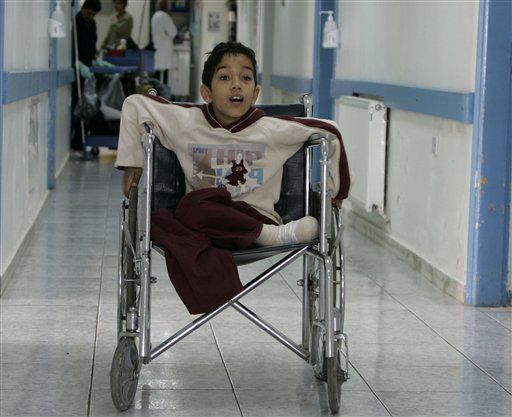
10 year old Iraqi boy called Karrar, seen in his wheelchair at a hospital run by the medical charity Medecins Sans Frontieres, also known as Doctors Without Borders, in Amman, Jordan, Monday, Feb. 23, 2009. Photo by