






Senate reaches agreement on a leaner stimulus plan
WASHINGTON • With job losses soaring nationwide, Senate Democrats reached agreement with a small group of Republicans on Friday night on an economic stimulus measure at the heart of President Barack Obama’s plan for combatting the worst recession in decades.
“The American people want us to work together. They don’t want to see us dividing along partisan lines on the most serious crisis confronting our country,” said Sen. Susan Collins of Maine, one of three Republican moderates who broke ranks and pledged their votes for the bill.
Democratic leaders expressed confidence that the concessions they had made to Republicans and moderate Democrats to trim the measure had cleared the way for its passage. No final vote was expected before today or Sunday.
The deal came on a day when the Labor Department reported that the nation had lost nearly 600,000 jobs in January, the worst showing in a third of a century, as a vicious cycle of cutbacks by consumers forced ever more layoffs by beleaguered employers. The unemployment rate catapulted to 7.6 percent, the highest in 16 years, and seems headed for double digits.
About 3.6 million jobs have disappeared in a deepening recession, which is shaping up as the biggest job killer in the post-World War II period and is raising pressure on Obama and Congress.
Democrats put the cost of the stimulus measure at $780 billion, including Obama’s signature tax cut of up to $1,000 for working couples. Much of the new spending would be for victims of the recession, in the form of unemployment compensation, health care and food stamps.
Republican critics said that the price tag was actually higher and that billions were ticketed for programs that would not create jobs. Official cost figures were not yet available.
The agreement capped a tense day of backroom negotiations in which Senate Majority Leader Harry Reid, joined by White House chief of staff Rahm Emanuel, sought to attract the support of enough Republicans to give the measure the needed 60-vote majority.
Democrats hold a 58-41 majority in the Senate, including two independents.
Uncertain of the outcome of the talks, Democrats called Sen. Edward Kennedy back to Washington in case his vote was needed. The Massachusetts senator, battling brain cancer, has been in Florida in recent days and has not been in the Capitol since suffering a seizure on Inauguration Day more than two weeks ago.
In addition to Collins, Republican Sens. Arlen Specter of Pennsylvania and Olympia Snowe of Maine pledged to vote for the legislation.
Whatever the price tag, the compromise marked a victory for the new president, who has veered between calls for bipartisanship and increasingly strong criticism of Republicans in recent days. And it indicated that Democratic leaders remain on track to deliver a bill to the White House by the end of next week.
Obama said further delay would be “inexcusable and irresponsible” given Friday’s unemployment report of 598,000 jobs lost last month. On Wall Street, investors optimistically assumed action was on the way and pushed stock prices higher. The Dow Jones industrials gained more than 217 points, and all broad stock indexes surged nearly 3 percent.
Also Friday, regulators closed FirstBank Financial Services in Georgia and two California banks, Alliance Bank and County Bank, marking nine failures this year of federally insured institutions.
Twenty-five U.S. banks failed last year, far more than in the previous five years combined. The six failures announced in the last two weeks are double the total for 2007.
ADVISERS NAMED
President Barack Obama has announced a team of outside economic advisers to help boost a U.S. economy in a virtual free fall.
The president signed an executive order creating the Economic Recovery Advisory Board, headed by former Federal Reserve Chairman Paul Volcker. In a statement, the White House said the board will offer independent advice in regular briefings to the president, vice president and their economic team.
MORE ON THE ECONOMY
Other January figures released Thursday:
• Factories slashed 207,000 jobs. That was the largest one-month drop since October 1982, partly reflecting heavy losses at plants making autos and related parts.
• Construction companies cut 111,000 jobs, professional and business services 121,000, retailers 45,000 and leisure and hospitality companies 28,000.
• There were gains for education and health services and in government jobs.
• The average time it took for an unemployed person to find a job – full or part time – rose to 19.8 weeks in January, compared with 17.5 weeks a year earlier. And the number of “long-term” unemployed – those out of work for 27 weeks or more – climbed to 2.6 million from 1.4 million a year earlier.
The Associated Press
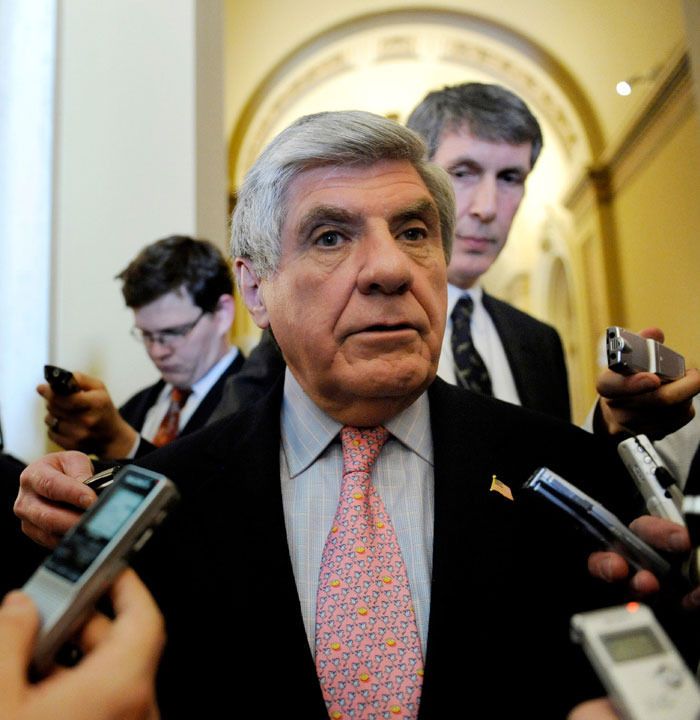
Sen. Ben Nelson, D-Neb., talks with reporters on Capitol Hill in Washington, Friday, Feb. 6, 2009, following a meeting with Senate Majority Leader Harry Reid of Nev. and Republicans on the economic stimulus legislation. Photo by (AP Photo/Susan Walsh)
