






The making of a triathlete: Hunter Kempler endures Olympic trials
Great triathletes, elite level triathletes are made, not born.
At least that’s what Hunter Kemper says. Kemper should know. The 2005 USOC Sportsman of the Year, who lives and trains in Colorado Springs, is one of the best Olympic triathletes on the planet.
Kemper and many other elite triathletes will compete in Tuscaloosa, Ala., Saturday for the chance to represent the United States in the 2008 Summer Olympics. The first American male and female to cross the finish line will be added to the six-person triathlon team, joining Jerrod Shoemaker and Laura Bennett who qualified at the Beijing World Cup in September 2007.
Olympic triathletes compete in a 0.9-mile swim, 24.8 miles of cycling and a 6.2-mile run before crossing the finish line.
To the lay person, each event sounds challenging on its own. Putting together all three, in succession, and finishing them all in about an hour, 50 minutes for the men and about 2 hours for the women is a task reserved for a select few.
And as Kemper says, someday maybe we can all be a part of that select few.
Here’s how.
MENTALITY
An elite triathlete has to possess the mental capability to actually shut down the brain. The brain is all about self-preservation. It doesn’t want us to hurt or feel discomfort. It wants us to remain happy. Anybody who has ever trained for any length of time understands that to progress, to improve, the body and mind have to be put into uncomfortable situations.
“I think the brain is your No. 1 limiter,” Kemper said. “It’s the No. 1 person or obstacle in your way. If you can shut your mind off and just kind of lose that idea of thinking to yourself the negative thoughts … how much faster do you think you’re going to go? It’s going to be unbelievable.”
Sports psychologists call it mindful meditation. The negative thoughts start to creep in. The athlete is conscious of this, so he brings the workout or race back to the present. He starts thinking about the little things, the running or swimming form, arm swing, cadence, breathing, etc.
The elite triathlete has to be able to refocus.
SWIMMING
Reaching that elite level might be a bit too late for some of us because we didn’t start swimming at an early age. Not that we can’t reach elite status. It’s just going to be a lot more difficult.
“I think swimming, of the three disciplines between swimming, cycling and running, swimming is the hardest to pick up as you get older,” Kemper said. “Start teaching your kids to learn how to swim at an early age for health reasons and safety reasons.
“It’s not a sport that you can power through. It’s not a sport where you can get in the weight room, push some big weights and become a great swimmer. Time in the water. Feel in the water. It’s a very unique type of sport in that way.”
Many triathletes compare the swim portion of the race to a brawl. They’ve gotten hit, kicked, elbowed and busted in the gut – and none of it was done purposefully. If you’re not comfortable in the water, the swimming mishaps only intensify.
BODY TYPES
Now some of us are just out of luck on this one. We can blame our parents. Look at the elite triathletes. How many of them look like bodybuilders or football players or sprinters? None. Elite triathletes sport long sinewy muscles. They have an abundance of Type I or slow twitch muscle fibers. Those are the muscle fibers that are able to withstand punishment over a longer period of time.
“Our sport ranges from sprint distance triathlon to Olympic distance, which last about an hour and 50 minutes to an Ironman which is 8, 9, 10 hours of racing,” Kemper said. “So these races are long endurance-oriented races where you are more inclined to have that slow twitch muscle fiber.
“I could never ever dunk a basketball. I’m 6-2 almost 6-3. I couldn’t come close. I was never a good sprinter. I was never a good jumper. I was never a good leaper. A great triathlete will be the type of athlete who definitely won’t have a very high vertical … or a big butt with all that power.”
VERSATILITY
One has to be multitalented if he wants to be a top-level triathlete. That means multitalented in time management as well as athletic skill. We all have to juggle life and our jobs.
Olympians with families are no different.
“I probably put in about 12-13 hours of bike riding a week,” Kemper said. “I would say I put in about 6 to 7 hours of running a week, so about half that. That’s only because the running takes more of a pounding. You can’t run as much as you can bike. Swimming, I probably swim about 9 hours a week. It’s about a 30-hour work week with core training and weight training and stretching.”
Thirty hours a week might not sound like much to those of us who work 50 and 60 hours a week.
But if we’re to reach Kemper’s level, we’re going to have to expend much more energy during our week – a whole bunch more.
AEROBIC CAPACITY
We need an engine to run this body. That engine needs fuel. Oxygen is the fuel we’re talking about here. Our muscles need oxygen to operate. The more oxygen we can get to them while we’re exerting energy, the more efficient they will work.Elite triathletes are able to facilitate the flow of oxygen to the muscle a lot better than the rest of us.
“A lot of that is something you’re born with,” Kemper said. “But one way to increase that is to be up here to train at altitude. We’re here at 6,000 feet and what that allows you to do is increase your red blood cell count. … It helps you supply the oxygen to your muscles to help you run faster and a longer distance.”
There are many local athletes who leave the Springs to go up in the mountains to train at even higher altitudes in hopes of further increasing that red blood cell count. That way, when they return to this altitude, they should have an even more efficient delivery system.
CORE
Our core body is that area from just below our shoulders to just above our pelvis, and it is involved in every move we make: running, swimming, biking, hiking, jumping and sitting – all of them.
Without a strong core, we lose energy to our extremities. That energy gets lost somewhere in our midsection when it should be transferring to opposite extremities.
“It’s important for injury prevention, but also to get yourself through the water faster,” Kemper said. “If you have a good core, a strong core and can turn your body from side to side; can whip it from side to side, back and forth, using your core muscles. That’s a strong area, which you can use as a fulcrum to get yourself back and forth. You see Michael Phelps, his core is probably unbelievable. He’s the best swimmer in the world. That midsection for him, that’s where he generates all his power.”
PAIN CONTROL
Finally folks, if we want to be elite, we’re going to have find a way to endure pain. Because being elite means we’re going to hurt.
“What it comes down to is mental toughness in a lot of ways,” Kemper said. “Can you lay yourself on the line, can you put yourself out there to the point where your heart rate is 172 or you’re on the edge for 30 minutes in that last part of the run, 174 heart rate or whatever and knowing to yourself, ‘OK, I’m not going to die. I’m not going to pass out here. I’ve got to keep on pushing on, and I’m going to get myself to the finish line.’
“You play mind games with yourself. You’re thinking, ‘Wow this hurts. This really hurts. I’m in pain. This is fast. These guys are going way too fast. This pace is too quick. I can’t believe they’re thinking they’re going to go a 10K like this!’ But you kind of know, because you’re at that level, that they are thinking the same thing. I mean, they’re not just cruising along. They’re not out there for a jog. They’re out there hurting as well.”
There you go, the seven steps to being an elite triathlete. Start training now. London is only four years away.
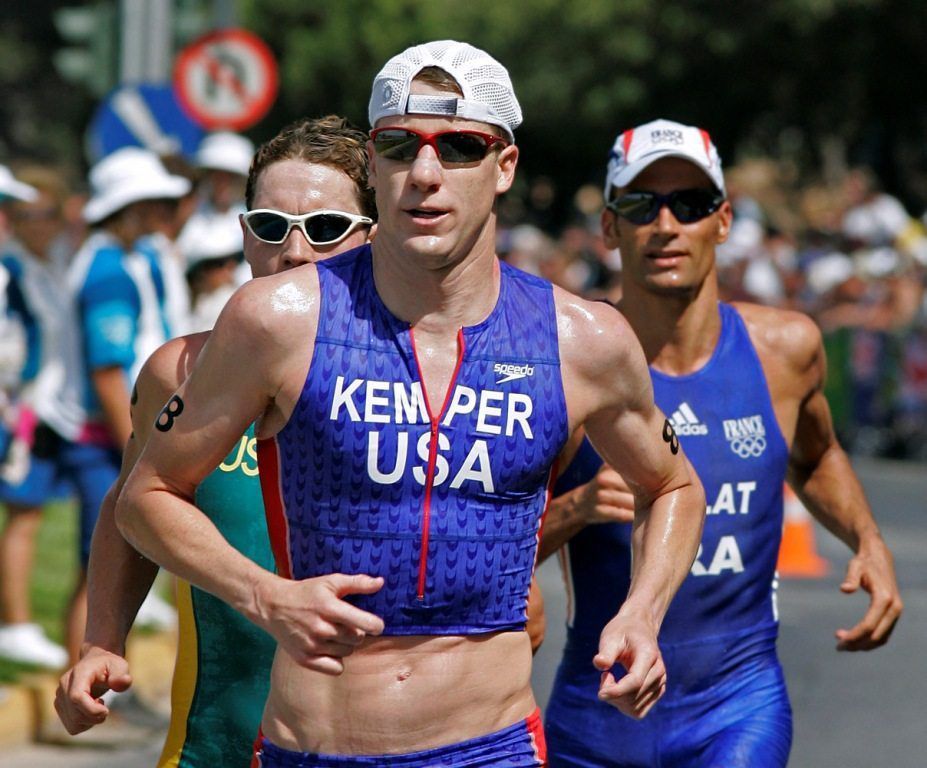
Colorado Springs’ Hunter Kemper is shown in various phases of training for and competing in the triathlon, whose trials take place Saturday in Tuscaloosa, Ala. Photo by THE ASSOCIATED PRESS