






It’s not a collapse if you still prevail
Locking eyes, Angie Moore clutched her husband and gave him a kiss months in the waiting. Their daughter, Brooklyn, latched onto his leg, competing for the first hug.Two feet back, Owen Moore, 6, refused to flinch and gazed silently at his father. A homemade sign in his hands delivered the message that Owen refused to speak:“Welcome Home, Daddy.”Through it all, Spc. Nick Moore never stopped smiling.In a crowded Fort Carson gymnasium, the Moore family laid the groundwork for a family reunion reminiscent of hundreds of others this month for the 2nd Brigade Combat Team. Topping the family’s massive to-do list: Acquainting Nick Moore with his youngest son, Hudson, born 31 days into his deployment.Their re-introduction lasted seconds. Hudson — now 10 months old — squirmed and cried as Angie handed her husband their youngest child.“This is always the thing that worries me the most about coming home,” said Nick, gazing at the boy, nestled back in his wife’s arms.Far more challenges faced the Moore family over the next couple days. Their story is emblematic of many other military families after an overseas deployment, child and family advocates say.“When we talk to them, we always talk about the new normal,” said Terry Blansett, the post’s mobilization and deployment manager for Army Community Services.“The reintegration process itself can take several, several months — sometimes up to a year even — for everything to get back to what the expected norm is.”Some families negotiate the reintegration process just fine. The list of hurdles a family might encounter, however, is long.Tensions can rise when soldiers return home thinking little — if anything — has changed, causing children to feel misunderstood, said Ken Sanders, program manager for the Center on Fathering in Colorado Springs. Children sometimes wrestle with feelings of abandonment, said Marlene Bizub, a forensic psychologist in Colorado Springs.Most marriages fare great the first month following a deployment, Blansett said.“It’s kind of like dating again, to some degree,” said Blansett.But as that “honeymoon” period ends and soldiers settle back into their pre-war routines, marriages can unravel.The post is accustomed to these issues. Fort Carson has shuttled thousands of soldiers to Iraq and Afghanistan since 2003.After an initial four-day leave, Blansett said all returning soldiers must attend marriage and parenting classes. Nick’s sessions begin Tuesday.Blansett stressed that myriad other programs are available to returning soldiers.But each family is different.“I just tell them to give it time,” Blansett said. “I used to always tell them even before they got off the plane, be careful with your expectations.”Nick and Angie Moore have seen their marriage crumble in the past. The couple divorced several years ago, but remarried shortly after Nick Moore enlisted in the Army in December 2009.They plan to use the lessons learned during those years apart to help ease them through their latest family reunion. Their first week back together proved hectic.Nick arrived home a day before his daughter’s ninth birthday, which the family spent moving into a new, bigger house on the post.While Brooklyn seemed to adjust well to the first week of Nick Moore’s return, Owen had a harder time.The couple — still settling back into pre-war roles — confronted everything in due time.On May 6, Nick’s biggest concern involved Hudson. Staring at the boy, Nick laid out the strategy he planned in Kandahar.“You got to be patient,” Nick Moore said. “Patience and understanding and love — just like being a dad.” Shifting prioritiesTuesday evening, Hudson climbed up and down the biceps Nick Moore developed in Afghanistan, using his father as a newfound jungle gym. While keeping Hudson balanced, Nick Moore used his free hand to shuffle through a set of blue cards.“OK. These are all power cards,” Owen told his father.“OK, power cards,” said Nick Moore, turning his head to the kitchen. “I’m learning how to play Pokemon.”Two nights after arriving home, no one expected Hudson to bond this quickly with his father. The two were literally on opposite ends of the earth when Angie Moore gave birth.On July 6, Nick Moore, a medic with the 1st Squadron, 10th Cavalry Regiment, listened in Kandahar while his wife screamed through a phone.“He couldn’t tell what I was saying, but I tried,” said Angie, smiling.The baby’s quick affinity for Nick Moore doesn’t surprise many child care experts. Children that age naturally soak in the world around them, and people who are emotionally open can bond quicker than others.But every child reacts differently. Infants normally experience “stranger anxiety” shortly before their first birthday, leaving them wary of new people, said Kathy Reschke, with the federally-run Military Families Learning Network.Around that time, infants also begin realizing that objects they no longer see still exist. The development is important for them to grow attached to their most important caregivers.Often, the parent who stayed home has the biggest impact on the bonding process, Reschke said.“If they (infants) see that that parent is comfortable and engaging with the other parent and laughing and just relaxed, that goes a long way to helping them be relaxed with them,” Reschke said.Nick Moore first held his newborn son in September. Their introduction was short — Nick Moore’s leave from Afghanistan lasted two weeks.As the deployment wore on, Angie tried whatever she could to keep Nick Moore in her newborn’s life.She held Hudson up to the phone whenever she talked with Nick. On days when he didn’t call, she played the infant 30-second videos of his father.At her father’s urging, Brooklyn also tried putting in a good word for dad.“I keep telling him how dad’s awesome,’ said Brooklyn, soon striking a body-builder’s pose. “He’s so strong.”Nick Moore decided to start to bond with Hudson over dinner the night he returned.“This kid eats 90 percent of his day,” Nick Moore said. “I haven’t seen a kid like this. So I just started giving him whatever I was eating. I mean, the key to any guys’ heart is their stomach.” Fearing a returnNick Moore’s budding relationship with his youngest son came, to some extent, at the expense of his oldest son.In the first two days home, Owen kept his father at a distance. Signs of hesitation emerged the first night home, when Nick Moore asked Owen if he wanted to play after the 9 p.m. homecoming ceremony.“He said ‘It’s too late to play,’” Angie said. “It gave Nick time to get to know Hudson.”Infants are mostly centered around their own needs. But children in elementary school begin to negotiate the normal give-and-take of relationships, said Kim Collins, clinical practice manager for Aspen Pointe in Colorado Springs.As a result, some children will try to reach out to the returning parent to reconnect, Collins said. Others will wait for the parent to reach out to them.“The child will kind of possibly stay shy in the beginning but then naturally begin to try to acclimate to that new person into everything that’s happened” in the last year, said Kim Collins, clinical practice manager for Aspen Pointe.During the deployment, Owen occasionally acted out. He had temper tantrums at home. When asked by his kindergarten teacher, Owen hedged.“He said he had a plant allergy and sometimes he just couldn’t control it,” said Nick Moore’s mother, Mechel Hasleton, chuckling at the boy’s clever excuse.Nick and Owen’s relationship is a work in progress.A couple hours after his game of Pokemon on Tuesday, Owen prayed for God to bless his family. A few days later, Owen began asking where his father was in the house — a sign that his hard feelings were thawing.Nick Moore took his son for ice cream and to see “The Avengers,” the first father-son outing since his return. That same day, Nick bought Owen more Pokemon cards.“He’s had a hard time,” Nick Moore said. “I love all my kids. We’ve (Owen and Nick) always been close. But now he’s worried I’m going to leave again.”For now, Nick plans to use the same strategy he originally planned to use for Hudson: patience.“It’s good,” Nick Owen said. “We’re just hanging out as a family.” “You have to work your way into it”Owen’s attachment concerns emerged as Nick and Angie Moore eased back into their old roles as dad and mom.There were pleasant surprises. Angie Moore spent 20 kid-free minutes shopping for groceries. Usually, those trips lasted more than an hour.Nick Moore started running errands himself.“I forgot how to do everything. It’s weird,” Nick Moore said on Tuesday. “I lost my keys today, I lost my son and I forgot the diaper bag.”“Where was he?” Brooklyn asked, of Hudson.“I just left him in the car for a little bit,” said Nick, shaking his head with a grin. “I walked just a few feet away before I remembered.”Settling into the daily routines at home and assuming childcare responsibilities remain the two top issues facing reunited military couples, according to the National Council on Family Relations, citing a 2011 RAND Corporation study.Nick and Angie Moore know what it’s like to start a new life together.The couple first married in 2001, when she was a few days shy of 19 and he was nearly 22.“It was a typical Utah ‘hurry and get married because you’re really old at 18,’” Angie said.The hastily-planned marriage ended in divorce. But with two children, they kept in touch and visited each other — plans meant solely to benefit their kids.When Nick Moore enlisted in the Army, he started writing Angie asking her to date again. Her initial reaction: “No way.” But he persisted.“I just totally believed in prayer, and I prayed and prayed and prayed,” Angie Moore said. “And I knew that if I didn’t do it, I would totally regret it.”The couple married again on May 29, 2010.The time that they spent apart helped prepare the family for his deployment, Nick Moore said.Brooklyn, for example, seems to have adjusted well to the first week of her father being back home, her parents said. It helps that Nick Moore swapped flights with another soldier so that he could be home in time for Brooklyn’s birthday on Monday.“I cried a little bit,” said Brooklyn, remembering the video she saw of her father getting off the plane Sunday night. “So did my grandmother, but she cried way more than me.”Two days after his return, Brooklyn played with her father at the playground outside their house, joking with Nick Moore about how swings make his stomach sick.“She (Brooklyn) was older, so she remembers when dad was just around for just a little,” Nick Moore said. “(Owen’s) always had me.”Nick and Angie Moore’s split also left the couple painfully aware of how a marriage can fall apart. Their communication skills are stronger these days. And they know how to resume their roles as parents.So far, Angie said, the journey has been “smooth.”“It’s been very surreal,” Angie Moore said. “I feel like he’s going to go right back (to Afghanistan). I don’t have the expectation that he’s going to stay.”“It’s hard to just say OK, you have to do everything or I’m doing everything and you’ve got to do it my way.” Angie Moore continued. “It’s hard to just go in the middle immediately. You have to work your way into it.”
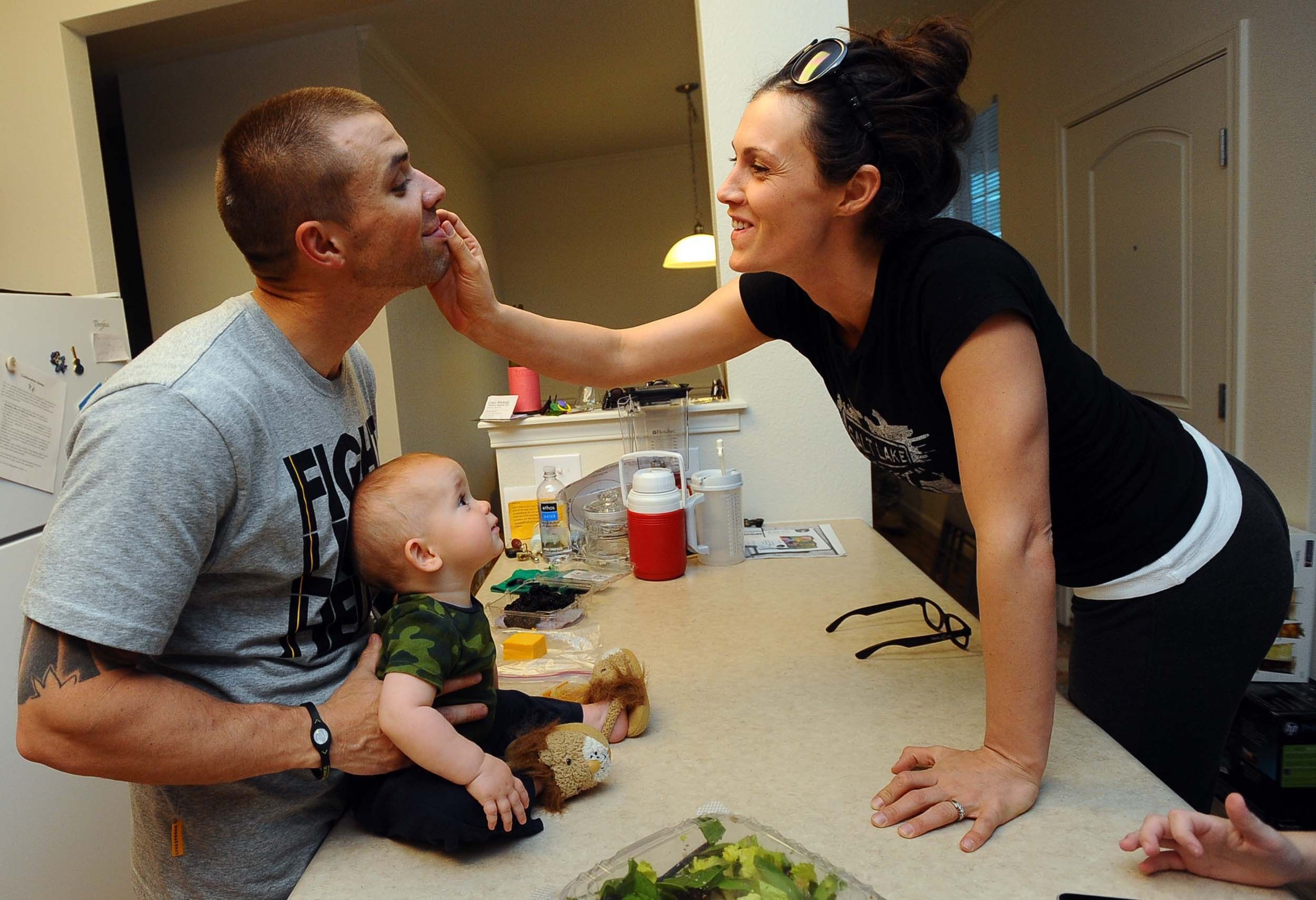
Angela Moore wipes food from the mouth of her husband, Nick Moore, while their 10-month-old son, Hudson, watches Tuesday, May 8, 2012, as they spend their first night together as a family in their new home on Fort Carson. Nick returned two days before from a year in Afghanistan with the 2nd Brigade Combat Team, 4th Infantry Division. Photo by CHRISTIAN MURDOCK, THE GAZETTE
Brooklyn Moore peeks over the back seat of her family’s car as she waits for the rest of the family Sunday, May 6, 2012, so they can head out to the homecoming of the 2nd Brigade Combat Team. Moore was excited to see her father, Nick Moore, who was return Photo by CHRISTIAN MURDOCK, THE GAZETTE
The Moore family waits for Spc. Nick Moore and the other returning soldiers from the 2nd Brigade Combat Team, 4th Infantry Division, to enter the Special Events Center on Fort Carson Sunday, May 6, 2012. Photo by CHRISTIAN MURDOCK, THE GAZETTE