






A golfer’s junior achievement
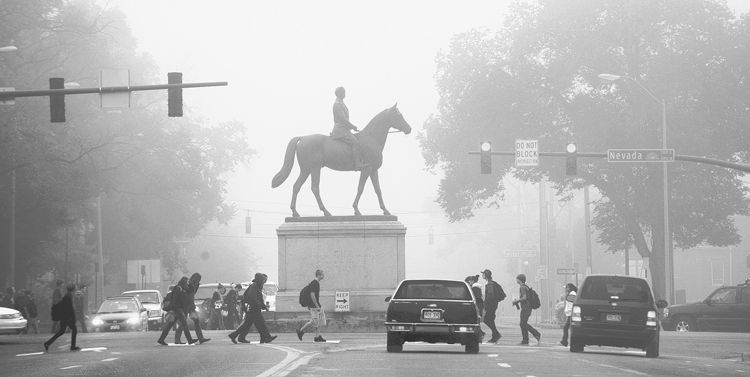
A statue of the Medal of Honor recipient who founded Colorado Springs surveys the city from atop a bronze horse on Platte Avenue at the center of downtown.
A few miles away from the statue of William Jackson Palmer and the adjacent high school that bears his name, is a facility to care for veterans named after William Crawford, another man who earned the nation’s highest honor.
To Palmer’s north, a dormitory at the Air Force Academy is named for Lance Sijan , a former cadet who earned the medal in Vietnam.
To his south, Fort Carson’s hospital is named for Donald Evans, a 4th Infantry Division medic who earned the medal while saving lives.
Veteran’s groups are hoping another Colorado Springs Medal of Honor recipient — Floyd Lindstrom — will have his name hung on a new Veterans Administration clinic being built to Palmer’s northwest off Fillmore Street.
Palmer, who was born Sept. 17, 1836, in Leipsic, Del., joined the Union Army in 1861 from Philadelphia, Pa. The military move was out of character for the 24-year-old Palmer, who had been raised in a violence-shunning Quaker household.
But Palmer soon showed a gift for combat and penchant for heroics that historians say is fit for Hollywood. He was known for lightning-fast cavalry raids behind rebel lines. Within a short period, he rose in rank from a captain of cavalry to a brevet, or brigadier, general.
The battle that earned Palmer the medal came in Red Hill, Ala., onJan. 14, 1865, when he and fewer than 200 comrades waded into combat against a large Confederate force.
Palmer won the day, taking 100 enemy prisoners and seizing an artillery piece without losing a single Union cavalryman.
“He did this over and over, riding into battle pistols blazing, swords slashing; it is amazing he survived,” Civil War historian Terrell Garren told The Gazette in 2011.
After the war, Palmer re-entered the railroad business, eventually founding the Denver & Rio Grande Western Railroad.
In 1871, he founded Colorado Springs with 10,000 acres of land he acquired near Old Colorado City.
And some of Palmer’s Army spirit grew in the streets of the city he started.
Over the years, Colorado Springs welcomed five military bases to the community, and the list of heroes grew.
“The fact that we have all of these connections to Medal of Honor recipients if further evidence of the enduring connection the Pikes Peak region has to the military,” said Matt Mayberry, director of the Colorado Springs Pioneers Museum. “One of the major themes of Colorado Springs history is that connection to the military.
“Because of that connection, it’s not a surprise to me how much the Medal of Honor is reflected in our community.”
Here are some of those heroes with a Colorado Springs connection.
Capt. Lance Peter Sijan
Sijan, who was born April 13, 1942, in Milwaukee, Wis., graduated from the Air Force Academy in 1965..
He was awarded the Medal of Honor for his actions in Vietnam.
On Nov. 9, 1967., Sijan ejected from his disabled F-4C over Vietnam. He was severely injured upon landing and did not have an emergency kit. He evaded capture for more than six weeks. After being captured, he escaped once but was recaptured. Though tortured by his captors, Sijan only gave his name, rank and serial number.
Sijan died at the famous “Hanoi Hilton”. prison in North Vietnam on Jan. 22, 1968. He was 25.
Then President Gerald Ford presented Sijan’s parents with his Medal of Honor in 1976.
During the same year, the Air Force Academy named the cadet dormitory Sijan Hall in his memory.
Sijan was the first and is the only Air Force Academy graduate to receive the Medal of Honor.
Retired Lt. Col. Gerald 
Orren Young
Young, who was born May 19, 1930, in Chicago, joined the Air Force from Colorado Springs.
He was awarded the Medal of Honor for his actions in Vietnam.
On Nov. 8-9, 1967, Young was a 37-year-old Air Force captain who was flying a helicopter on a mission to rescue soldiers.
Two helicopters had already attempted the rescue but were lost to hostile ground fire.
During Young’s mission, heavy fire damaged one rescue helicopter, but three soldiers were saved. The pilot of the damaged helicopter recommended that Young abandon further attempts to save the other soldiers on the ground. It was too dangerous, the other pilot said.
Despite the warning, Young hovered under intense fire until the remaining survivors were aboard his chopper.
The enemy blasted the aircraft with fire at point-blank range. Young’s helicopter crashed and burst into flames.
Young, who escaped through a window of the burning helicopter, disregarded serious burns and aided a wounded man.
He later refused rescue because he’d seen enemy forces setting up automatic weapons positions to entrap rescue aircraft.
He evaded the enemy for 17 hours until a rescue helicopter could safely land.
In 1980, Young retired from the Air Force.
He died in 1990 and is buried at Arlington National Cemetery.
Pfc. Floyd K. Lindstrom
Lindstrom, who was born June 21, 1912, in Holdrege, Neb., joined the Army from Colorado Springs.
He was awarded the Medal of Honor for his actions during World War II.
On Nov. 11, 1943. Lindstrom was a 31-year-old Army private who, along with his platoon, was providing cover fire for soldiers attacking a hill near Mignano, Italy.
While under attack from the enemy, Lindstrom hauled a machine gun 15 yards up a rocky hillside to a position 10 yards from an enemy machine gun.
After realizing that he couldn’t kill the enemy gunners because they were hiding behind a large rock, he charged further uphill under a steady stream of fire and killed both gunners with a pistol.
Lindstrom took the enemy’s machine guns down to his own men, then returned two recover two boxes of ammunition.
His actions, performed “in the face of almost certain death,” spoiled the German’s counterattack, according to his Medal of Honor citation.
He was killed in action less than three months later.
Lindstrom is buried in Evergreen Cemetery in Colorado Springs.
A group of Colorado Springs veterans, headed by Keith LaMee, Jr., the vice president of the American Legion Riders of Colorado, is pushing for an under-construction Veterans Administration clinic, located at south of the intersection of Fillmore and Centennial streets, to be named after Lindstrom, which would require an act of Congress.
“Here is a man who received the Medal of Honor and is being forgotten in his own city,” LaMee told The Gazette in November. “He did everything to save his buddies, so why not honor him as they get medical help now?”
Sgt. Peter C. Lemon
Lemon, who was born June 5, 1950, in Toronto, Canada, joined the Army in 1968 from Tawas City, Mich.
He was awarded the Medal of Honor for his actions in Vietnam.
On April 1, 1970, Lemon was a 19-year-old specialist who was assisting in the defense of Fire Support Base Illingworth during an attack.
He provided machine-gun fire until both of his weapons malfunctioned. Then used hand grenades to kill all but one remaining enemy soldier in his vicinity.
Lemon pursued the remaining enemy and killed him in hand-to-hand combat.
Though he’d been wounded by a grenade, Lemon carried a more seriously wounded comrade to an aid station. He was wounded two more times, but managed to secure a machine gun and fire it from a fully exposed position atop an embankment. He did so until he collapsed from his wounds.
After regaining consciousness at an aid station, Lemon refused evacuation until those more seriously wounded had been taken to safety.
He now lives in Colorado Springs and works as a motivational speaker.
He is the executive producer of the Emmy-winning documentary “Beyond the Medal,” which profiles Pueblo’s four Medal of Honor recipients: William Crawford, Carl Sitter, Jerry Murphy and Drew Dix. He is also the author of a book by the same title.
Master Sgt. William 
Crawford
Crawford, who was born May 19, 1918, in Pueblo, joined the Army in July 1942 from his city of birth.
On Sept. 13, 1943, a 25-year-old Crawford was serving as a squad scout near Altavilla, Italy. When his platoon was pinned down by enemy fire, Crawford advanced and destroyed a machine gun and killed three enemy troops with a hand grenade.
When his platoon was again pinned down by enemy fire, Crawford advanced, using grenades and his rifle to kill additional enemy fighters and destroy another gun emplacement. As the Germans began to flee, he fired on them using a captured machine gun.
Soon after the battle, Crawford was captured by the Germans and presumed dead by American commanders. His Medal of Honor was presented to his father in 1945. Later that year, Crawford was rescued from German captivity.
Crawford retired from the Army in 1967, he retired and took a job as a janitor at the Air Force Academy.
In 1984, President Ronald Reagan presented Crawford with the Medal of Honor at the Air Force Academy graduation. The ceremony made up for the one that Crawford missed when he was imprisoned by the Germans.
He died on March 15, 2000, in Palmer Lake, and was buried at the Air Force Academy Cemetery.
A small memorial to Crawford made of bronze and stone currently exists at Palmer Lake. Organizers are attempting to raise money for a much larger memorial that would honor Crawford and other area veterans who’ve received medals of valor.
Palmer High School students on their lunch break Thursday, September 15, 2011, cross Platte Avenue as fog and light misting rain hang over downtown Colorado Springs. Mark Reis, The Gazette Photo by MARK REIS, THE GAZETTE