






MWC explains its reviews
On cherished summer days, Clinton Romesha carried a .22 rifle across his grandfather’s spacious ranch in western Nevada, hunting squirrels alongside his older sister. • Back home, Clinton Romesha lugged a chainsaw across his parents’ ranch in northeast California, thinning trees and earning every penny of his allowance. • “Our biggest threat was maybe shooting each other in the leg with a BB gun,” Tonya Howell, Romesha’s sister, recalled of their childhood. “It was just different. It was just totally different.” • Those days, spent outside at two different ranches, forever shaped Romesha. • One led him into the Army. • The other taught him how to persevere during one of the deadliest attacks of the war in Afghanistan. • On Monday, the former Fort Carson staff sergeant described as “quiet” and “humble” will stand before President Barack Obama to receive the Medal of Honor.
But long before he was lauded as a hero worthy of the nation’s highest medal for valor in combat, Romesha spent his days hopping on Shetland ponies, driving four-wheelers to the lake and hoping the fish would bite.
Echoes of that upbringing were evident on Oct. 3, 2009, when Romesha led his men against hundreds of attacking Taliban insurgents at Combat Outpost Keating in Afghanistan.
‘I’ve had grown men cry’
The fourth child of five in his family, Romesha called a small ranch in Lake City, Calif., home for 18 years.
Here, Romesha’s schoolwork came first. Then chores. Then video games.
His father, Gary Romesha, a Vietnam veteran who served for about 15 months during the war, doled out the orders to his five children. They each helped maintain their ranch.
Allergies always bothered Clinton Romesha, so Gary Romesha tried to keep him away from the hay fields that fed the family’s beef cattle.
Wielding a chainsaw, Clinton Romesha cut down trees to thin the nearby forest and earn his money.
“I always kind of figure if a kid can do a man’s work, he got a man’s pay,” Gary Romesha said. “If he could only do half a man’s job, he got half a man’s pay.”
He was reliable with his chores.
And Clinton Romesha was tough, said his mother, Martishia Rogers.
One day in elementary school, he ran into another boy while playing, his mother said.
Unlike other boys, Romesha didn’t cry.
He asked to stay home, where he whimpered around the house, downplaying everything. He kept up the silent routine in front of the country doctor who was “just a sweetheart in the valley that everybody loved,” Romesha’s mother remembered.
The doctor also thought he was fine. Then she looked at the x-rays.
“I’ve had grown men cry,” the shocked doctor told Romesha’s mother. “This kid’s got a broken collarbone.”
‘Taught very well’
One brother joined the Marines.
Another brother joined the Army and later switched to the Air Force.
Clinton Romesha’s decision made sense.
“He actually tried to get me to sign papers before he was 18,” said Martishia Rogers.
No one influenced Romesha in making that decision quite like his grandfather, Aury Smith, a World War II veteran and former Army cavalryman and engineer. The few childhood trips Romesha took away from northeast California usually led to Smith’s ranch in western Nevada.
Smith’s house felt set apart from time. No electricity. They pulled water from a natural spring.
As Romesha’s sister remembers, the children woke up with the sun and lay down for bed at sunset. They saddled up Shetland ponies, loaded .22 rifles and explored for squirrels. Some days they’d bury treasure. Other days they went fishing.
“We were exposed to all that stuff very young,” Howell said. “But we were also taught very well.”
“We might have had a lot of freedom with that but it was supervised and well taught.”
And while playing with .22-caliber rifles and fishing in the nearby hills, they heard fabled war stories from their grandfather.
The tales of battle were something that his father avoided.
“You just don’t you don’t talk about that stuff,” Gary Romesha said. “It kind of comes in your mind, you think about it and you push it back down again is what you do.”
Smith felt otherwise. Clinton Romesha hung on his grandfather’s every word, Howell said.
Romesha decided against the two-year missionary trip that’s customary for young men raised in the Church of Jesus Christ of Latter-day Saints. He’d already done four years of two-hour Bible lessons before each day of high school.
A month after turning 18, Romesha joined the Army.
His first job: Driving a tank.
Never mind he didn’t have a driver’s license.
He didn’t need one. He saw his older siblings get cars — only to watch them need jobs to pay for the vehicles.
Anyway, Romesha also had something better, he once told his mother.
“I got a girlfriend with a car,” he said.
The girlfriend’s name was Tammy.
‘You say a little prayer’
The deployments started soon after basic training.
Kosovo for six months, then Kosovo again. Iraq followed a few years later — a bloody 15-month tour that gave Romesha his first true taste of combat.
He returned to Iraq in 2006 for another 15-month tour. In calls home, he offered scant details of his job, instead talking about fellow soldiers.
At one point, Romesha and one of his brothers served in Iraq at the same time — a burden felt by his entire family.
“Every day, you get up and you say a little prayer that please, don’t let this be the day that call comes in because I can’t think of anything worse,” Martishia Rogers said.
Stateside, his wife Tammy — the girl who had the car — waited for his return. She watched as their first daughter started combining words into sentences. Meanwhile, daddy walked on patrol halfway across the world.
After his second deployment to Iraq, he moved to Colorado, where his family settled in Pueblo. Tammy Romesha went to school and worked at Pueblo Community College while earning a degree in biology.
They welcomed their second daughter in early 2009. Five weeks later, he deployed to Afghanistan.
It was a different tour.
No more sprawling Army bases like in Iraq.
He was at Combat Outpost Keating, a remote place surrounded by mountain walls.
A desperate battle
The first reinforcements on Oct. 3, 2009 didn’t arrive until 13 hours after the first mortar round fell on Keating.
And to help Romesha defend the place, Capt. Stoney Portis first needed to walk down the same steep mountainside that hundreds of Taliban fighters flooded hours earlier.
Portis, who took command of Romesha’s cavalry troop two weeks before the attack, had been away from Keating on other business when the assault began.
Two-thirds of the way down, Portis saw bodies.
“It got to like 20 or 25, and I just realized at that point that I’m seeing bad guys that are dead, and I’m counting them,” Portis said.
“And I think for me, psychologically, I had to kind of come to an agreement with myself that if I came to 100, I would stop counting.”
Portis hit 100. He kept walking.
And 13 hours after the deadliest attack on Fort Carson soldiers since the Vietnam War began, he stepped onto Combat Outpost Keating alongside the reinforcements that Romesha’s soldiers desperately requested on the radio.
He looked around. Flames still shot from buildings. Eighty-percent of the compound was in ruin or ablaze. Romesha — who had suffered shrapnel wounds along his shoulder, neck and arm when a rocket-propelled grenade hit a generator — came into view.
He sat quietly, smoking a cigarette.
The next day, Romesha pointed out for Portis where the Taliban advanced and where eight Fort Carson soldiers died.
And while the reinforcements guarded Keating, Romesha and his men ventured to the neighboring village to count civilian casualties and root out any remaining insurgents.
The tone of Romesha’s voice never wavered when he described what happened, Portis said.
“Calm and cool,” Portis said.
‘He would never brag’
Romesha dialed his phone a little more than three years after the attack.
His stepmother, Diane Romesha, picked up and heard her stepson on the line, mentioning something about a medal.
“All Clinton ever told us was that he took up a firing position,” said Diane Romesha.
So why was Clint calling? He received a medal, Romesha’s father remembers hearing. Not any specific kind. A medal.
Gary and Diane Romesha prodded.
“Once he said he’s getting the Medal of Honor…” Diane Romesha paused. “They don’t just give them out for taking up firing positions and getting a scratch on the arm.”
“Then you start wondering, Well, what else is going on?”
His parents embarked on their own research. A book called “The Outpost” by Jake Tapper — then the chief White House correspondent for ABC News — detailed the fight of Oct. 3, 2009 at Combat Outpost Keating, as well as the miscues by Army leaders that kept soldiers at Keating despite security problems.
His stepmother read it.
“It made me mad — like we never learned anything from Vietnam,” Diane Romesha said.
His father read it, too.
“You’ve got some good military leaders, and then you’ve got some real morons in there,” Gary Romesha said. “But I guess you’ve got that any place you go.”
His mother read it.
“My goodness,” Martishia Rogers said.
“He would never brag about something like this,” she said. “Or ever bring it about. I’m just so thankful for those boys that were there with him.
“I should say men. Those men that were with him.”
‘He’ll always stay humble’
Clinton Romesha has a new home.
He traded the arid air of Pueblo for the chilly breezes along the Souris River in Minot, N.D. After the 2011 floodwaters in North Dakota receded, he bought a house there, stripped it to the frame and remodeled it for his growing family. He and Tammy Romesha welcomed their third child, a son.
He has a new job.
After leaving the Army on April 4, 2011, he took a job inspecting oil fields — a boomtown business that’s proven a smooth transition from platoon sergeant to clipboard-toting civilian. He gets to come home at night, and he doesn’t always have to worry about another trip overseas.
Now he has the medal.
He has to leave home again — this time to go to the White House for an unexpected family reunion.
“He’ll always stay humble and quiet and that kind of stuff,” Gary Romesha said. “But he’s facing all kinds of new challenges now with people wanting to know this and wanting to know that.”
Beside him will be Tammy Romesha, the woman he calls his “rock and anchor.”
And on Tuesday, he’ll celebrate 13 years of marriage to this girl that he met back in northeast California.
The one with the car.
—
RELATED CONTENT
• 2009 battle one of the bloodiest in war.
• Colorado Springs founded on heroism, valor.
• ‘Home of Heroes’ adding one more.
• Medal from 1967 willed to Fort Carson troops.
• List of medal recipients with Colorado ties.
• PHOTOS: Men who died in battle for Combat Outpost Keating.
• PHOTOS: 4th ID roll of valor.
• PHOTOS: Top medals for valor.
Photo by Courtesy photo
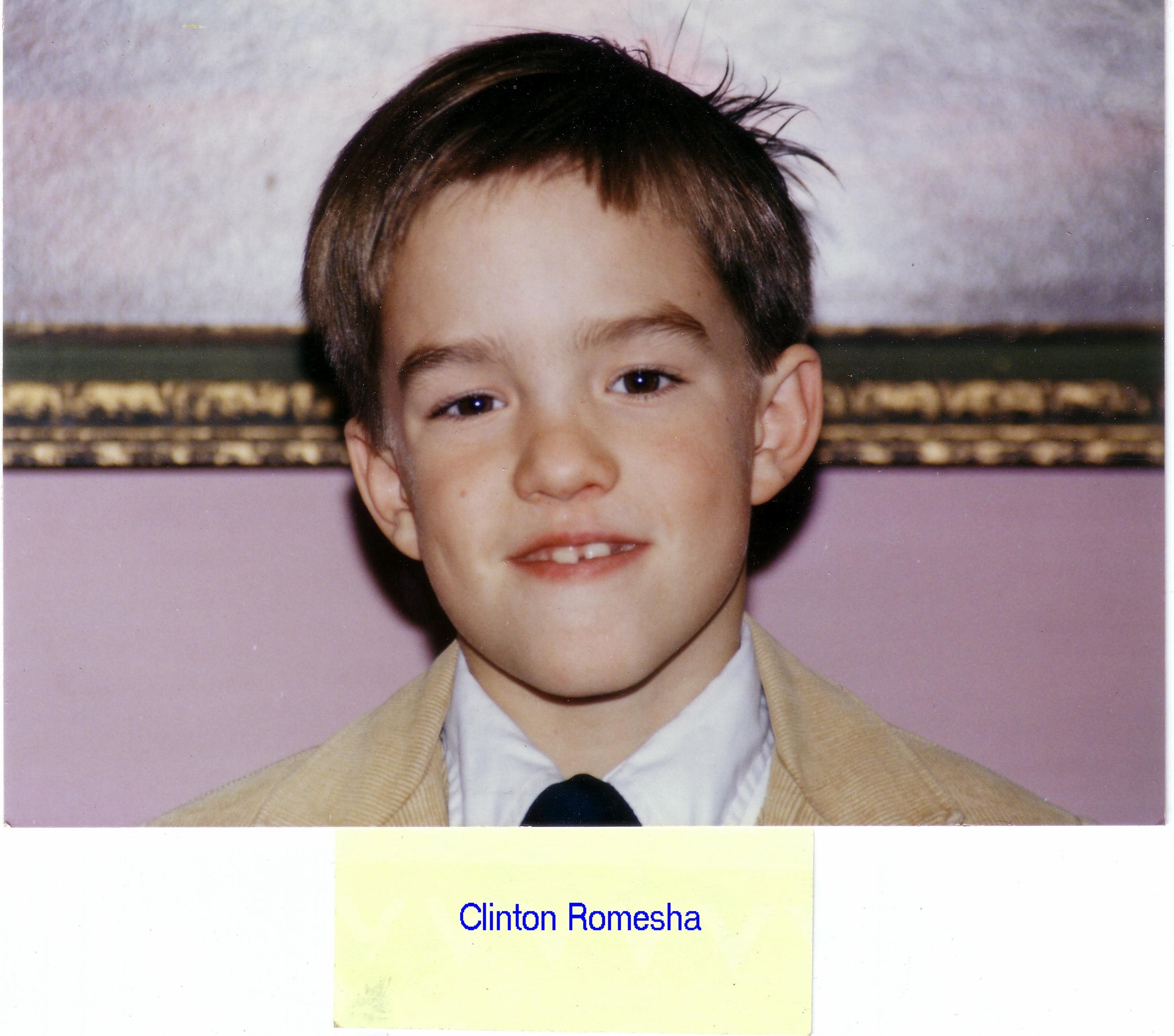
Clinton Romesha is shown in an undated photo from his childhood. Photo by
Clint Romesha, a North Dakota veteran set to receive the Medal of Honor for courageous action during a 13-hour firefight in Afghanistan, right, speaks at a news conference alongside his wife, Tammy, Wednesday, Jan. 16, 2013, in Minot, N.D. Photo by The Associated Press