






Scorecards, once a ballpark staple, have become a novelty
Army wife Dina McDonald didn’t attend Spouse Relationship Resiliency Day to learn to cope with deployment.She attended to learn to cope with its aftermath.Nearly a year and a half after her husband returned from Afghanistan, her marriage hangs on by a thread.“We’re fighting a lot, so I told him that I wanted to come here and make it better,” said Dina, who convinced her husband, Spc. Mark McDonald, to join her at the Oct. 19 Fort Carson seminar.“He wasn’t sure if he should come or not, but he did it for me.”A glimpse at the day’s schedule, which included presentations on understanding post-traumatic stress disorder and reconnecting after deployment, had her hopeful that she and her combat-hardened husband would experience a breakthrough.“He has no patience,” she said, her eyes bloodshot from crying. “He has a temper. He doesn’t beat us, but he’s really mean to our daughter. When she does something like spill a drink, he freaks out.”During a discussion break Mark talked with other seminar attendees about missing his daughter’s first year of life due to deployment.“It was the most important year of her life,” he said. “I’ll never get that back again.”As he spoke, Dina stared downward, nervously tapping her feet and fighting back tears.Another spouse turned away and covered her eyes with clenched fists as her husband talked about racing home from war only to find that his ailing father had died.Others blotted their eyes and blew their noses during a presentation by retired Navy Lt. Commander Alan Garner, who spoke on how to bond with a partner who has PTSD.Garner, a former chaplain who deployed to Afghanistan in 2005, said he struggled with depression and felt confused after returning from deployment.He and his wife had marital problems, he said, and he sometimes wanted to “punch out” civilian chaplains who tried to relate to him.“Mentally, even though I knew I was home, I didn’t believe that I was home,” he said. “Part of me still wanted to be there.“How many of you have partners who want to go back?” he asked the crowd.Several tentatively raised their hands.“After two years of being back here, I was still sort of over there,” he said.Garner challenged spouses to develop creative ways to physically, mentally, emotionally, socially and spiritually support their partners, and called PTSD “a normal reaction to abnormal life events.”“You are more qualified to help your partner than anyone else,” he told spouses.Halfway through the seminar Dina said she’d learned more about her husband’s combat experience than she had in the months since his return.“When he came back from Afghanistan, I never asked him what happened,” she said. “I didn’t want to be the one to ask if he killed anybody, stuff like that. Today he said something.”The knowledge was helpful, she said, but hearing new details of Mark’s deployment in front of a group of strangers instead of in private hurt.Her hope for their Friday evening together after the seminar: “That we talk about stuff and become a family again.”
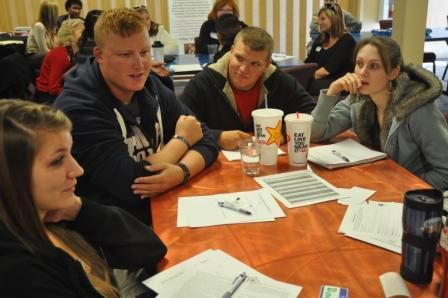
Spc. Mark McDonald, left, discusses the hardships of deployment with his wife, Dina, far left, and other attendees of Spouse Relationship Resiliency Day, held Oct. 19 at The Hub on Fort Carson. The seminar was attended by 60, most of whom were Army and Air Force spouses. Photo by ERIN PRATER/ THE GAZETTE