






Defending champs cannot stop Chow
Paula Ozzello’s voice raised ever so slightly a half-hour into a meeting at the Trinidad Community Center, her words zeroing in on the topic of calving.
One newborn calf disturbed by helicopters and left for dead could cost her $1,000, she said.
Across the room, Col. David Grosso worried about another cost — that of his soldiers’ lives if they’re improperly trained before heading to war.
Their words showed the challenge: How does the military mend relations with ranchers in southern Colorado as Fort Carson continues to grow and increase training?
An effort to repair the frayed relationship between Fort Carson officials and southern Colorado ranchers who have grown wary of the post’s training and intentions at its Piñon Canyon Maneuver Site is under way. It’s an effort likely to be tested more in the coming year.
Fort Carson officials plan to resume regular training exercises at the 235,000-acre site in 2013, a year that should begin with all four of the 4th Infantry Division’s brigade combat teams at home from war, said Grosso, the post’s garrison commander.
Training cycles at the site were reduced as the wars in Iraq and Afghanistan dragged on.
In addition, a renewed element to the relationship — a 113-helicopter combat aviation brigade new to the post — is expected to begin taking to the skies over Piñon Canyon in the coming years.
The first helicopters are expected to arrive next year, along with some of the brigade’s 2,700 soldiers.
Those factors have left Fort Carson leaders managing a delicate dance as they work to repair relations with their neighbors to the south.
Quarterly meetings, such as that one held Friday morning, have been a priority for the post.
So have workshops on applying for military contracts and one-on-one meetings over breakfast with the locals, Grosso said.
The commander of any brigade that trains at Piñon Canyon will have to meet with residents in southern Colorado before his troops head to the site.
“If we were not a great neighbor in the past, then we need to be,” Grosso said at one such meeting Friday.
Rough plans have been outlined for the incoming helicopters’ exercises.
The aviation brigade is expected to spend a third of its training hours at Piñon Canyon, according to the environmental assessment that cleared the brigade’s construction.
The rest of the aviation brigade’s time would be spent downrange at Fort Carson, where they could fire rockets and coordinate with ground troops in massive live-fire exercises.
The Army plans to fly less than 25,000 hours per year in Colorado’s skies. Training time at Piñon Canyon will be 4.7 months per year.
Fort Carson officials said the post “has not analyzed or identified a need” to expand that time slot.
That promise had done little to calm lingering fears of ranchers still mindful of the military’s history in the region.
Ranchers revolted and gained a congressional rebuke of Fort Carson plans in 2006 to expand the maneuver site by more than 100,000 acres.
The frosty relationship between the Army and its neighbors in southeastern Colorado goes back for decades. Ranchers complain that promised economic growth when Piñon Canyon opened more than 30 years ago never came, and they say local contractors aren’t used as often for the post’s needs as initially suggested.
Looming over everything are lingering concerns that Fort Carson could ask for more land.
“It will take a long time for us to get comfortable where we feel like we’re dealing with someone who’s giving us straight answers to straight questions,” said Steve Wooten, a rancher who lives on the eastern edge of the site. “It can happen, but it’s going to take a long time.
“It’s a wait-and-see type deal.”
Skepticism toward the new brigade’s arrival comes amidst budding optimism to the north, where the prospect of more than $700 million in construction spending in the coming years is welcome.
Colorado Springs economists say the addition could create jobs at a time when the unemployment rate remains high.
“There’s some good stimulus ahead for the coming year then, in the construction sector anyway,” said Tom Binnings, with Summit Economics.
The new brigade also signals a return to normalcy for the post, which was home to helicopters when the 4th Infantry Division was previously stationed at the post before 1995.
When the division returned in 2009, it did not include a helicopter brigade — leaving it without the customary combat aviation brigade to supplement its ground troops.
“They need to train the way they’ll fight — as a unit,” said Brian Binn, outgoing military liaison for the Greater Colorado Springs Chamber of Commerce.
The meeting Friday morning at the Trinidad Community Center offered a glimpse of the growing pains and occasional gains in the relationship between the Army and ranchers.
A handful of ranchers, a few businessmen and local elected officials aired concerns and hopes to about 10 Fort Carson officials.
Headway was made on some issues, such as the type of fencing used by post officials.
Others issues, such as calving, are likely to take time to resolve.
“The end result of that calving process is that calf is worth $1,000 at sales,” Ozzello, head of the Southern Colorado Environmental Coalition, said at the meeting.
Grosso said that the post recognizes the concerns, but flights during calving times remain an open issue. He said his troops must train, though they’ve been told to stay a half-mile from people and animals in the process.
“I’m not trying to minimize the value of one calf,” Grosso said. “And I was just thinking as, you were talking about those numbers, I was thinking about how much it has cost the United States taxpayer for Command Sgt. Maj. (Kevin) Griffin’s death.”
Griffin, the 4th Brigade Combat Team’s top enlisted soldier, died last week in a suicide bombing in Afghanistan that also killed two others stationed at Fort Carson. Grosso estimated his death to cost more than $500,000.
“And that’s a human life, a father and a husband and a son to a lot of people. … Both have value, calves have value. Human lives have value,” he said.
Ozzello, head of the Southern Colorado Environmental Council, assured the colonel that ranchers value the military’s service.
“We know we got to find common ground to survive,” Ozzello said. “But just as we make concessions from the civilian side, there needs to be common ground from the military side of understanding what our region is all about.
“And the main function of our region is agriculture.”
—
Contact Jakob Rodgers: 476-1654
Twitter @jakobrodgers
Facebook Jakob Rodgers
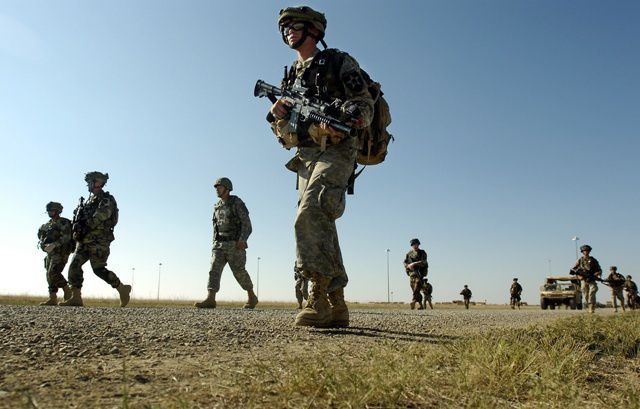
Soldiers from Fort Carson take part in training in 2006 at the Pinon Canyon Maneuver Site. (The Gazette file) Photo by
A Chinook helicopter kicks up dust as it takes off during training exercises in 2006 at the Pinon Canyon Maneuver Site. (The Gazette file) Photo by