






Milo F. Bryant: Kobe striving to recapture his NBA glory
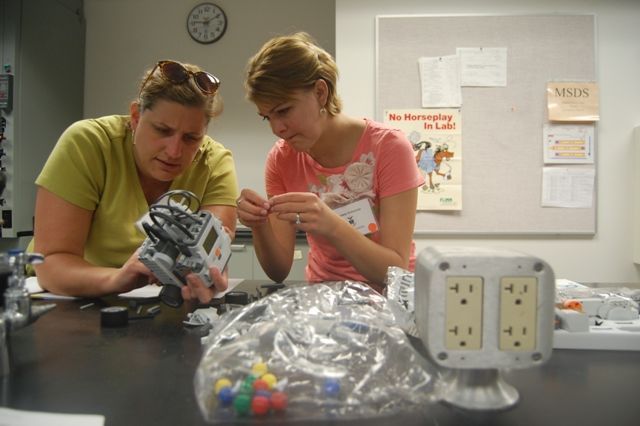
Rubber and plastic wheels were scattered out on black tabletops. Nearly two-dozen middle school teachers rearranged scores of gray sticks and Lego pieces — much as they used to do long ago in their parents’ basements.
“Let your creative juices flow,” said Capt. Michael Knauf, an engineering mechanics instructor at the Air Force Academy.
As teachers across the state prepare for the rush of children back into their classrooms later this month, nearly 100 expect to draw from their time spent at the Air Force Academy STEM Boot Camp, where they fiddled with Lego-constructed robots and remote-controlled underwater machines.
The goal: Inspire and engage students in science, technology, engineering and math courses at a time when education, military and industry leaders worry that their talent pool is shrinking.
The experience left smiles on the faces of some old Lego veterans. Others struggled.
“This is like survival mode for me right now,” said Lindsey Simonton, with St. John’s Lutheran School in Denver, standing before a table of Lego wheels and spare parts.
The program, organized by the academy’s K-12 STEM Outreach Center and the Colorado Consortium for Earth and Space Science Education, brought in teachers from across Colorado and a handful of other states to learn how to program robots, wage cyber security competitions or start up other high-tech engineering courses for children.
High school teachers programmed a calculator set on wheels to drive across the floor, back up in front of a wall and return — all by inputting a few numbers into the machine. Others assembled a SeaPerch, which is an undewater robot constructed largely of plastic pipes.
Many teachers took home robotic kits used in the course.
The purpose was two-fold, said John Wood, a professor of engineering mechanics at the academy.
Constrained by dwindling finances and increasingly strapped for time, some teachers have hold off developing high-level science programs.
Often — such as with Lego robots — teachers can be intimidated or too set in their ways to try to assemble the machines, Wood said.
“Kids pick up on it like that,” Wood said. “They have no preconceived notions of how things are supposed to go together. They just start throwing stuff together. They can be more creative and they have more fun.”
Wood speaks with urgency. Children, he said, are most likely to develop a life-long yearning to explore careers in science and engineering if reached in middle school or early in high school.
Carol Snyder, who works through the gifted and talented program at Timberview Middle School, said the key is making sure students remain engaged.
“A lot of them have some interest in science and math or technology,” Snyder said. “But they don’t necessarily know how that would translate to the real world.”
At the boot camp, she poured over the Legos — helping to match wheel sizes with gear ratios to create a car that went fast, the first part of the class’ competitoin that day. The second portion involved making the car go up a steep incline.
Nearby, Simonton started to get a feel for how to put the robot together.
Making sure that teachers can get those “creative juices” flowing — while understanding the challenges that students encounger — can be half the battle.
“It’s nice to be in the students’ shoes,” Simonton said.
—
Contact Jakob Rodgers: 476-1654
Twitter @jakobrodgers
Facebook Jakob Rodgers
Beth Peters and Lindsey Simonton try to assemble a robot made largely of lego pieces in July during the Air Force Academy’s STEM Boot Camp. Photo by Jakob Rodgers / The Gazette