






Rookie Bell sees action vs. Arizona
WASHINGTON, July 24, 2012 – A redesigned program for service members separating from the military will help veterans better apply the experience they’ve gained in uniform, Defense Secretary Leon E. Panetta said.
President Barack Obama announced the revamped program, called “Transition GPS,” in a speech yesterday at the Veterans of Foreign Wars national convention in Reno, Nev.
“I applaud the leadership of President Obama to bring together government agencies around the goal of enhancing career opportunities for service members,” Panetta said in a statement. “Our personnel have developed extraordinary technical expertise and world-class leadership skills that are in high demand. Transition GPS will help military members apply their experience to additional training, formal education, and develop successful civilian careers.”
Transition GPS is the first major overhaul of the military’s Transition Assistance Program in nearly 20 years, White House officials said. TAP was developed by an interagency team from the departments of Defense, Veterans Affairs, Labor, Education and Homeland Security, as along with the Office of Personnel and Management and the Small Business Administration.
Veterans Affairs Secretary Eric K. Shinseki said the redesign will better ensure that veterans today and in the future will receive the care and benefits they have earned.
“One of our fundamental responsibilities as a government is to properly prepare and support those serving in our military so they are career ready as they transition back into civilian life,” he said. “This collaborative effort will have an impact well beyond this current generation of individuals returning from combat.”
The redesign is being developed by the Veterans Employment Initiative Task Force created in August to help separating service members successfully transition to the civilian workforce, start a business, or pursue higher education.
TAP consisted of pre-separation counseling and a voluntary, three-day workshop from the departments of Labor, Defense and Veterans Affairs that was presented at selected military installations and attended by nearly half of the service members who separated from the services each year, White House officials said. Transition GPS is designed to strengthen, standardize and expand counseling and guidance for service members before leaving the military, and transform the military’s approach to education, training, and credentialing, they added.
Transition GPS is to be implemented throughout the military by the end of 2013. It will:
— Extend the current three-day transition program to five to seven days;
— Offer individual assessment and counseling, including an individual transition plan;
— Include a five-day curriculum of financial planning, available veterans’ benefits and servicesand a redesigned employment workshop;
— Include a “Military Occupational Code Crosswalk” to translate military skills, training and experiences into civilian occupations and credentialing;
— Include optional training specific to pursuing higher education, technical skills and training, or starting a business;
— Include a “capstone” event to verify that the participant is career-ready;
— Give a “warm handover” to appropriate government agencies and organizations for continued benefits, services and support of veterans; and
— Create a “Military Life Cycle Transition Model” to incorporate career readiness and transition preparation early into a service member’s career.
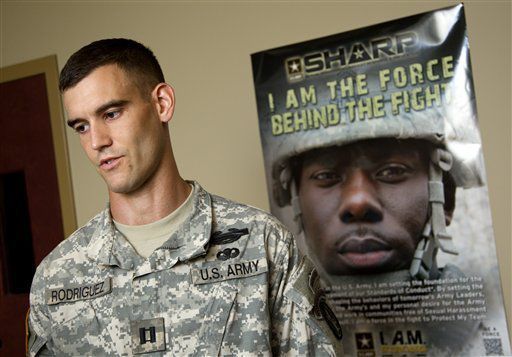
In this photo taken July 18, 2012, U.S. Army Capt. John Rodriguez, who deployed to Afghanistan’s Korengal Valley, speaks to an Associated Press reporter while on break from a resume writing class at Joint Base Myers Henderson Hall in Arlington, Va. Rodriguez, who plans to transition to the Maryland Army National Guard after six years of being an active duty Army soldier, discusses his experiences serving an an infantry officer and how they could translate for civilian employment. U.S. combat troops patrol dusty pathways in Afghanistan, look for hidden roadside bombs, load and fire mortar shells at insurgents’ positions. So when they come home, how will that help them land a civilian job? (AP Photo/Haraz N. Ghanbari) Photo by STF