



One of the first homes in Ute Pass for sale for $1.5 million

Courtesy of CC Signature Group
One home can tell a hundred stories.
How many pairs of boots have tromped the floors of The Wellington House, built in 1888? Impossible to say, thanks to the countless miners, diners, farmers and gamblers who have all passed through the historic home’s doors.
On a sunny summer day, oblivious drivers on U.S. 24 cruise by the longstanding piece of Colorado history, shrouded by dense forest. For up on the hill stands a solitary, sweet, yellow, turn-of-the-century farmhouse, picture perfect with its surrounding white picket fence that poses no obstacle for the bears who live on the mountain to the east of Wellington Gulch, which runs parallel to the property. They amble by on the regular, stopping to play on the grass and in the trees and to dine on the abundant choke cherries, before wandering off to complete the day’s errands.
“We’ve had three generations of bears that come down,” said homeowner Kayle Higinbotham. “Every year they introduce me to their new cubs. Last year they had three. This year they had two. We’ve learned to cohabitate.”
Higinbotham has lived in the house at 5975 Wellington Road in Cascade on and off since she was born at Penrose Hospital, and full time for the last 35 years. Her parents bought the property in 1950 and used it as a weekend house. They once owned The Loop in Manitou Springs and stayed in an apartment over the restaurant when they weren’t living in the woods. But now it’s time for a new season of life and a new home for Higinbotham, likely somewhere on another continent.
So she must sell her self-described “eclectic, shabby chic”-designed, 4,700-square-feet, $1.5 million home that stands on 50 acres, stretching from undeveloped frontage land along the highway back into the forest, where a seven-minute walk delivers you to a hidden waterfall. It raises your hackles to see how close Higinbotham came to losing her home and the vegetation to the 2012 Waldo Canyon fire. The decimated mountain past the wide gulch to her east is decorated with burned, dead trees.
Edwin Stanton Armentrout and Anna May Wellington were the first to own the home. It was one of the first in the Ute Pass area and was designated a historical landmark by the Ute Pass Historical Society.
“Anna May was a photographer,” said Higinbotham, while observing an old photo of the couple that hangs in a hallway. “She developed her own photos and a lot of the historical photos they use for the Ute Pass Historical Society are from her. And that’s her gun. She was like an Annie Oakley.”
The Wellingtons also had front row seats to the Colorado Midland Railway, which stood opposite them.
“Across the highway there was the train station that took people up to Cripple Creek,” Higinbotham said. “They had 80 trains at that point because of that ore, bringing it back and forth. So this was like a boarding house for lot of the miners or people working in the mines.”
The home and property also have served as a dairy farm, fox farm, a restaurant named Chipita Garden Inn, famous for having the best fried chicken in the valley, and an illegal gambling casino in the 1960s that operated out of an attached studio apartment Higinbotham’s parents added on.
“It was the mayor and sheriff and everyone would come up here for a little gentlemanly game,” Higinbotham said. “And then one time this reporter from The Gazette came and he had a little camera and took pictures of everything. He’d lost a lot of money. And it was on the front page of the paper and they had to close it down, but there are pictures of the mayor and sheriff and everyone at the roulette wheel.”
And the unsurprising coda: “That was when Cripple Creek was a county seat, so they put all the gambling equipment in a truck to take it up for evidence, and somehow the truck broke down and all the evidence went missing. They were never able to prosecute or do much about it.”
Inside the four-bedroom, three-bath home, built with timber from the surrounding forest, are parts from the original home, including a Garland stove, also called a parlor stove, wood floors and the original fireplace, made with rocks from the gulch and decorated with Van Briggle tiles Higinbotham found and installed.
The ground-floor bathroom features a ceiling and wall decor made from pressed tin, which she salvaged from a cowboy bar on Larimer Street in Denver. She estimates the tin, replete with a bunch of authentic bullet holes, is from around the same time the house was built in the 1800s. Stained glass in the light-filled front room was salvaged from an old church in Cripple Creek, and chandeliers are from The Broadmoor’s remodel in the 1940s.
It will be a teary goodbye to the home that’s been in Higinbotham’s family for about 75 years, but it’s time.
“Wherever I go I’m going to have to have nature,” she said. “I’ve got to have the birds and the trees. It will be difficult having neighbors. I’m going to have to adjust to that.”
Contact the writer: 636-0270

PREV
PREVIOUS

Band with area roots proving potential promise towards ‘Evergreen’ status
Facebook Twitter WhatsApp SMS Email Print Copy article link Save Facebook Twitter WhatsApp SMS Email Print Copy article link Save Like a timeless evergreen tree, independent musicians Richy Mitch and the Coal Miners (RMCM) have proven their sustainability, just as their very first release, “Evergreen” continues to gain listeners and popularity eight years since the […]
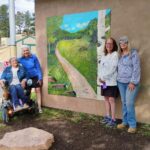
Mural jazzes up the Woodland Park Senior Citizens Club
Facebook Twitter WhatsApp SMS Email Print Copy article link Save Facebook Twitter WhatsApp SMS Email Print Copy article link Save A mural of fields and flowers, with a trail running through it, invites reflection and celebration. Titled “Journey, the artistry on the exterior wall of the Woodland Park Senior Citizens Club, highlights the role of […]